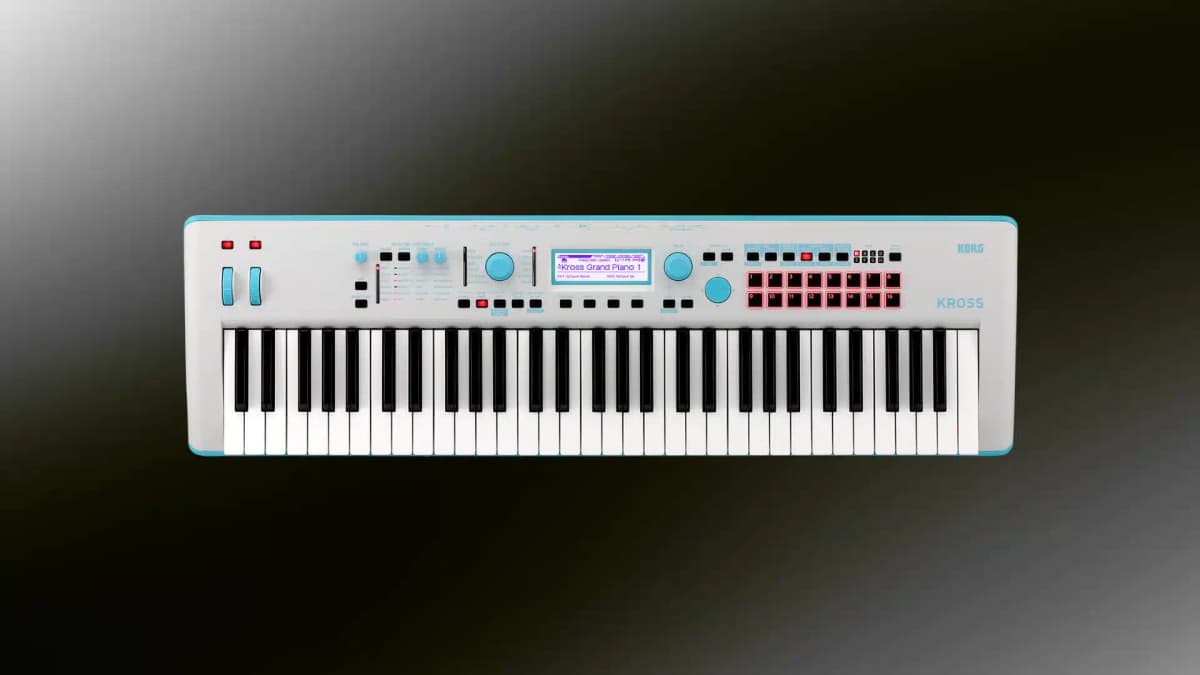
The Korg Kross 2 is an entry-level keyboard workstation that Korg announced on September 1, 2017, as the successor to the original Kross of 2013. It comes in a 61-key version with a light synth-action keyboard and an 88-key version with Korg’s weighted NH hammer action, and both run on six AA batteries as well as a mains adapter.
Inside is EDS-i, a streamlined version of the sample-based engine used in Korg’s larger workstations, with 120-voice maximum polyphony, more than 1,000 sounds, 134 effect types, a 16-track sequencer, a drum track, an arpeggiator, and a sampler played from 16 illuminated pads. Its significance is less any single feature than the package: a genuine Korg workstation that weighs 3.8 kg in its 61-key form and costs a fraction of the company’s flagships.
The Korg Kross 2 sounds like a compact member of the Korg workstation family, which is exactly what it is. Its programs are built from sampled multisamples run through filters, envelopes, and Korg’s effects, so the character is polished and mix-ready rather than raw. Reviewers singled out the pianos and electric pianos, the strings, and the pads: MusicTech’s Andy Jones called the overall sound quality a triumph, and Sound On Sound’s Gordon Reid concluded that, for all its limitations, it can sound great.
The engine explains both the strengths and the ceiling. Sound On Sound traces EDS-i back through the first Kross to the HD-1 engine of the OASYS. A program uses one or two oscillators, each able to cross-fade four velocity-switched multisamples, feeding a pair of 12dB/octave multimode filters that can run in series, in parallel, or as a single 24dB/octave filter. Each voice also gets two envelopes, two LFOs, AMS mixers, and key-tracking generators, generous modulation at this price. What is missing are the features that defined Korg’s higher-end machines: there is no wave sequencing, vector synthesis, or KARMA.
The limiting factor is sample memory. Sound On Sound counted 496 multisamples and 1,014 drum samples, against 1,077 and 1,609 in Korg’s earlier EDS workstations, and estimated the ROM at about 112MB; Korg’s own specification lists preset PCM at approximately 128MB. Sounds that depend on long, deeply sampled sources, such as a large concert grand or orchestral sections, are good rather than outstanding, and MusicTech suggested skipping the brass category altogether. Korg added 128MB of user-loadable expansion memory for optional libraries, which partly offsets this.
Where the Korg Kross 2 is strongest is breadth. With 134 effect types based on Korg’s REMS modeling, including amp simulations, rotary speaker, and a vocoder that works directly from the mic input, a single program can be made to sit in a mix without outboard gear. It leans modern, clean, and general-purpose rather than toward a signature voice.
Features and architecture
Manufacturer: Korg Inc.
Year introduced: 2017; announced on September 1, 2017, with the 61-key black version available first and the 88-key model following that autumn
Production years: 2017 to present; Korg still lists the Korg Kross 2 and released a system update (version 1.2.4) in May 2025
Polyphony: up to 120 voices, with 60 voices listed for double-oscillator programs; layered combinations reduce it further
Multitimbrality: 16 parts in Combination and Sequencer modes
Original price: $749 (61-key) and $1,049.99 (88-key) in the United States; £689 and £969 in the UK at launch
Current market price: about $886 to $930 new for the 61-key model at major US retailers in October 2026, with discounted listings lower; used units commonly appear around $600 to $650
Oscillators: one or two per program, each with up to four velocity-switched or cross-faded multisamples; 496 multisamples and 1,014 drum samples in ROM
Sample memory: about 128MB of preset PCM according to Korg (Sound On Sound estimated about 112MB), plus approximately 128MB of expansion PCM for optional libraries
Sampling: pad sampler at 48kHz/16-bit, up to about 14 seconds of stereo per pad, 16 pads in eight banks, four playable at once; a separate stereo audio recorder writes to SD card
Filter: two multimode filters per voice, 12dB/octave each, configurable in series, in parallel, or as a single 24dB/octave filter
LFOs: two per voice plus a common LFO
Envelopes: filter and amplitude envelopes per voice plus a pitch envelope; two key-tracking generators
Modulation system: AMS (Alternate Modulation Source) routing and AMS mixers, with real-time control knobs for filter, envelope, and effect parameters
Sequencer / arpeggiator: 16-track MIDI sequencer (128 songs, 210,000 events); 64-step step sequencer; drum track with 772 preset patterns; polyphonic arpeggiator, two in Combination and Sequencer modes
Effects: 134 effect types; five insert effects and two master effects simultaneously, including a vocoder
Memory: 1,280 user programs, 896 user combinations, 58 user drum kits, plus GM2 sounds; 128 Favorites
Keyboard: 61 velocity-sensitive synth-action keys, or 88 weighted NH hammer-action keys; no aftertouch on either
Inputs / outputs: unbalanced 1/4-inch stereo outputs, 3.5mm headphone output, 1/4-inch mic input (no phantom power), 3.5mm line input, damper, assignable switch, and assignable pedal inputs
MIDI / USB: 5-pin MIDI In and Out (no Thru); USB Type B with USB-MIDI and USB audio interface functions
Storage: SD and SDHC card slot (up to 32GB; SDXC not supported)
Display: 240 x 64 backlit monochrome LCD
Dimensions / weight: 61-key 935 x 269 x 88 mm and 3.8 kg; 88-key 1,448 x 383 x 136 mm and 12.3 kg (both excluding batteries)
Power: external 9V DC adapter or six AA batteries (about six hours with alkaline, about seven with NiMH), 5W consumption
Strengths
It is a full Korg workstation at a low weight. The 61-key model weighs 3.8 kg and runs for hours on batteries.
The sound quality is better than the price suggests. Korg’s EDS-i pianos, electric pianos, strings, and pads, run through REMS effects, give finished, usable sounds straight out of the box.
The pad sampler adds something the original lacked. Loops, vocal phrases, and effects can be recorded from the line input or loaded from SD and triggered from 16 lit pads, and those pads double as Favorites for fast live recall.
It is a complete sketchpad. The 16-track sequencer, step sequencer, drum track, arpeggiator, and stereo audio recorder let a song be built and recorded without a computer.
Connectivity is practical for small setups. The mic input with built-in vocoder, line input, and USB audio interface mean one keyboard can handle a singer-keyboardist’s live rig or a basic home recording setup.
The editor and plug-in editor, added after launch, open up the deep program structure on a computer screen and let the Korg Kross 2 behave like a hardware instrument inside a DAW.
Limitations
Neither keyboard transmits aftertouch, a common complaint in reviews; aftertouch can be received over MIDI but not played from the keys.
The small 240 x 64 monochrome display and Shift-heavy menus make deep editing slow. Sound On Sound described the editing system as rooted in the 1990s, and AudioTechnology found the menus cryptic.
Sample memory is modest by workstation standards. Fewer multisamples than Korg’s earlier EDS machines means some acoustic categories, brass in particular, sound thinner than on larger instruments.
Polyphony drops quickly with layered programs and combinations, so dense multi-part arrangements can run out of voices.
The pad sampler is limited: pad samples do not run through the effects, and a sample converted into a program maps only across a short key range rather than chromatically.
The connections are budget-level: a single unbalanced stereo output, no XLR mic input, no MIDI Thru, and an external power adapter with a barrel connector that Sound On Sound criticized.
It lacks the signature features of Korg’s flagships, such as wave sequencing, vector synthesis, and KARMA, so it competes on practicality rather than on unique sound design.
Historical context
The Kross line began at the Musikmesse trade show in April 2013, when Korg introduced the original Kross as an affordable, portable workstation. It shipped in August 2013 at US street prices of $699 and $999, ran on six AA batteries, and was promoted as Korg’s first battery-powered, full-featured workstation. It used the EDS-i engine with sounds drawn from instruments such as the SG-1D piano and the M1, and borrowed an analog-style step sequencer from the Electribe line. Reviewers liked its sound but not its implementation, including the absence of real-time control.
Korg announced the Korg Kross 2 on September 1, 2017, after the original had been on sale for about four years. The changes addressed those criticisms directly: polyphony rose from 80 to 120 voices, the preset count went from 809 to 1,075, a real-time control section and dedicated layer/split button appeared, Favorites doubled to 128, and the 61-key model dropped from 4.3 kg to 3.8 kg.
New additions included the pad sampler, a longer audio recorder, 128MB of expansion memory, and audio and MIDI over USB. In the UK the black 61-key model was available immediately at £689, a red marble version followed in September, and the 88-key model in October at £969.
The Korg Kross 2 has been revised by software and finish rather than replaced. A 2018 system update added more audio formats for import and export, improved vocoder control, and support for the Kross 2 Editor and Plug-In Editor; free Kross 2 Option Libraries followed in 2019, and further system updaters appeared in 2023 and 2025. Over its run Korg has offered Super Matte Black MB versions of both sizes, a limited pure white 61-key edition, and 61-key Special Editions in neon green, orange, red, and blue with extra pre-installed sounds. In 2026 the Korg Kross 2 remains in Korg’s catalog as the entry point below its larger workstations.
Legacy and significance
The Korg Kross 2 matters because it lowered the entry point to a full workstation without reducing it to an arranger or home keyboard. Its programs, combinations, sequencer, and effects follow the same structure Korg used from the M1 and Triton through the Kronos, so a player who learns it learns the grammar of the company’s larger instruments. That continuity and its price make it a common first workstation.
The Korg Kross 2 also reflects a broader shift in workstation design. By the late 2010s, sequencing and recording had largely moved to computers, and the Korg Kross 2’s answer was to become a hybrid: a sound module, a USB audio interface, a sketchpad, and a sampler pad controller in one light case. MusicTech’s 2018 follow-up review framed it as a controller keyboard, interface, and workstation at the same time, and its first MusicTech review measured it against rivals such as the Roland FA-06 and Yamaha MOXF6 on exactly that mix of roles.
There is no software clone, though the Plug-In Editor lets the hardware appear inside a DAW. In Korg’s history it occupies the same role the X5 and X50 once did: the compact, inexpensive door into the workstation range.
Artists, users, and curiosities
The Korg Kross 2 has no well-documented roster of famous users, which fits its role: it was designed for working players who need many sounds in one light keyboard, and it turns up mostly in rehearsal rooms, worship settings, classrooms, and home studios. Crowd-sourced listings such as Equipboard’s link it only to a few smaller artists and YouTube performers.
Several details are less widely known. The 88-key model has a battery compartment accessible from the front and a small storage compartment for spare batteries or cables, and both sizes have an illuminated Korg logo on the rear panel. The vocoder runs from the 1/4-inch mic input without any extra mixer, so a singer can use it on stage with nothing more than a dynamic microphone. The original Kross’s step sequencer came from the Electribe line, and some of its piano and electric piano sounds trace back to the SG-1D and the M1, connecting a budget keyboard to two of Korg’s most important instruments.
Market value
Current market position: a current-production, entry-level workstation and one of the least expensive ways to get Korg’s workstation structure in a new keyboard
New price signal: Sweetwater lists the 61-key Super Matte Black model at $929.99 in October 2026, with other US retailers around $886 and discounted listings near $625; European dealers list the 88-key MB model around $1,022 before VAT
Used market signal: Equipboard’s price tracking shows used 61-key units around $650 on Reverb, roughly two-thirds of new street price; 88-key units sell higher but are heavier to ship
Availability: easy to find new and used; stock of individual color editions varies, and some limited finishes, such as the neon Special Editions, are listed as out of stock at UK dealers
Buyer notes: check pads for missed triggers, key contacts, battery compartment condition, and the SD slot; confirm the system has been updated to 1.1.0 or later for editor support, and note whether the original power adapter is included
Support ecosystem: Korg still issues system updates, the editor and plug-in editor are free, and optional sound libraries can be loaded into expansion memory
Market character: a practical tool whose value depends on use rather than scarcity; prices track the new street price and the general workstation market
Long-term position: likely to remain an affordable used workstation rather than a collectible, with limited color editions the only versions that may attract a small premium
Conclusion
The Korg Kross 2 shows how much of a workstation can be kept when weight and price are pushed down. It drops the deep sample libraries, large screens, and flagship features of the Kronos and Nautilus, but keeps the program and combination structure, the effects, the sequencer, and the editing depth that make a Korg workstation useful, then adds a pad sampler and USB audio for the computer era. Its compromises are real, especially the missing aftertouch and the small display, yet for many players it has been the most practical way into Korg’s workstation tradition, and that is where its significance lies.
His connection with music began at age 6, in the 1980s, when his father introduced him to Jean-Michel Jarre's Rendez-Vous on vinyl. He works professionally in the legal field, while synthesizers became his space for abstraction and creative exploration. Founder of The Synth Source.