

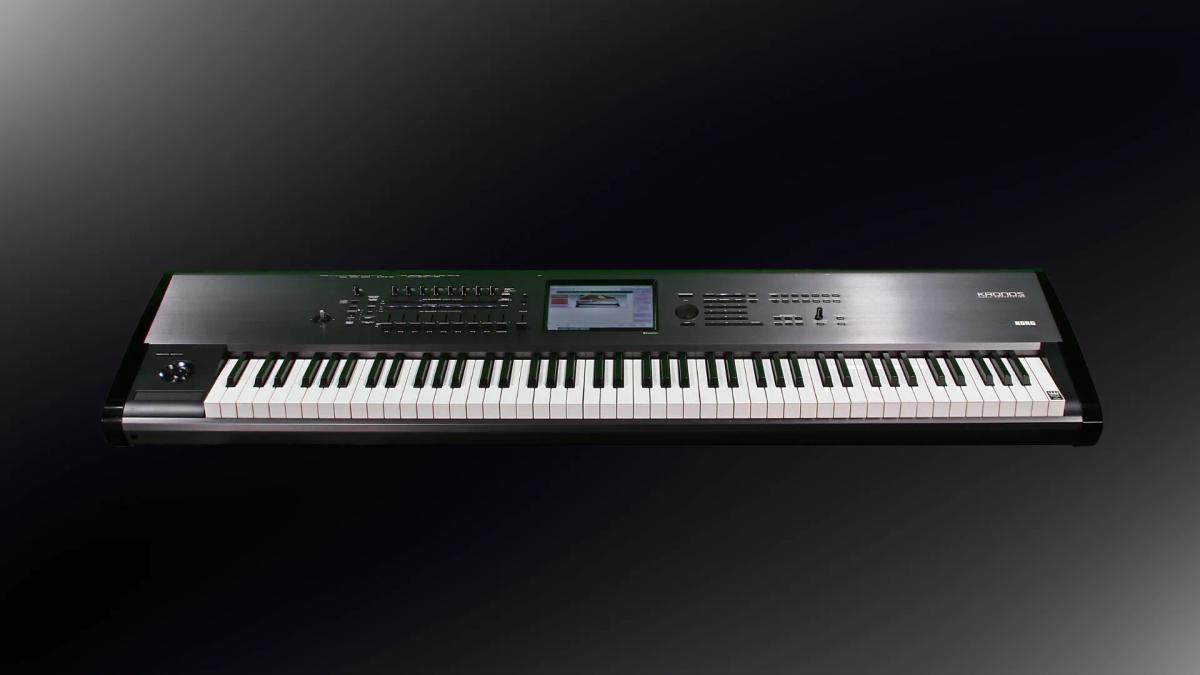
The Korg Kronos is a flagship music workstation unveiled at the NAMM show in January 2011 and offered in 61-, 73- and 88-key versions. Built on PC-style hardware running a Linux-based system, it combines nine synthesis engines, covering sampled pianos, modeled electric pianos, tonewheel organ, three flavors of virtual analog, FM, physical modeling and PCM, with a 16-track MIDI and audio sequencer, sampling, KARMA and a large touchscreen. It inherited most of its technology from the far more expensive OASYS and defined Korg’s top-tier keyboard for a decade through the Kronos X of 2012 and the late-2014 revision commonly called the Kronos 2.
Table of Contents
Sound and character
The Korg Kronos has no single sonic signature in the way a vintage analog polysynth does. Its identity is breadth at high fidelity, and its character depends on which engine is speaking. That is the point of the design: rather than one synthesis method stretched to imitate everything, each family of sounds gets an engine built for it.
The keyboard-instrument engines are where players first heard the difference. SGX-1 used unlooped piano samples with eight velocity layers and separate piano noises, and the 2014 revision’s SGX-2 raised velocity switching to 12 levels and added sympathetic string resonance and una corda samples. EP-1 uses Korg’s MDS approach to avoid audible transitions between velocity layers, and Sound On Sound’s Gordon Reid said EP-1 alone would justify the purchase. The same review called the CX-3 tonewheel organ the best clonewheel available at the time.
On the synthesizer side, the Korg Kronos leans clean and precise rather than gritty. The AL-1 virtual analog engine, carried over from the OASYS, was designed to minimize aliasing. MS-20EX and PolysixEX model Korg’s 1978 and 1981 analog instruments, the former with an expanded patch panel. MOD-7 combines Variable Phase Modulation (Korg’s FM approach) with waveshaping, ring modulation and samples, and can import DX7 patches.
STR-1 models plucked and struck strings, while HD-1, the core PCM and wave-sequencing engine, supplies the orchestral, drum and hybrid textures. The result is a polished, studio-ready sound that suits pop, gospel, jazz, prog and covers work; it can bite through MS-20EX or MOD-7, but its default posture is controlled rather than colored.
Features and architecture
- Manufacturer: Korg
- Year introduced: 2011 (announced at NAMM in January 2011, with availability expected from March)
- Production years: original from 2011, Kronos X from 2012, Kronos 2 announced late 2014 and shown at NAMM 2015; production ended in the early 2020s, before a new generation returned in 2025
- Synthesis type: multi-engine digital workstation: sample playback, modeled electric piano, tonewheel organ modeling, virtual analog, VPM/FM, physical modeling
- Category: flagship keyboard workstation
- Polyphony: dynamically allocated; Korg’s single-engine maximums range from 40 voices (STR-1, MS-20EX) and 52 (MOD-7) to 140 (HD-1), 180 (PolysixEX) and 200 (CX-3); 16-part multitimbral
- Original price: U.S. list prices of $3,750 (61), $4,350 (73) and $4,750 (88), with UK pricing from around £3,000; U.S. street prices fell in July 2012 to $2,799, $3,299 and $3,499
- Current market signal: roughly $1,000 to $1,100 on Reverb’s price guide for a used Kronos 88 or Kronos X 88
- Oscillators: engine-dependent; HD-1 offers about 1,500 multisamples and 1,300 drum samples, with up to eight velocity-crossfaded sources per oscillator
- Filter: engine-dependent; AL-1 offers 22 filter profiles, HD-1 uses multimode resonant filters, MS-20EX and PolysixEX model their originals
- LFOs: engine-dependent; AL-1 LFOs offer close to 200 waveform variations
- Envelopes: engine-dependent
- Modulation system: per-engine modulation, patch panels on MS-20EX and MOD-7, vector synthesis
- Sequencer / arpeggiator: 16 MIDI and 16 audio tracks (up to four recorded at once, 24-bit/48 kHz); KARMA 2; Drum Track; RPPR
- Effects: 16 simultaneous (12 insert, 2 master, 2 total) from 185 types on the original and X, plus per-track EQ
- Memory: original with 2 GB RAM and a 30 GB SSD; Kronos X with about 2 GB of PCM sample RAM, a 62 GB SSD, 2,560 program and 1,792 combination locations; 128 Set Lists of 128 slots
- Keyboard: 61-key semi-weighted (from the M3-61); 73- and 88-key RH3 graded hammer action; velocity and aftertouch
- Inputs / outputs: main L/R plus four individual outputs, headphones, two mic/line inputs, optical S/PDIF in and out, damper, switch and pedal inputs
- MIDI / USB: MIDI In, Out, Thru; USB-B for MIDI and two-channel audio; two USB-A host ports
- Display: 8-inch color TouchView touchscreen, 800 x 600 pixels
- Controls: nine sliders, eight knobs, joystick, ribbon controller, vector joystick and assignable switches
- Dimensions / weight: Korg lists about 14.2 kg (61), 20.4 kg (73) and 23.4 kg (88) for the current generation; original-generation figures were not verified
- Power: 60 W consumption listed for the Kronos X
Strengths
- Nine dedicated engines in one chassis. Instead of approximating organs, electric pianos and analog synths with samples, the Korg Kronos gives each its own synthesis method, and reviewers rated several among the best in hardware at the time.
- Keyboard-instrument realism. SGX pianos, EP-1 electric pianos and the CX-3 organ made it a credible single-board rig for players who would otherwise carry several instruments.
- Performance design that solves gig problems. Set List mode puts programs, combinations and songs in one footswitch-steppable list with room for notes or lyrics, and Smooth Sound Transition lets held notes and effects ring out when switching sounds.
- A complete production environment. The 16 MIDI plus 16 audio track sequencer, sampling, KARMA and Drum Track let a song be written, arranged and recorded without a computer.
- Long-lived platform. Korg extended it through software (OS 2.0 with the Kronos X, OS 3 with the 2014 revision) and kept sound libraries compatible across generations.
- Flagship lineage at a lower price. It delivered the OASYS engine and much of its interface for well under half the OASYS’s roughly $8,000 street price.
Limitations
- Long boot time. Sound On Sound measured 2 minutes 15 seconds on its review unit, a real issue on stage.
- Computer-style hardware. The review unit’s fan was audible, and the PC architecture brings the usual concerns about storage, cooling and aging components.
- Load-dependent polyphony. Heavy engines and effects reduce voice counts, and Sound On Sound noted polyphony could drop to a handful of notes.
- Little free sample RAM on the original. With factory libraries loaded, only about 148 MB was free for user sampling on the 2011 model, a constraint the Kronos X addressed.
- Steep learning curve. MusicRadar’s review of the later model still listed “takes time to learn,” and the sequencer lacks a piano-roll editor.
- Size, weight and omissions. The 73- and 88-key versions are heavy, the screen is not angled, and there is no optical drive, no XLR mic input and fewer individual outputs than the OASYS.
Historical context
The Korg Kronos arrived when computers and plugins had become the default production environment, and when Korg’s own no-compromise answer, the 2005 OASYS, sold for around $8,000. Korg discontinued the OASYS as the Korg Kronos appeared, and the new instrument answered a clear question: how to put that engine in front of far more players.
The answer was partly technical. Where the OASYS ran on a Pentium 4, the Korg Kronos moved to a lower-power Intel Atom processor and a custom Linux-based system, which Sound On Sound judged sensible for heat, power and cost. Korg called the relationship a “blood relation,” and the Korg Kronos could load OASYS programs, combinations and sequences. Yet it was not sold as an OASYS Mk II. New engines (SGX-1 and EP-1), Set List mode and smooth sound switching shifted the emphasis from studio system to stage instrument, which Korg framed as making it “an instrument rather than a system.”
The line then evolved in software-led steps. The Kronos X, launched at Summer NAMM 2012, moved to a 62 GB SSD, substantially enlarged sample RAM and introduced OS 2.0 with User Sample Banks and an Open Sampling System, with the new software free to existing owners. Korg USA lowered street prices that July.
The late-2014 revision, commonly called the Kronos 2, added SGX-2 with the Berlin Grand, wider touch-and-drag editing, a more flexible Set List, wooden end panels and gold-plated audio jacks. In 2020 the Nautilus carried all nine engines into a more affordable workstation, and the Korg Kronos left the market in the early 2020s before returning in a new generation at NAMM 2025.