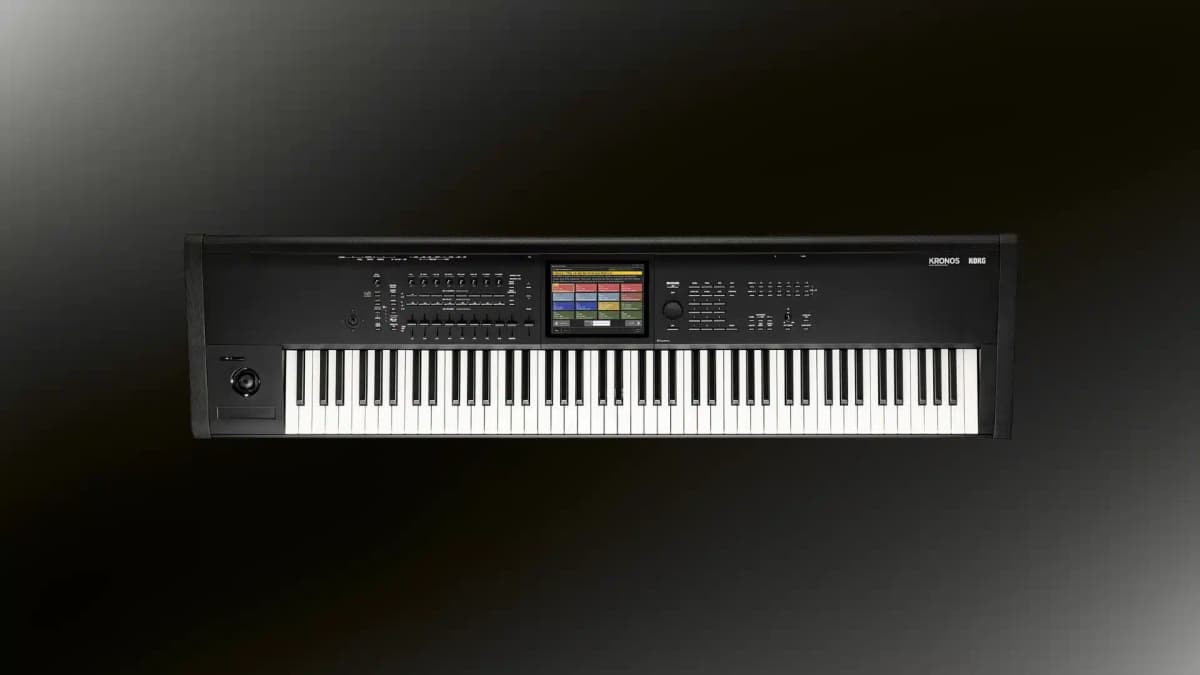
Korg Kronos (2025): The refreshed flagship that put Korg’s nine-engine workstation back in production
The 2025 Korg Kronos is the latest generation of the workstation Korg first launched in 2011, unveiled at the NAMM Show in January 2025 under the plain name KRONOS and quickly nicknamed the Kronos 3 by press and players.
The 2025 Korg Kronos is the latest generation of the workstation Korg first launched in 2011, unveiled at the NAMM Show in January 2025 under the plain name KRONOS and quickly nicknamed the Kronos 3 by press and players.
It keeps the platform’s defining idea, nine distinct sound engines running on one computer-based instrument with a sampler, a 16-track MIDI and audio sequencer, KARMA and a set list mode, but rebuilds the hardware around a new motherboard, a 120GB SSD, a more responsive 8-inch TouchView screen and a slimmer powder-coated chassis. It comes in 61-, 73- and 88-key versions. Its significance is less about new synthesis than about continuity: it returned Korg’s top workstation to production after the Kronos 2 had disappeared from the catalog.
Because the Korg Kronos 2025 runs the same nine engines as earlier Kronos instruments, its core sound is familiar: the SGX-2 acoustic pianos, the EP-1 modeled electric pianos, the CX-3 tonewheel organ, the HD-1 sample-playback engine that carries most of the orchestral and general-purpose material, the AL-1 and the two analog models (MS-20EX and PolysixEX), the MOD-7 FM and waveshaping engine, and the STR-1 plucked-string physical model.
The result is a broad, polished, production-ready palette rather than a single signature tone. What distinguishes the Kronos from most rompler workstations is that several of those engines are genuine models with their own parameters, so organs, electric pianos and analog-style patches respond to playing and editing in ways that static samples do not.
The audible changes in 2025 are concentrated in the Korg Kronos 2025 instruments. The SGX-2 engine gains an Italian Grand, joining the German, Japanese and Berlin grands, and adds sympathetic string resonance along with newly recorded una corda samples for soft-pedal playing. The EP-1 engine adds a Tine EP I Early model, an earlier-style tine electric piano. On the Korg Kronos 2025 side, the MS-20EX gains an enhanced patch panel that includes audio-rate filter modulation and audio-to-control conversion, and Korg says the PolysixEX now offers higher polyphony with modern enhancements, although published sources do not give the new voice count.
The factory content has also been reshaped toward working players. Korg added 256 programs, half of them new sounds and half drawn from its existing KRONOS Sound Libraries, and preloads collections such as KRS-08 Best of TRITON, the KRS-04 and KRS-05 split, layer and ensemble sets, and the CX-3 Signature Sounds organ banks. Preset waveform data occupies about 21GB.
In character, the Kronos sits firmly on the clean, high-fidelity side of the workstation spectrum. It is strongest at realistic pianos, organs, electric pianos and big layered stage sounds, and capable rather than distinctive as an analog-style synth. Its virtual-analog engines are competent but conventional; its real advantage is the number of convincing instruments available under one set list.
Features and architecture
Manufacturer: Korg Inc., Japan
Year introduced: announced at NAMM in January 2025; Korg’s press release is dated January 21, 2025, and shipping was reported for around May 2025
Production years: 2025 to present
Synthesis type: multi-engine workstation combining sample playback (HD-1), modeled acoustic and electric pianos (SGX-2, EP-1), tonewheel organ modeling (CX-3), virtual analog (AL-1, MS-20EX, PolysixEX), FM and waveshaping (MOD-7) and string physical modeling (STR-1)
Category: flagship keyboard workstation with sampler, sequencer and audio recorder
Polyphony: varies by engine; retailers quoting Korg’s specifications list SGX-2 at 100 voices, EP-1 at 104, HD-1 at 140, AL-1 at 80 and CX-3 at 200, with resources shared across engines
Multitimbrality: 16 parts in Combination and Sequencer modes
Original price: Bonedo listed European prices of 3,149 euros (61 keys), 3,499 euros (73 keys) and 3,799 euros (88 keys); UK coverage at launch put the starting price at around 2,599 to 2,649 pounds; a US price of about $2,999 for the 61-key model was reported secondhand on forums but not confirmed by a primary source here
Current market price: in October 2026, German retailers list the 61-key at about 2,827 euros, the 73-key at about 3,279 euros and the 88-key at about 3,543 euros
Oscillators: engine-dependent; HD-1 uses multisample and wave-sequence oscillators, while the modeled engines use their own oscillator structures
Filter: engine-dependent, including multimode filters in HD-1 and AL-1 and models of the MS-20 and Polysix filters
LFOs: multiple per program, plus common LFOs, depending on engine
Envelopes: multiple per voice, depending on engine
Modulation system: Alternate Modulation and AMS mixers inherited from earlier Kronos models, with the MS-20EX adding an enhanced virtual patch panel
Sequencer / arpeggiator: 16 MIDI tracks and 16 audio tracks, with up to four audio tracks recorded at once at 16 or 24 bits and 48kHz; second-generation KARMA with wave sequencing, note mapping and eight scenes per layer; Drum Track with expanded drum performances
Sampling: Open Sampling System that can sample external audio or resample the Korg Kronos 2025 in any mode; loads AIFF, WAV, SoundFont 2.0 and Akai S1000/S3000 data from USB storage
Effects: 16 processors (12 insert, 2 master, 2 total effects) with a three-band EQ on every timbre and track; retailers give 185 or 197 effect types
Memory: 120GB internal SSD, with about 62GB free for user samples and libraries; preloaded data supports both KRONOS 1/X and KRONOS 2 program orders
Keyboard: 61-key semi-weighted Natural Touch action with aftertouch, or 73- and 88-key RH3 Real Weighted Hammer Action with four graded zones and aftertouch
Controllers: eight knobs, nine sliders, four-way joystick, vector joystick, ribbon, two assignable switches; damper input with half-damping plus assignable pedal and switch inputs
Inputs / outputs: balanced main L/R outputs, four balanced individual outputs, two mono line/mic inputs, headphone output, optical S/PDIF in and out
MIDI / USB: 5-pin MIDI In, Out and Thru; USB-B for MIDI and 2-channel, 24-bit, 48kHz audio; two USB-A host ports for class-compliant controllers and storage
Display: 8-inch 800 x 600 color TouchView touchscreen with a reworked, more responsive interface and a new sound search function
Dimensions / weight: 61-key about 1064 x 363 x 134 mm and 14.2 kg; 73-key about 1245 x 370 x 148 mm and 20.4 kg; 88-key about 1457 x 370 x 148 mm and 23.4 kg
Power: internal power supply with IEC cable
Strengths
It is one of the few workstations that combines serious modeled engines with deep sample playback. Pianos, organ, electric pianos and analog-style patches come from dedicated engines, not from a single rompler architecture.
The startup time is far shorter than before. Korg claims about 60 percent faster booting, and forum users at NAMM timed around 48 seconds, compared with more than two minutes for earlier Kronos models, which matters when a power failure hits mid-gig.
Backward compatibility is unusually thorough. The preloaded data supports both the original and Kronos 2 program orders, and older sounds and libraries carry over, so existing set lists can move to the new hardware.
The live features are mature. Set List mode with color-coded slots, performance notes and a nine-band graphic EQ, together with smooth sound transitions, reflects more than a decade of refinement for stage use.
It remains a complete production environment: sampler, audio recorder, 16-track sequencer, KARMA and Drum Track in one instrument, plus a USB audio interface.
The doubled 120GB SSD leaves meaningful room for sample libraries, one of the main constraints owners of earlier models complained about.
Limitations
It is an evolution, not a reinvention. The nine engines are the same ones introduced in 2011, and reviewers and players noted the absence of new synthesis methods.
The operating system and user interface remain close to earlier versions, and some forum users described the new model as largely the old platform with new parts.
Aftertouch is channel-only; polyphonic aftertouch is not offered, a gap some players noticed on a flagship.
Free SSD space, at about 62GB, falls short of what some reviewers hoped for, and there was no mention of a second drive slot.
The 73- and 88-key versions are heavy, at roughly 20 and 23 kilograms, and the weighted RH3 action is not to every synth player’s taste.
Computer editor support remained a sore point in at least one buyer review, which cited the lack of a new editor for Mac or PC.
Historical context
The Kronos line grew out of the OASYS, Korg’s 2005 flagship built around a PC processor running a Linux core, which Sound On Sound reviewed at more than 5,000 pounds. The 2011 Kronos packed most of that concept into a cheaper Intel Atom-based instrument with nine engines and an SSD, and was followed by the Kronos X and then the Kronos 2 in 2015, each enlarging storage and refining the keyboards and interface.
Dan Phillips, a product manager at Korg R&D in California, lists the OASYS, Kronos and Kronos X among the instruments he helped develop. In 2020 Korg introduced the Nautilus, a simpler and more affordable workstation using the same engines, and the Kronos was discontinued around 2022.
For a time the Nautilus served as Korg’s top workstation. The new KRONOS was announced at NAMM in January 2025, with Korg presenting it as the return of its flagship, and Sonicstate reported that the delay had been tied to pandemic-era component and regulation problems. Changes were concentrated in the hardware and content: a new motherboard and system architecture, an SSD doubled to 120GB, a faster and more responsive TouchView display, an all-black powder-coated chassis with black wooden end cheeks, and new pianos, electric pianos and programs. Forum reports from the show also described a quieter, fanless design.
Coverage differs on how to count the generations. Synth Anatomy called it the fourth generation, counting the original, the Kronos X and the Kronos 2, while some retailers describe it as the third. Korg itself did not add a number. The Korg Kronos 2025 remains in production in October 2026, and Korg promised a sound pack bringing its new content to earlier Kronos and Nautilus owners in the second half of 2025.
Legacy and significance
The Korg Kronos 2025 matters mainly because it kept a category alive. Large multi-engine flagship workstations have become rare, and Korg’s decision to rebuild rather than retire the Kronos signaled that it still sees a market for a single instrument that covers pianos, organs, synths, sampling and sequencing on stage.
Its design also illustrates how a software-based instrument can be extended across hardware generations. The same engine set has now run on three or four hardware revisions, and the Korg Kronos 2025’s compatibility with both program orders means sounds created for the 2011 instrument still load. The original 2011 Kronos is covered separately on this site, and this article focuses on what the 2025 revision changed.
Its long-term place will depend on whether Korg extends the platform beyond refreshed hardware. As it stands, the Korg Kronos 2025 is best understood as a modernized flagship: a more reliable and faster version of a proven instrument, rather than a new direction for Korg’s workstations.
Artists, users, and curiosities
The Korg Kronos 2025 is too new for a well-documented list of signature recordings, and press coverage at launch focused on its features rather than named users. The Kronos platform as a whole has long been popular with touring keyboardists, cover and session players and worship musicians, who value its set list mode and the breadth of its pianos and organs, and that is the audience Korg’s launch material addressed.
Among the curiosities, the preloaded KRS-08 Best of TRITON collection brings 128 programs from Korg’s earlier Triton workstations into the new instrument, a nod to a lineage that runs back through the M1. The new Tine EP I Early model and the una corda samples are examples of Korg adding detail to existing engines rather than adding new ones.
At NAMM, forum attendees reported that demonstration units were running an existing 3.1.x operating system and noted a different power switch and a black vector joystick, small details that show how closely the Korg Kronos 2025 follows its predecessors. The comparison with the original is also striking: the 2011 Kronos shipped with a 30GB SSD that MusicRadar’s reviewer called a first for a keyboard, and the Korg Kronos 2025 has four times that capacity.
Market value
Current market position: Korg’s current flagship workstation, in production and sold through major dealers in 61-, 73- and 88-key versions
New price signal: European list prices started at 3,149 euros for the 61-key version and rose to 3,799 euros for the 88-key; in October 2026, German retailers list it at roughly 2,827 to 3,543 euros depending on key count
Used market signal: the used market is still thin, with B-stock units appearing at European retailers; most secondhand Kronos listings are still earlier models, which sell for considerably less
Availability: readily available new from major retailers in Europe and the UK
Buyer notes: decide between the semi-weighted 61-key and the heavy RH3 versions according to playing style, check whether you need the new hardware or whether the promised sound pack for earlier models covers your needs, and confirm the OS version installed
Support ecosystem: Korg’s KRONOS Sound Libraries, a large third-party sound market built since 2011, and compatibility with older programs and samples
Market character: a working musician’s tool bought for performance and production rather than collecting
Long-term position: likely to hold value moderately well as the last revision of a long-running platform, though, like earlier Kronos models, it will depreciate as a computer-based instrument ages
Conclusion
The Korg Kronos 2025 is a careful revision rather than a rethink. Korg kept the nine engines, the sampler, the sequencer and the set list workflow that made the platform a stage standard, then addressed the practical complaints owners had raised for years: boot time, storage, screen responsiveness and noise. The new pianos and electric pianos refine the Korg Kronos 2025’s strongest area, while compatibility protects the investment of players with years of sounds built on earlier models. Its importance lies in that combination of continuity and maintenance: it shows that a large, multi-engine hardware workstation can still be renewed instead of abandoned.
His connection with music began at age 6, in the 1980s, when his father introduced him to Jean-Michel Jarre's Rendez-Vous on vinyl. He works professionally in the legal field, while synthesizers became his space for abstraction and creative exploration. Founder of The Synth Source.