

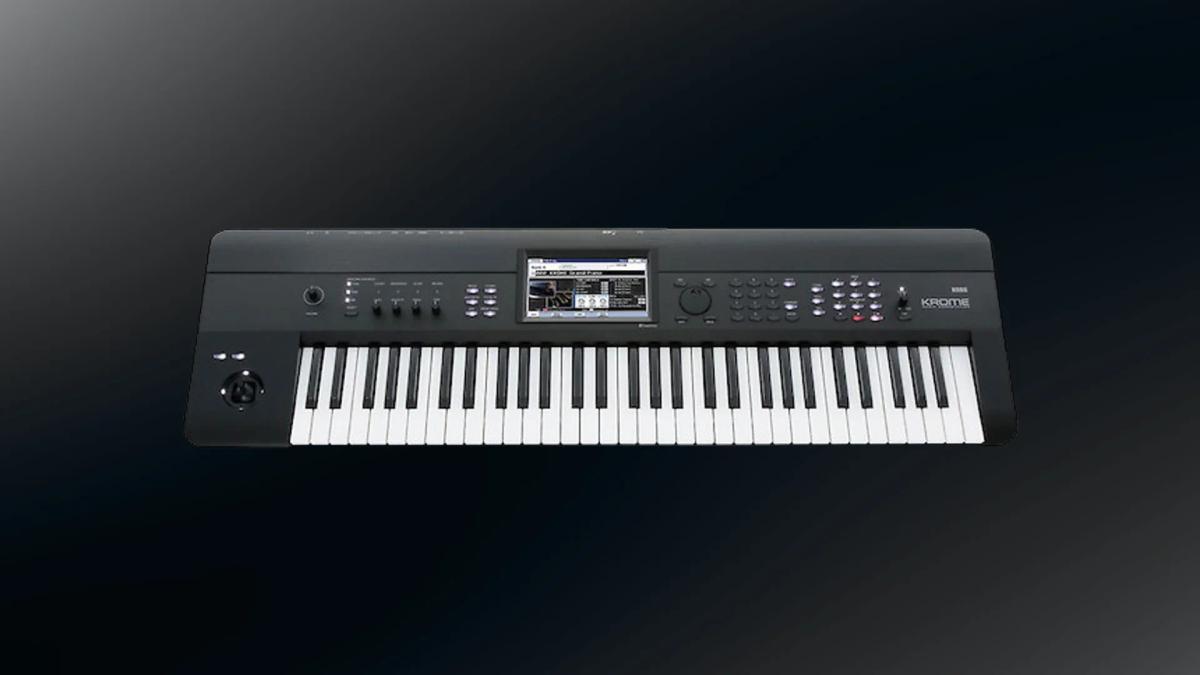
The Korg Krome is a sample-based music workstation that Korg announced in September 2012 and shipped that fall in 61-, 73- and 88-key versions, later refreshed as the Krome EX in 2019. It sat below the Kronos flagship and replaced the M50, using Korg’s EDS-X sample playback engine with 3.8 GB of PCM, 120-voice polyphony, a 7-inch color TouchView screen and a 16-track MIDI sequencer. Its selling point was simple: the German D Grand piano, Jazz Ambience drums and electric pianos from the Kronos, in a lighter instrument at about a third of the price. It became one of Korg’s most widely used gigging keyboards of the 2010s.
Table of Contents
Korg Krome sound and character
The Korg Krome sounds like a condensed Kronos: polished, detailed and immediately usable rather than characterful in a synth sense. Everything comes from PCM samples played by the EDS-X engine, without the Kronos’s analog modeling, organ modeling or other synthesis engines. A Program has one or two oscillators, each able to switch among up to eight velocity-layered multisamples, followed by two multimode filters per oscillator, a nonlinear driver, a three-band EQ, envelopes, LFOs and Korg’s AMS modulation routing.
The acoustic piano is the center of its reputation. It uses the German D Grand from the Kronos with unlooped samples for every note, eight velocity layers and a second oscillator devoted to damper resonance. Keyboard magazine’s review, published by MusicRadar, said its pianos rivaled much pricier keyboards, and AudioTechnology’s Brad Watts called the piano staggeringly good. The electric pianos, also derived from the Kronos, include several Rhodes models and a Wurlitzer 200A, while the Jazz Ambience drum kit lets players blend direct and room sound.
Beyond those headline sounds, the factory set covers strings, brass, pads, organs, basses and a broad range of synth patches, some modeled on earlier Korg instruments such as the M1, DW-8000, MS2000 and Wavestation. They are clean and well programmed, and the four real-time knobs let players adjust cutoff, resonance and envelopes during a performance. What it cannot do is the deeper synthesis work of the Kronos: reviewers routinely pointed synth enthusiasts toward the flagship, and AudioTechnology listed the single sound generation system as its main drawback.
The Krome EX of 2019 kept the engine but expanded the sound memory to about 4 GB, adding newly recorded grand and upright pianos, three new electric piano types, EDM and cinematic programs, instruments such as kalimba and kokyu, and amp and cabinet emulations. Its position never changed: a modern, clean, broad-coverage workstation built for songs and stages rather than for sound design.
Features and architecture
- Manufacturer: Korg
- Year introduced: announced September 2012 and in stores from late 2012; Krome EX announced in January 2019 ahead of NAMM
- Production years: Krome from 2012 to about 2019, when the Krome EX replaced it; the EX is now listed by Korg Japan as discontinued, with no clearly published end date
- Synthesis type: sample-based (PCM) synthesis, EDS-X (Enhanced Definition Synthesis-eXpanded)
- Category: midrange music workstation
- Polyphony: 120 voices in Single mode, 60 in Double mode
- Multitimbrality: 16 parts in Combinations and Sequencer mode
- Original price: US street prices of $999 (61), $1,199 (73) and $1,599 (88), against list prices of $1,499, $1,799 and $1,999; Krome EX launched at 999, 1,249 and 1,499 euros, or £869, £1,080 and £1,299 in the UK
- Current market price: Sweetwater’s Gear Exchange guide gives about $520 to $770 for a Krome 61, and Equipboard tracked a used Krome EX 88 at around $1,170 on Reverb
- Sample memory: 3.8 GB of PCM (48kHz, 16-bit) with 583 multisamples and 2,080 drum samples; about 4 GB in the Krome EX, with 728 multisamples and 2,502 drum samples
- Oscillators: 1 or 2 per Program, each with 8 velocity zones
- Filter: 2 multimode filters per oscillator (low-pass, high-pass, band-pass, band-reject) in four routing types, plus a per-voice driver with low boost and a three-band EQ
- LFOs: 2 per oscillator plus a common LFO
- Envelopes: filter, amp and pitch envelopes
- Modulation system: Korg AMS (Alternate Modulation Source) with two AMS mixers
- Sequencer / arpeggiator: 16-track MIDI sequencer plus master track, 128 songs, 210,000 events, piano roll editing, RPPR and cue lists; one polyphonic arpeggiator in Program mode and two in Combination and Sequencer modes; Drum Track with 637 preset patterns
- Effects: 5 insert, 2 master and 1 total effect, with 193 effect types and a three-band EQ per track
- Memory: 640 preset Programs and 288 Combinations in 768 and 512 user locations, 48 drum kits, plus GM2 sounds; the Krome EX carries 896 Programs and 512 Combinations
- Keyboard: 61 or 73 semi-weighted Natural Touch keys, or 88 keys with Korg’s NH (Natural Weighted Hammer) action; velocity sensitive, no aftertouch
- Controllers: joystick, two assignable switches, four real-time knobs, arpeggiator and Drum Track switches
- Inputs / outputs: stereo 1/4-inch outputs, 3.5 mm headphone output, damper (half-damper), assignable switch and assignable pedal inputs; no audio inputs
- MIDI / USB: MIDI In and Out, USB-MIDI; Krome Editor and plug-in editor for VST, AU and RTAS hosts
- Storage: SD and SDHC cards up to 32 GB
- Display: 7-inch 800 x 480 color resistive touchscreen (TouchView)
- Dimensions / weight: 1,027 x 313 x 93 mm and 7.2 kg (61); 1,191 x 313 x 93 mm and 8.2 kg (73); 1,448 x 383 x 131 mm and 14.7 kg (88)
- Power: 12V DC external adapter, 13 W
Strengths
- The pianos are far above what the price suggested. The Kronos-derived German D Grand, with unlooped samples and damper resonance, became the main reason many players bought it.
- It is light for a workstation. The 88-key model weighs 14.7 kg, and Korg’s product manager Richard Formidoni called it the lightest workstation the company knew of at launch.
- The touchscreen made editing approachable. A 7-inch color display with drag editing and a piano roll gave it a DAW-like sequencing view that keyboard reviewers praised.
- It covers a wide range of work out of the box. Electric pianos, drums, strings, organs and synth sounds are all solid, and the Drum Track and arpeggiators speed up writing.
- The effects section is deep for the class, with five inserts, two masters and a total effect drawn from the same 193-type library as Korg’s larger workstations.
- It integrates easily with computers through USB-MIDI, SD storage and a plug-in editor, and it could load M50 sound files, which eased upgrades.
Limitations
- There is only one synthesis engine. Without the Kronos’s modeling engines, it is a sample player with filters, and reviewers pointed sound designers elsewhere.
- The keys do not transmit aftertouch on any model, a notable gap for expressive synth and string playing.
- Connectivity is minimal: two main outputs, a 3.5 mm headphone jack and no audio inputs or sampling, which MusicTech’s Krome EX review found limiting.
- The resistive touchscreen is less responsive than modern capacitive screens, small controls are easier with a stylus, and the fixed display can look washed out when seated.
- The front panel is sparse, with no dedicated octave buttons, so many functions depend on menus and assignable switches.
- Boot-up takes around a minute, a minor but recurring complaint on stage.
- In Combination mode, parts share the available insert effects, which limits complex layered setups.
Historical context
The Korg Krome arrived at a point when Korg’s workstation range had split into two levels. The Kronos, launched in 2011 and covered separately on this site, was the flagship with nine sound engines, sampling and KARMA, while the M50 of 2008 served the midrange. Formidoni described the Korg Krome as a direct replacement for the M50, and called the two instruments different beasts with shared features: the Korg Krome took the Kronos sample libraries, its sample libraries, Drum Track, 16-part Combis and TouchView displays but none of its extra engines.
Korg announced the Korg Krome on September 4, 2012, alongside the microKORG XL+, and Synthtopia reported October availability; by early December units were reaching stores at $999, $1,199 and $1,599 street. Reviews were consistently positive: Keyboard magazine called it the new entry-level workstation to beat, AudioTechnology called it exceedingly great value, and Expert Reviews gave it five stars in 2014 while noting that the interface was starting to show its age. Korg also sold color variants, including a red limited edition of the Krome 61.