

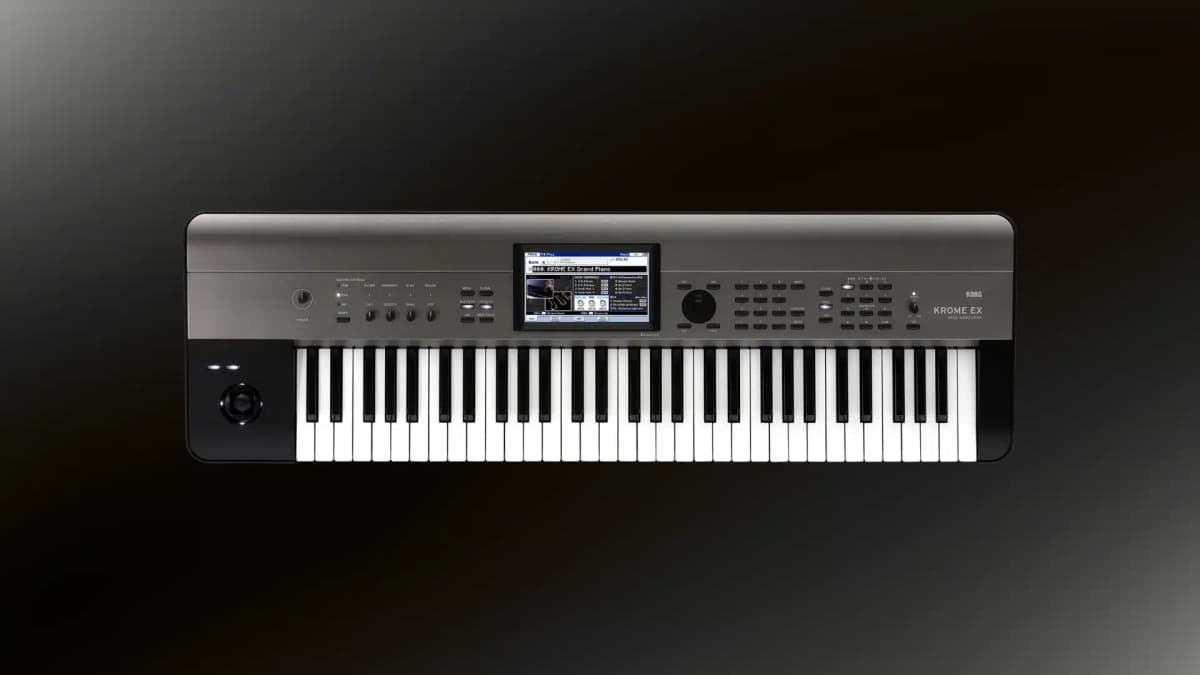
The Korg Krome EX is a sample-based music workstation that Korg announced on January 16, 2019, ahead of that year’s NAMM show, as an expanded version of the Krome it had introduced in 2012. It keeps the Krome’s EDS-X synthesis engine, 120-voice polyphony, 16-track sequencer, Drum Track and 7-inch TouchView screen, but adds a reworked sound set built on 4GB of PCM data: a new grand piano, an upright from the Grandstage, refreshed electric pianos and drums, and a large block of EDM, world and cinematic sounds. It comes in 61, 73 and 88-key versions with a slate-grey aluminum panel. The Korg Krome EX matters as Korg’s long-running answer to the mid-priced workstation question, a Kronos-derived sound library at a fraction of the cost.
Table of Contents
Korg Krome EX sound and character
The Krome EX sounds clean, polished and production-ready, the character of a modern ROMpler built for players who want results without programming. The pianos are the headline. Korg developed new piano sounds under the supervision of the producer and engineer Seigen Ono, and AudioTechnology’s Christopher Holder called them the Korg Krome EX’s main draw, singling out the upright for particular praise. American Songwriter’s reviewer found them natural and responsive, while MusicTech’s John Andrews noted the new grand, upright and electric pianos alongside strings and orchestral sounds that he found very realistic at times.
The electric pianos come in three types with eight velocity levels, and their amp and cabinet effects add the dirt that makes Rhodes and Wurlitzer sounds convincing. The drums are another strength: more than 2,500 drum samples, many using Korg’s Ambience technique to blend in room sound, and about 700 Drum Track grooves played by professional drummers. The EDM content, much of it reportedly from the team behind Korg Gadget, covers leads, basses, risers and vocal-style presets; Andrews found it more usable than he expected, although its contemporary vocal elements will not suit everyone.
Under the sounds, the EDS-X engine is a conventional but capable sample-playback design: one or two oscillators per program, each with two multimode filters, a nonlinear driver, two envelopes and two LFOs. That gives enough depth to reshape sounds, but not the range of synthesis types found in the Kronos. The Korg Krome EX sits squarely in the modern, clinical part of the spectrum. It is very good at covering many styles quickly and less convincing as a sound-design instrument or for gritty analog-style character.
Features and architecture
- Manufacturer: Korg
- Year introduced: 2019, announced January 16, 2019 ahead of NAMM and shipping from about February to March 2019 (not 2016, as some lists suggest)
- Production years: 2019 to present; still listed by Korg and sold new in October 2026
- Synthesis type: sample-based (EDS-X, Enhanced Definition Synthesis eXpanded)
- Category: mid-priced music workstation
- Polyphony: 120 voices in Single mode, 60 in Double mode
- Original price: €999 (61), €1,249 (73) and €1,499 (88) at launch in Europe; MusicTech later cited UK street prices from about £665, with the EX-88 at a little over £1,000
- Current market price: about $1,099.99 new for the EX-61 at US dealers such as Guitar Center and Chicago Music Exchange in October 2026; used units around $800 to $840
- Sample memory: 4GB PCM (48kHz, 16-bit equivalent), 728 multisamples and 2,502 drum samples
- Oscillators: one or two oscillators per program, stereo multisamples supported, eight velocity zones per oscillator with switching, crossfades and layers
- Filter: two multimode filters per oscillator (low-pass, high-pass, band-pass, band-reject) in single, serial, parallel or 24dB configurations; per-voice nonlinear driver and 3-band EQ
- LFOs: two per oscillator plus a common LFO
- Envelopes: filter and amp envelopes per oscillator, plus a pitch envelope
- Modulation system: AMS mixers, key-tracking generators and Korg’s alternate modulation routing
- Multitimbrality: 16-part Combinations and 16-track sequencer
- Sequencer / arpeggiator: 16-track sequencer with 210,000-event capacity, RPPR patterns and cue lists; two polyphonic arpeggiators in Combination and Sequencer modes; Drum Track with 710 preset and 1,000 user patterns
- Effects: 5 insert, 2 master and 1 total effect, 193 effect types, with 3-band EQ per timbre
- Memory: 1,536 user programs (896 preloaded), 768 combinations (512 preloaded), 80 drum kits, plus 256 GM2 programs
- Keyboard: EX-61 and EX-73 semi-weighted; EX-88 with Natural Weighted Hammer Action (NH); velocity-sensitive, no aftertouch
- Controllers: joystick, two assignable switches, four knobs for tone, user and arpeggio control
- Inputs / outputs: two unbalanced main outputs, headphone output, damper (half-damper supported), assignable switch and assignable pedal inputs
- MIDI / USB: MIDI In and Out, USB-MIDI (no USB audio); SD/SDHC card slot up to 32GB
- Display: 7-inch 800 x 480 color TouchView touchscreen
- Dimensions / weight: EX-61 1,027 x 313 x 93mm and 7.2kg; EX-73 1,191 x 313 x 93mm and 8.2kg; EX-88 1,448 x 383 x 131mm and 14.7kg
- Power: 12V DC external adapter, 13W consumption
Strengths
- The piano sounds are the main reason to choose it. The new grand and upright, developed under Seigen Ono’s supervision, lift the EX above the original Krome for piano-led players.
- It delivers a large, usable sound library for the price. More than 1,500 program slots and 700 combinations cover acoustic, electric, orchestral and electronic needs out of the box.
- The touchscreen workflow is clear. AudioTechnology praised the 7-inch display as logical and legible, and American Songwriter found it reduced reliance on the data dial.
- The Drum Track and dual arpeggiators make idea generation fast. Real drummer grooves and patterns carried over from the Kronos turn a single program into a backing part quickly.
- The weights are manageable. At 7.2kg for the 61 and 14.7kg for the weighted 88, it is easy to carry compared with flagship workstations.
- It remains good value. Street prices around $1,100 for the 61-key model place a Kronos-derived sound set well below flagship pricing.
Limitations
- There are only two main outputs, which MusicTech’s reviewer found limiting for stage and studio routing.
- USB carries MIDI only; there is no built-in audio interface, a drawback noted on the original Krome that the Korg Krome EX did not fix.
- Physical controls are sparse. Four knobs and a joystick give less direct access than rivals with more hands-on panels.
- Effects are shared in Combination mode, so five insert effects can run out quickly in complex layered setups.
- There is no sampling, and only one synthesis engine, so it cannot import or record its own samples or match the Kronos for sound design.
- The chassis is light and plain, and the external power supply can be pulled out easily, as AudioTechnology pointed out.
- Boot-up is relatively slow, and the semi-weighted 61 and 73-key versions may not satisfy piano purists.
Historical context
Korg launched the original Krome in 2012 as a mid-priced workstation that drew on sounds and ideas from the Kronos flagship, covered in the site’s separate Kronos article, while using a single sample-playback engine instead of nine. It competed against Yamaha’s MOXF and Roland’s FA series, and it stayed in the catalog for several years with little change.
Rather than replace it, Korg revamped it. The Korg Krome EX was announced on January 16, 2019 and shown at NAMM that month, with European prices of €999, €1,249 and €1,499 and deliveries from February to March 2019. Synthanatomy noted that the functions were not extended: the changes were a 4GB PCM set, a larger and modernized sound library, new pianos, electric pianos and drums, amp and cabinet effects, 128 new combinations and a new slate-grey finish. AudioTechnology estimated that the EX upgrade added roughly $500 to the price of a standard Krome in its market.
The Korg Krome EX has stayed in production since then without a formal successor, which is unusual for a workstation. Its position has been framed by Korg’s other instruments: the Kronos and Nautilus above it, the Kross workstations below, and arranger keyboards such as the Pa series for players who need accompaniment features.