

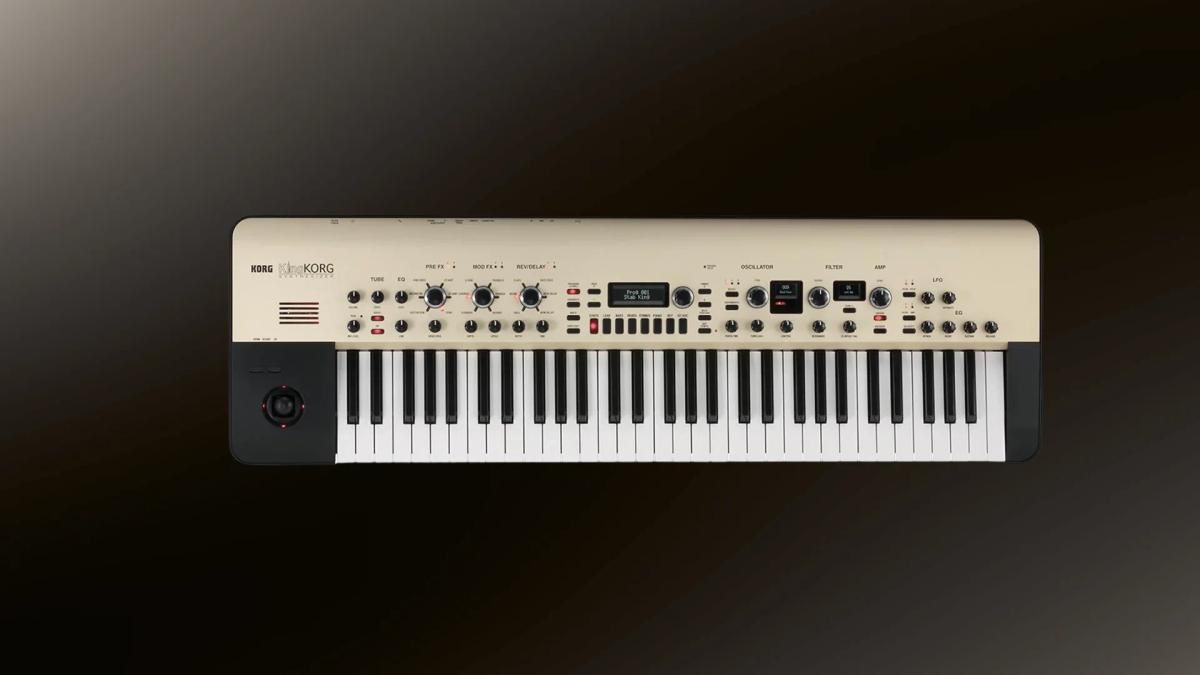
The Korg KingKORG is a 61-key virtual analog synthesizer that Korg announced at NAMM in January 2013 and shipped from February that year at a US street price of $1,299. It runs Korg’s XMT (eXpanded Modeling Technology) engine, a development of the MMT platform behind the RADIAS and microKORG XL, with 24 voices, two timbres, three oscillators per timbre, 18 filter models and a 16-band vocoder. What set it apart was a real vacuum tube driver at the end of the signal path, visible behind a grille on the panel. In a champagne gold finish and weighing about 7 kg, it was Korg’s attempt at a dedicated, knob-rich performance synth for players who wanted vintage-style sounds without vintage maintenance.
Table of Contents
Korg KingKORG sound and character
The Korg KingKORG sounds smooth, full and polished, aimed squarely at recreating the analog synths of the 1970s and 1980s. Sound On Sound’s Gordon Reid heard few digital artifacts and no zipper noise or quantization on filter sweeps, and found it capable of convincing analog-style pads as well as DWGS hybrids and FM-like tones from VPM modulation. AudioTechnology’s Brad Watts answered his own question about whether it sounded good with an emphatic yes. Bonedo singled out pads, strings and supersaw-style chords as particular strengths.
Its versatility comes from the oscillator and filter menus. Each timbre has three oscillators drawing on analog waveforms, noise, DWGS, PCM and the mic input, around 127 types in all (Sound On Sound counted 126), and a single filter offering 18 types: seven low-pass, five high-pass and six band-pass. Several are modeled on the filters of the Minimoog, Prophet-5, Oberheim SEM, MS-20 and TB-303, which is why the Korg KingKORG covers Moog-style leads, acid basslines and soft polysynth pads from the same panel. A Synthtopia-featured demo by KurtzMindfields used it to emulate SEM bass, Minimoog lead, Prophet pad and Mellotron parts in a Tangerine Dream homage.
The tube stage is real but subtle. A stereo vacuum tube driver, with drive and boost controls and a red LED that glows brighter as drive increases, adds warmth or overdrive, and MusicRadar found that it and the effects added pleasing grit. Reid, however, found it not especially gritty and criticized its placement after the reverb and rotary effects, where distortion can sound unnatural.
Its weaknesses are mostly at the edges: some aliasing at the top of self-oscillating filter sweeps, occasional clicks when voices are stolen in unison, and PCM pianos that Synthtopia called good but not state of the art. Overall it sits on the clean, modern side of virtual analog, closer to a well-behaved emulation than to the instability of real analog circuits.
Features and architecture
- Manufacturer: Korg
- Year introduced: 2013, announced at NAMM on January 24, 2013, with availability from February 2013
- Production years: 2013 to the early 2020s; no official end date has been published, and it is now listed as discontinued, with the 37-key KingKORG NEO announced in January 2024
- Synthesis type: virtual analog modeling, Korg XMT (eXpanded Modeling Technology), with DWGS and PCM waveforms
- Category: 61-key performance-oriented virtual analog polysynth with vocoder
- Polyphony: 24 voices
- Multitimbrality: 2 timbres per Program, in Layer or Split
- Original price: $1,299 US street at launch; Sound On Sound listed £1,199.99 in the UK, and MusicRadar gave £999 and $1,549
- Current market price: Equipboard tracked used units on Reverb at about $650 in September 2026, and listings are now sparse
- Oscillators: 3 per timbre, with around 127 types across analog and noise, DWGS, PCM and mic input; unison available
- Filter: 1 per timbre, 18 types (7 low-pass, 5 high-pass, 6 band-pass), including models of Minimoog, Prophet-5, SEM, MS-20 and TB-303 filters; self-oscillating
- LFOs: 2 per timbre, 7 waveforms each, tempo-syncable
- Envelopes: 2 ADSR per timbre, for filter and amplifier
- Modulation system: virtual patch with 6 routings per timbre
- Sequencer / arpeggiator: arpeggiator with 6 patterns and up to 8 steps; no sequencer
- Effects: Pre FX (distortion, decimator, ring mod, guitar amp, EP amp, tone), Mod FX (flanger, chorus, U-Vibe, tremolo, phaser, rotary) and Reverb/Delay (hall, room, plate, tape echo, mod delay, BPM delay), plus 2-band EQ and a stereo vacuum tube driver
- Vocoder: 16 bands with formant shift and formant hold
- Memory: 300 Programs (200 preset, 100 user) in 8 categories, plus Favorites banks
- Keyboard: 61 semi-weighted, velocity-sensitive keys with selectable response; no aftertouch
- Controllers: backlit X/Y joystick, octave up and down buttons, dedicated knobs for oscillators, filter, envelopes and effects
- Inputs / outputs: unbalanced 1/4-inch L/Mono and R outputs, 3.5 mm headphone output, balanced XLR mic input, damper and switch/pedal jacks, CV/Gate out on one TRRS jack (cable for the monotribe included)
- MIDI / USB: MIDI In and Out, USB-B
- Display: 16 x 2 character OLED main display plus 128 x 64 OLED displays for the oscillator and filter sections
- Dimensions / weight: 1,027 x 313 x 96 mm; 7.0 kg
- Power: external 12V DC adapter, 10 W
Strengths
- It covers a wide vintage palette from one panel. Filter models of the Minimoog, Prophet-5, SEM, MS-20 and TB-303, combined with three oscillators, give it a broad range of analog-style sounds.
- The interface is direct and readable. Dedicated knobs and OLED screens for the oscillator and filter sections led Sound On Sound to write that nothing is hidden and nothing is arcane.
- It is light for a 61-key synth. At about 7 kg, it was praised by Sound On Sound, AudioTechnology and Juno as easy to carry to gigs.
- The 16-band vocoder with a balanced XLR input makes it a complete stage instrument without extra hardware.
- The effects section is broad and well chosen, including amp models, rotary, tape echo and plate reverb, plus the tube driver for added warmth.
- A CV/Gate output lets it play a monotribe, MS-20 or other analog gear, a useful link between modeling and real analog circuits.
Limitations
- Only 100 user Program slots are available, a limit cited by both Sound On Sound and MusicRadar.
- The keyboard has a light action and no aftertouch, which restricts expressive playing.
- The build is lightweight: reviewers mentioned wobbly encoders and a chassis that feels fragile under rough handling.
- The tube stage is global and placed after the effects, so it cannot be set per sound in an ideal position, and replacing the valve requires a service center.
- Multitimbral use is limited to two timbres, and the CV/Gate output does not work as a general MIDI-to-CV converter.
- There is no line-level audio input for external processing, only the mic input.
- The arpeggiator cannot be edited in depth from the front panel, and tap tempo requires a two-button combination.
Historical context
The Korg KingKORG came from the modeling line Korg had built since the mid-2000s. MMT had powered the RADIAS, R3 and microKORG XL, and Sound On Sound noted that the Korg KingKORG’s lineage from the microKORG XL was clear, sharing its analog and PCM/DWGS oscillators, virtual patching and formant-based vocoder. XMT extended that platform with three oscillators per timbre, a much larger filter library and a full-size performance panel. In the early 2010s the virtual analog market was crowded with cheap hardware and software instruments, alongside the Roland Gaia and the Studiologic Sledge, and Reid called the Korg KingKORG a brave release in that context.
Korg introduced it at NAMM 2013, in the period around the company’s 50th anniversary, describing it as an analog modeling synth for live performance with a vacuum tube driver, dedicated oscillator display and champagne gold finish. It shipped in February 2013 at $1,299 street. Reviews were largely positive: Bonedo gave it 4.5 out of 5, AudioTechnology was enthusiastic, and MusicRadar called it a monster synth for stage and studio, while most reviewers criticized the user memory, keyboard action and build.