

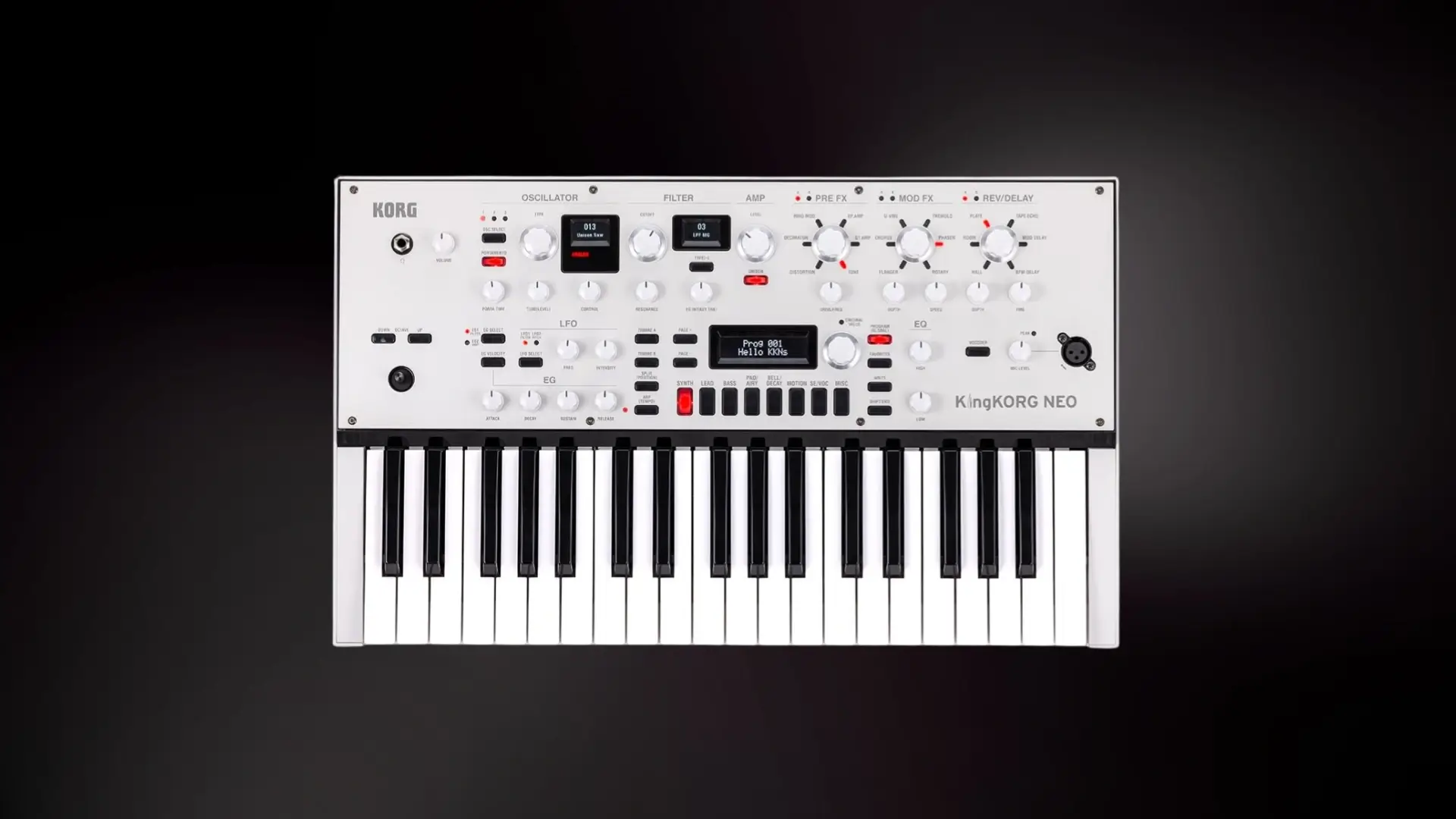
The Korg KingKORG NEO is a 24-voice, bi-timbral digital synthesizer announced in January 2024 and released in a compact 37-full-size-key format. It revives the XMT synthesis architecture introduced with the original 61-key KingKORG in 2013, combining virtual-analog oscillators, DWGS digital waveforms, PCM sources, modeled filters, a 16-band vocoder and three effect stages. Its importance lies less in technological novelty than in reassessment: Korg took an overlooked engine from the previous decade, removed some of the original hardware’s more conspicuous features, and repackaged its strongest musical ideas for a smaller, more performance-oriented instrument.
Table of Contents
Korg KingKORG NEO sound and character
The Korg KingKORG NEO does not have one narrowly defined tonal identity. Its natural center is polished, controlled and distinctly digital, but that description understates how widely its architecture can move. The conventional virtual-analog waveforms cover the expected basses, leads, brass, strings and pads, while DWGS and PCM sources introduce metallic attacks, bell-like spectra, sampled transients and textures that would be difficult to construct from sawtooth and pulse waves alone. Reviewers have consequently described it as a strong all-rounder rather than a synthesizer dominated by one unmistakable signature.
At its smoothest, it produces broad pads, clean polysynth chords and rounded leads with a studio-ready finish. This refinement can be an advantage in arrangements where unstable oscillators or heavily saturated filters occupy too much space, but it also means the Korg KingKORG NEO does not automatically generate the irregularity associated with vintage analog circuitry. Korg provides an Analog Tune parameter for introducing randomized pitch variation, although the underlying behavior remains deliberately controllable rather than inherently erratic.
The filter section provides much of the Korg KingKORG NEO’s personality. Korg includes 18 models divided among low-pass, high-pass, band-pass and combined responses. The parameter guide identifies families labeled King, MG, P5, OB, MS-20 and Acid, referencing several recognizable schools of subtractive synthesis without turning the Korg KingKORG NEO into a strict recreation of one historical machine. Some high-pass and band-pass variants are deliberately hypothetical adaptations of filter characters that were not necessarily available on the instruments that inspired them. That decision makes the Korg KingKORG NEO more interesting than a museum of digital imitations: it treats vintage filter behavior as material to be rearranged rather than merely copied.
The MS-20-derived model is particularly useful when the otherwise smooth engine needs abrasion. Korg’s documentation describes modeled noise, distortion and rough self-oscillation, allowing aggressive basses, resonant effects and unstable electronic percussion. The Acid family supplies another route toward sharper resonance, while onboard distortion, decimation, ring modulation and amplifier effects can push the sound beyond the restrained character of many factory patches.
Layering is central to the sound. Each program can contain two timbres arranged as a layer or keyboard split, with three oscillators available inside each timbre. A bright PCM attack can therefore be placed over a slower analog-style body, or a digital upper layer can be combined with a filtered bass foundation. These structures can sound substantially larger than the physical instrument suggests, although layered and unison programs also expose the practical limits of its 24-voice maximum polyphony.
The vocoder is not a decorative addition. Its 16 bands, formant shifting, formant hold and individual band-level and panning controls make it capable of conventional robot voices, sustained vocal textures and more abstract spectral processing. Timbre B, an oscillator or another internal source can act as the modulator, so the vocoder can also process relationships generated entirely inside the Korg KingKORG NEO. This gives the Korg KingKORG NEO a performance identity that goes beyond ordinary virtual analog, especially for electro, synth-pop, spacesynth and other styles in which the boundary between lead instrument and processed voice is deliberately blurred.
Features and architecture
- Manufacturer: Korg.
- Year introduced: 2024. Korg dated the announcement and initial documentation January 18, 2024, with retail availability reported for February.
- Production years: 2024 to the present. The model remained listed by Korg and available through major retailers in August 2026.
- Synthesis type: Korg XMT, or eXpanded Modeling Technology. The engine combines modeled analog-style waveforms, noise, DWGS waves, PCM material and a microphone-input oscillator source.
- Category: Compact digital performance synthesizer with virtual-analog synthesis, two-timbre operation and an integrated 16-band vocoder.
- Polyphony: Maximum 24 voices. Available voice count falls when unison modes stack two, three or four voices and can be consumed more rapidly by two-timbre layers.
- Original price: The initial United States price signal was approximately $999.99.
- Current new-market price: On August 1, 2026, observed United States listings ranged from approximately $630 to $799.99, depending on retailer and promotion.
- Oscillators: Three oscillators per timbre, with 138 oscillator types: 32 analog or noise types, 40 DWGS types, 65 PCM types and one microphone-input type.
- Filter: One filter per timbre, with 18 types comprising seven low-pass, five high-pass and six band-pass or combined models. Resonant self-oscillation is supported by applicable models.
- LFOs: Two LFOs per timbre.
- Envelopes: Two envelope generators per timbre, conventionally associated with filter and amplifier functions but also available as modulation sources.
- Modulation system: Six virtual-patch connections per timbre, allowing sources such as envelopes, LFOs and performance controls to be assigned to synthesis destinations.
- Sequencer and arpeggiator: No conventional note sequencer. The Korg KingKORG NEO includes an arpeggiator with six pattern types and up to eight editable steps.
- Effects: Three serial program-effect sections: Pre FX, Mod FX and Reverb/Delay, followed by two-band equalization. Each section offers six effect algorithms.
- Memory: 300 program locations, consisting of 200 factory presets and 100 user-programmable locations, plus 40 Favorite registrations.
- Keyboard: 37 full-size keys with velocity and release-velocity sensing. Aftertouch is not specified.
- Audio inputs and outputs: Balanced XLR microphone input, left/mono and right quarter-inch outputs, quarter-inch headphone output, damper-pedal connection and assignable switch or pedal connection. A gooseneck vocoder microphone and windscreen are included.
- MIDI and USB: Five-pin MIDI input and output plus USB-B for MIDI communication, librarian use and editor integration. Korg’s published specifications do not list USB audio.
- Displays: A 16-by-2-character OLED main display and a separate 128-by-64-pixel OLED display for oscillator and filter information.
- Dimensions and weight: 565 × 338 × 92 mm; 3.1 kg, or approximately 6.83 lb.
- Power: External 12-volt DC adapter; rated power consumption of 9 watts.
Strengths
- Unusually broad oscillator vocabulary: The combination of modeled analog waves, DWGS spectra and PCM material allows the instrument to move between traditional subtractive synthesis and recognizably digital textures without requiring separate sound engines.
- Filter variety with meaningful differences: The 18 models are not merely minor EQ variations. They provide different slopes, resonance behaviors and tonal responses, including rougher MS-20-inspired behavior and several hypothetical extensions of vintage filter families.
- Fast primary workflow: Oscillator selection, filter operation, effects and major performance functions are physically separated into clear panel blocks. Dedicated effect dials reduce the need to navigate menus for the operations most likely to be performed during rehearsal or onstage.
- Substantial vocoder architecture: Sixteen bands, formant controls, internal modulation sources and an included XLR microphone make the vocoder an integrated synthesis tool rather than an optional novelty.
- Useful two-timbre design: Layer and split modes make it possible to build composite sounds or assign contrasting sounds across the keyboard. The same structure also permits basic two-part multitimbral operation over MIDI.
- Performance-oriented memory system: Two hundred presets, 100 user locations and 40 Favorite registrations provide enough organization for set lists without forcing performers to search through the complete program bank between songs.
- Low physical burden: At 3.1 kg, the Korg KingKORG NEO delivers full-size keys, two timbres, effects and vocoding in a format that is significantly easier to transport than the original 61-key instrument.
- Improved computer support: Korg released a free Sound Librarian in April 2025, while Soundtower introduced editor and plug-in versions in May 2025. These tools make program management and deeper editing less dependent on the front-panel display.
Limitations
- The synthesis engine is fundamentally inherited: The Korg KingKORG NEO is not a generational redesign of the 2013 XMT platform. Buyers seeking wavetable import, granular synthesis, sample loading, polyphonic modulation systems or other newer digital techniques will not find them here.
- Thirty-seven keys restrict extended performance: The compact keyboard is practical for leads, basses and single-handed parts, but it gives split programs and two-handed polyphonic playing relatively little physical room.
- No aftertouch: Korg specifies velocity and release velocity, but not channel or polyphonic aftertouch. Expressive pressure control therefore requires an external controller or another modulation method.
- Twenty-four voices are conditional rather than abundant: Unison stacking reduces the available voice count, while layered programs can consume voices from both timbres. Dense sustained arrangements can therefore reach the ceiling earlier than the headline figure suggests.
- Only two timbres: The architecture supports layers, splits and basic two-part MIDI use, but it is not intended to function as a deeply multitimbral workstation or complete arrangement module.
- No conventional sequencer: The eight-step arpeggiator can produce rhythmic patterns, but it does not replace a multitrack or longer-form note sequencer.
- Reverb and delay occupy the same effect stage: Because the final slot offers either a reverb or delay algorithm, both cannot be run simultaneously within that stage. External processing may be needed for more elaborate spatial chains.
- Deeper editing still involves menu navigation: The primary controls are immediate, but detailed oscillator, modulation and arpeggiator parameters extend beyond the knob-per-function surface and rely on the relatively small display.
- Several original KingKORG hardware features disappeared: The Korg KingKORG NEO omits the original model’s 61-key keyboard, vacuum-tube output stage and CV/Gate output. The smaller format is more portable, but the redesign is not an across-the-board expansion.
- The launch price weakened its initial case: Reviews repeatedly identified the original price as difficult to justify for a reused digital architecture. Subsequent reductions have made the Korg KingKORG NEO more coherent as a value proposition, but that improvement came through market pricing rather than a change to the hardware.
Historical context
The original KingKORG appeared at the 2013 NAMM show as a 61-key virtual-analog synthesizer during a period when hardware analog synthesis was returning to the center of the market. Korg introduced it alongside the MS-20 Mini, a physically smaller reproduction of one of the company’s most historically important analog instruments. The contrast was unfavorable to the new digital machine: the MS-20 Mini embodied the era’s appetite for analog authenticity, while the KingKORG represented the more familiar language of late-1990s and 2000s virtual analog. Contemporary retrospectives have consequently characterized the original as capable but overshadowed.
That timing matters because the KingKORG was not technologically backward in 2013. Its three-oscillator, two-timbre architecture, multiple modeled filters, vocoder and direct controls were musically substantial. The problem was cultural positioning. At a moment when manufacturers and musicians were rediscovering voltage-controlled oscillators, modular formats and one-control-per-function analog instruments, another modeling synthesizer was less likely to be perceived as a statement of intent.
By 2024, the market had changed. Analog synthesizers were no longer scarce, and compact digital instruments had regained legitimacy through wavetable, wave-sequencing, FM and hybrid designs. Korg itself had developed a recognizable family of lightweight 37-key performance synthesizers. The Korg KingKORG NEO entered that environment not as a revolutionary new engine, but as a compact return of an architecture that had never received a definitive second generation.
The redesign reveals Korg’s priorities. The company retained the core XMT architecture, filters, vocoder, virtual patches and effects, but reduced the keyboard from 61 to 37 keys, removed the tube stage and CV/Gate connection, revised portions of the oscillator content and supplied a vocoder microphone. The result is less expansive as a studio centerpiece but more clearly defined as a portable performance synthesizer.