

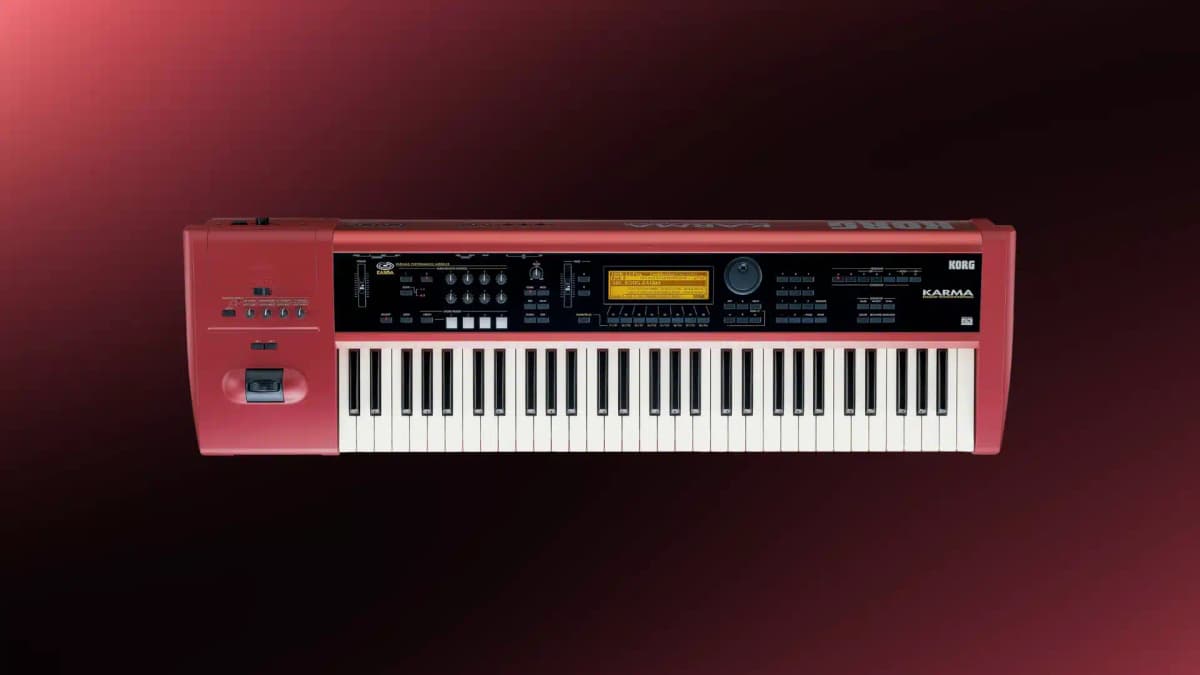
The Korg KARMA is a 61-key music workstation that Korg launched at the NAMM show in January 2001. Under the hood it is a streamlined Triton, with the same HI sample-based synthesis, 62-voice polyphony, effects, and 16-track sequencer, but its reason to exist is the Korg KARMA engine: Kay Algorithmic Realtime Music Architecture, a system developed by musician and programmer Stephen Kay that generates arpeggios, grooves, strums, glissandos, and evolving phrases from the notes a player holds. With 1,190 preset Generated Effects controlled by knobs and switches, it was the first instrument to put Kay’s technology in hardware, and that technology went on to appear in Korg’s OASYS, M3, and Kronos flagships.
Table of Contents
Korg KARMA sound and character
The KARMA’s raw sound is the Triton’s. Its 32MB of 48kHz waveform ROM holds 425 multisamples and 413 drum samples, and each program uses one or two oscillators, a resonant filter (24dB low-pass or 12dB low-pass and high-pass), five-stage pitch, filter, and amplitude envelopes, and two LFOs. Sound On Sound’s Simon Trask summarized it as having all the Triton’s synthesis power and quality, which means polished, mix-ready pianos, strings, pads, basses, and drums typical of early-2000s Korg workstations. Two EXB-PCM slots and the EXB-MOSS board could extend that palette with sample sets or the Z1’s modelling engine.
What sets it apart is what the instrument plays rather than how it sounds. A Generated Effect, or GE, reads the notes and chords on the keyboard and turns them into musical material: Real-Time GEs produce arpeggios, strums, and runs; Drum GEs generate grooves; Gated GEs rhythmically chop sustained sounds; Riff GEs create melodic figures. Each GE draws on more than 400 underlying parameters covering rhythm, harmony, phrase variation, velocity, duration, and controller data, of which up to 16 can be edited and up to 10 assigned to the panel at once.
In a Combination, up to four GEs can run at the same time, driving separate drum, bass, comping, and pad parts that respond to playing dynamics and chord changes. The results range from realistic guitar picking and harp glissandos to orchestral ostinatos, blues and jazz accompaniment, and dance-style gated patterns. Sonic State’s first report from NAMM 2001 found the factory material better suited to pop, film scoring, and electronic music than to anything especially edgy, and that remains a fair description: the Korg KARMA is a polished, generous-sounding workstation whose character comes from motion and interaction rather than from an unusual tone.
Features and architecture
- Manufacturer: Korg Inc., Japan, with KARMA technology licensed from Stephen Kay (Karma Lab LLC)
- Year introduced: 2001; shown at the NAMM show in January 2001 and reviewed by Sound On Sound in May 2001
- Production years: 2001 to the mid-2000s; an exact end date is not clearly documented, and the M3 of 2007 carried Korg KARMA forward
- Synthesis type: HI (Hyper Integrated) sample-based subtractive synthesis with the KARMA algorithmic phrase generator
- Category: music workstation with real-time algorithmic performance engine
- Polyphony: 62 voices (31 in double mode); 68 notes with the optional EXB-MOSS board
- Multitimbrality: 8 parts in Combination mode, 16 in Sequencer mode
- Original price: $2,250 list in the United States; in the UK it sold for roughly 80 percent of the price of a basic Triton
- Current market price: Reverb’s price guide suggests around $525, with listings commonly between about $620 and $1,000
- Oscillators: one or two per program drawing on 32MB of 48kHz PCM ROM (425 multisamples, 413 drum samples)
- Filter: resonant filter per oscillator, 24dB per octave low-pass or 12dB per octave low-pass and high-pass
- LFOs: 2 per oscillator
- Envelopes: five-stage pitch, filter, and amplitude envelopes
- Modulation system: alternate modulation sources from the joystick, two assignable switches, real-time knobs, aftertouch, velocity, and pedals; effect dynamic modulation
- Sequencer / arpeggiator: Korg KARMA engine with 1,190 preset Generated Effects in 16 categories and four types (Real-Time, Drum, Gated, Riff), one GE per Program and up to four per Combination; 16-track sequencer with master track, 192 ppqn, 200,000 events, 200 songs, cue lists, and RPPR pattern playback
- Controllers: eight KARMA Real-Time Control knobs, two KRTC switches, two Scene memories, four Chord Trigger buttons, GE tempo knob (40 to 240 bpm), KARMA on/off and latch, joystick
- Effects: five insert effects, two master effects, and a three-band master EQ, from 102 insert and 89 master effect types
- Memory: 640 user Programs (384 preloaded) plus 256 GM2-compatible ROM Programs; 768 user Combinations (384 preloaded); 64 user drum kits plus GM2 ROM kits
- Storage: 3.5-inch floppy disk drive
- Expansion: two EXB-PCM slots (16MB each, cards from EXB-PCM01 to EXB-PCM09) and an EXB-MOSS slot for the six-voice modelling board derived from the Z1
- Keyboard: 61 keys with velocity and channel aftertouch
- Inputs / outputs: main stereo outputs and two auxiliary outputs, headphones, damper, assignable footswitch and pedal inputs; no audio inputs or sampling
- MIDI / USB: MIDI In, Out, and Thru; no USB
- Display: 240 x 64 pixel backlit LCD (no touchscreen)
- Dimensions / weight: published specifications list 1,100 x 320 x 119 mm and 10 kg, about four kilos lighter than the Triton
- Power: internal power supply, about 20W
Strengths
- It makes complex accompaniment playable. Holding a chord can start a drum groove, a bass line, and guitar-style comping that follow the harmony, which made the Korg KARMA a practical tool for live performance, songwriting, and demos.
- The real-time controls are part of the instrument. Eight knobs, two switches, and two Scenes let players change density, rhythm, and phrasing during a performance instead of triggering fixed patterns.
- It delivers Triton sound quality for less money. Reviewers noted that it offered the Triton’s synthesis, effects, and sequencer at a lower price, minus features many players did not need.
- The expansion options are broad. EXB-PCM boards add pianos, vintage keyboards, orchestral and dance sounds, and the EXB-MOSS board brings in the Z1’s modelling engine.
- It is lighter and simpler than the Triton, at around 10 kg, which made it easier to gig with.
- OS 2.0, a free upgrade, added user GE memory, tap tempo, time signatures, and swing quantization, and the KARMA MW editor gave computer access to the full engine.
Limitations
- The Generated Effects are demanding to understand in depth. Sound On Sound flagged them as hard work, and user reviews describe a learning curve close to vertical.
- It lost several Triton features: the sampler, touchscreen, ribbon controller, two of the four outputs, and the host interface.
- Editing on a 240 x 64 LCD with menus is slower than on the Triton’s touchscreen, a point Gordon Reid criticized when he wrote that Korg’s keyboard interface had been going backwards since 1995.
- The KARMA control knobs could not be reset while playing, which reviewers found awkward in live use.
- Storage relies on a floppy disk drive, now an obstacle to loading sounds and backups without replacing the drive with an emulator.
- Its factory sounds and GEs reflect the pop, film, and accompaniment style of their time, and some players find the results too polished or too automatic.
- There is no audio input, so the Korg KARMA engine cannot process external sound in the way a sampler-equipped Triton could.
Historical context
Korg KARMA began as a musician’s problem. Stephen Kay, known within Korg for the demo sequences he produced for instruments such as the 01/W, wanted a realistic harp glissando and, after spending a day editing notes in a sequencer, began writing software to generate such gestures automatically. Over about seven years the project grew into a general system for algorithmic phrase generation. Gordon Reid’s history of Korg recounts that Kay came close to bankruptcy, patented his work, and that Korg’s founder Tsutomu Katoh took the risk of licensing it.
Korg’s involvement began around 1999, reportedly because the company wanted a keyboard that offered more than a cut-down Triton. The Triton engine provided sound, effects, and sequencing; Kay’s algorithms supplied the GEs; and Korg’s voicing team, led on the factory Programs and Combinations by Steve McNally, learned the system during a three-day session at Korg USA. The instrument was unveiled at NAMM in January 2001 at a US list price of $2,250 in a dark red case that Sonic State’s correspondent found less red than the photos suggested.
Reception was respectful rather than overwhelming. Sound On Sound called it very impressive and quite unique, while Reid later wrote that it had yet to achieve its full potential. An OS 2.0 update extended the instrument, and Korg kept the technology rather than the product: KARMA reappeared in a second-generation form inside the OASYS in 2005, the M3 in 2007, and the Kronos in 2011, while the standalone Korg KARMA keyboard faded from Korg’s range in the mid-2000s.