

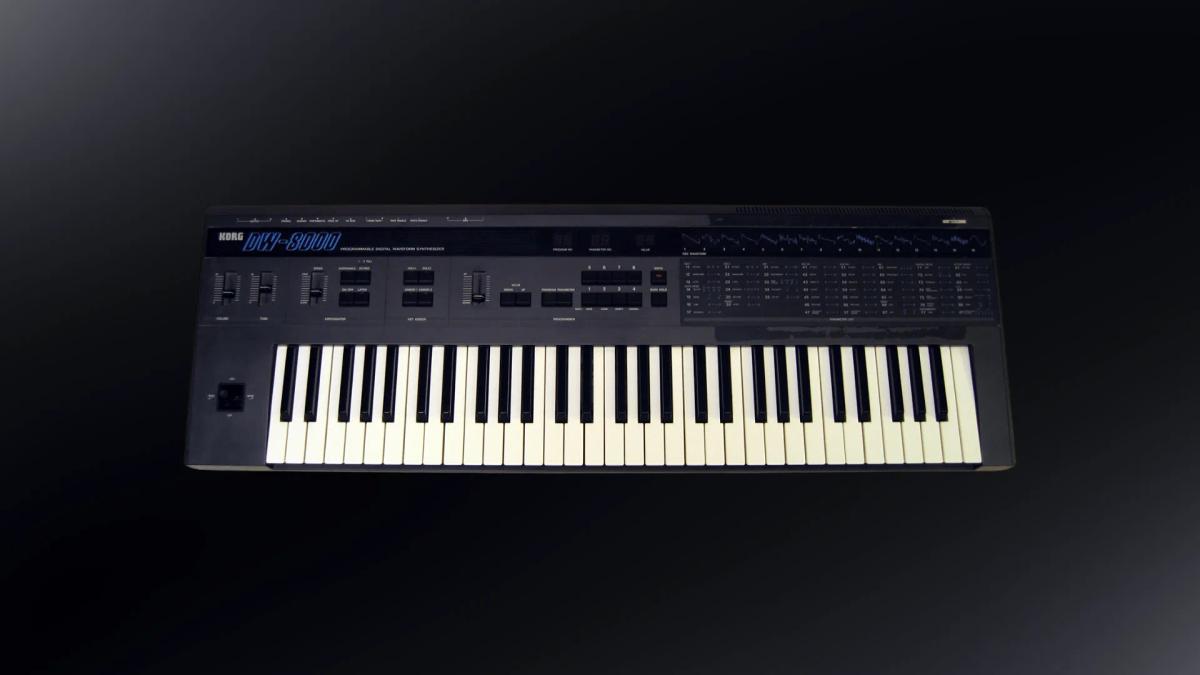
The Korg DW-8000 is an eight-voice hybrid polyphonic synthesizer introduced in 1985 and produced until around 1987. Each voice pairs two digital oscillators, drawing on 16 single-cycle waveforms from Korg’s Digital Waveform Generator System (DWGS), with an analog resonant low-pass filter and analog VCA, and the Korg DW-8000 adds velocity, aftertouch, an arpeggiator, and a built-in digital delay. Arriving in the shadow of Yamaha’s DX7 and shortly before Korg’s M1 changed the market again, it was Korg’s attempt to give players digital timbres without asking them to abandon the subtractive programming they already understood. That compromise is precisely why it is still discussed today.
Table of Contents
Sound and character
The Korg DW-8000 sounds like an analog polysynth that has been handed a more varied set of raw materials. Its oscillators do not generate classic analog shapes in the conventional sense. Instead they play back short 8-bit single-cycle waveforms, stored in four 256-kbit ROM chips and originally derived from additive synthesis, with a different sample used for each octave. Alongside sawtooth and square, the waveform set includes tones labelled piano, electric piano, clavinet, organ, brass, sax, violin, guitar, bass and bell. These are harmonic templates rather than true instrument samples, giving the filter something richer or stranger to work on.
That is the key to its character. Contemporary reviewers heard it as fundamentally analog in behavior, with digital colour layered on top. Simon Trask, writing in Electronics & Music Maker in 1985, described the DWGS as “basically traditional analogue with some added advantages”, and praised its electric pianos and strings. Paul Colbert in One Two Testing heard softer, richer wind and brass tones than on the DW-6000, along with strong spiky piano and bell sounds. Later retrospectives describe the tone as warm and musical, with some aliasing in the upper register that owners tend to count as part of its charm rather than a flaw.
The analog 24 dB per octave low-pass filter, built around the Korg NJM2069 chip also found in the Poly-800, is what keeps those waveforms from sounding brittle. It is fully resonant, and Sound On Sound’s 1998 retrospective called it Moog-like.
Pads come out warm and full, basses have punch, and the bright, slightly nasal digital waves can be pushed into lead territory: Paul Ward memorably described one of his Korg DW-8000 patches as “oboe on acid”, a sound he said he had not reproduced on other synths. The onboard delay adds chorus, flanging and doubling, which helps the instrument sound wider and more finished than its single filter per voice might suggest.
The overall impression is restrained rather than wild. Its strengths lie in clean, characterful bread-and-butter sounds with a slightly glassy, mid-1980s digital edge.
Features and architecture
- Manufacturer: Korg
- Year introduced: 1985
- Production years: commonly listed as 1985 to 1987
- Synthesis type: hybrid subtractive, with digital single-cycle waveform oscillators feeding analog filter and amplifier stages
- Category: keyboard polysynth
- Polyphony: 8 voices, single timbre; key assign modes Poly 1, Poly 2, Unison 1 and Unison 2
- Original price: £1,075 including VAT in the UK at launch, according to two 1985 reviews; commonly cited at $1,295 MSRP in the United States
- Current market signal: Reverb’s price guide places a typical used example in the mid hundreds of dollars
- Oscillators: 2 digital oscillators per voice, each selecting one of 16 DWGS waveforms; 16′, 8′ and 4′ octave settings, interval and detune for oscillator 2, plus an analog noise generator
- Filter: analog resonant 24 dB per octave low-pass with keyboard tracking, envelope polarity, velocity and aftertouch control
- LFOs: 1 LFO (Korg’s “MG”) with four waveforms and a delay control, routable to oscillator pitch and filter cutoff
- Envelopes: 2 six-stage ADBSSR envelopes (attack, decay, break point, slope, sustain, release) for filter and amplifier, plus a programmable Auto Bend pitch effect
- Modulation system: joystick for pitch bend and modulation, velocity to filter and/or amplitude, channel aftertouch to modulation, filter and volume, and a single data slider for parameter edits
- Sequencer / arpeggiator: arpeggiator with up, down and assign modes, one-octave, two-octave or full-range settings, latch, and sync to MIDI clock; no sequencer
- Effects: built-in digital delay, 2 to 512 ms, with time, feedback, level and modulation parameters stored per patch, covering chorus, flanging and echo
- Memory: 64 patches; storage via cassette or MIDI SysEx; the optional MEX8000 expander adds four banks of 64
- Keyboard: 61 keys with velocity and channel aftertouch
- Inputs / outputs: stereo outputs (the delay is the only stereo element), headphone output, pedal inputs for program up, portamento and damper, cassette interface
- MIDI / USB: MIDI In, Out and Thru; no USB
- Display: three 2-digit LED displays
- Dimensions / weight: 998 × 338 × 101 mm, about 10.9 kg
- Power: internal supply, 31 W, with a two-pin mains socket
Strengths
- It offered a broader tonal palette than conventional analog polysynths of its era. Sixteen waveforms per oscillator, with two oscillators per voice, gave the filter organ, piano, bell and reed-like starting points that analog VCOs could not easily provide.
- The analog filter and VCA keep the sound warm and familiar. Players could program it with subtractive instincts rather than learning a new synthesis method, which contrasted sharply with the steep curve of FM.
- Touch response was a genuine step up. Velocity could shape both brightness and level in several steps, and E&MM’s reviewer considered the keyboard one of the best Korg had fitted to a synth in some time.
- The built-in, per-patch digital delay made many presets sound finished straight out of the box, and the arpeggiator combined with it in ways reviewers found especially enjoyable.
- Its factory sounds were usable by demanding professionals. Keith Emerson told International Musician in 1986 that he was impressed with the presets and used some with very little alteration.
Limitations
- Editing is menu-driven through a numeric keypad, slider and up/down buttons. Retrospectives repeatedly cite the lack of hands-on control as its main downside.
- Aftertouch has only four levels, so pressure changes arrive in audible steps rather than smooth gradations, a criticism raised by more than one launch review.
- The modulation system is shallow: one LFO, no oscillator sync or cross-modulation, no LFO sync to tempo, and filter sweeps that can step audibly.
- The delay is the only stereo element, and Sound On Sound noted that the outputs carry opposite-phase signals, which can cause cancellation if summed to mono.
- Several practical irritations surfaced in reviews: the fine-tune slider is not programmable and easy to knock, patches have no names, MIDI resets to Omni mode at power-up, and there is no unison detune.
- Age-related wear is common. Keyboards can mis-trigger after long periods of inactivity, and owners report replacing tactile switches.
Historical context
The Korg DW-8000 belongs to a short but revealing chapter in Korg’s history. By 1985 the Yamaha DX7 had pushed the industry toward digital synthesis, and analog manufacturers needed answers. Korg’s first response was the DW-6000, a six-voice hybrid with eight digital waveforms and an analog chorus. The Korg DW-8000 followed shortly after and expanded the idea in every direction: eight voices, sixteen waveforms, velocity and aftertouch, an arpeggiator, a third key assign mode, more LFO shapes, Auto Bend, and a digital delay in place of the chorus. Trask summed up the relationship bluntly in E&MM: “The DW8000 is the Korg DW-8000 the 6000 should have been.”
E&MM weighed it against Roland’s JX8P and Yamaha’s DX7, concluding that it could hold its own while admitting that DWGS was “never going to make the same size splash as Yamaha’s FM did.” International Musician called it “the most impressive all-rounder for some time.” The Korg DW-8000 was, in effect, a market correction: a way to deliver some of the new digital timbres while keeping the analog workflow that many keyboard players still trusted.