

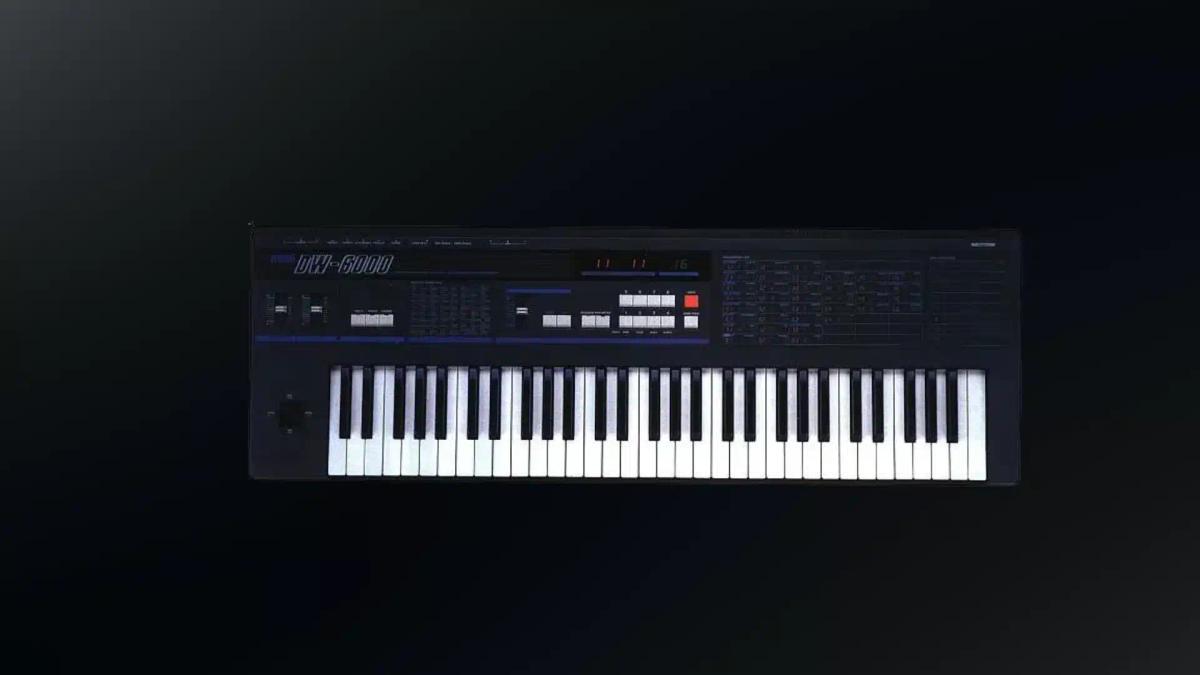
The Korg DW-6000 is a six-voice polyphonic synthesizer that Korg released in early 1985, and it was the first instrument to carry the company’s Digital Waveform Generator System, or DWGS. Each voice pairs two digital oscillators, reading from eight waveforms built by additive synthesis and stored in ROM, with an analog resonant low-pass filter and analog VCA shaped by six-stage envelopes. It had 61 unweighted keys, 64 memories, MIDI, a stereo chorus and a single-slider editing panel inherited from the Poly-61. It matters as a bridge: a practical, affordable answer to the question of how to mix digital timbres with analog filtering after the DX7, and the direct ancestor of the better-known DW-8000.
Table of Contents
Korg DW-6000 sound and character
The Korg DW-6000 sounds like a Korg analog poly that has been handed a richer box of raw material. Instead of the sawtooth and square of the Poly-800, the oscillators read single-cycle waveforms whose harmonic spectra are printed on the front panel, some modeled on instruments such as acoustic piano, electric piano, violin and brass. Because those spectra already carry overtone structure, a patch can sound bright and complex before the filter does anything, and then the filter can be used to tame or sweep that brightness in the familiar subtractive way.
Reviewers in 1985 heard two distinct personalities. Electronics & Music Maker’s Dan Goldstein found it strongest on tuned percussion, digital-sounding timbres, key-click organs and solo basses, and weaker on raunchy brass and on dramatic filter sweeps. One Two Testing’s Paul Colbert made the opposite half of the point: it could produce glassy digital voices an analog synth could not, and also warm strings, brass and basses that an FM synth of the time struggled with. Electronic Soundmaker described the filter as recognizably Korg, less smooth than a Roland and less hard than an Oberheim.
The digital side is not pristine. Gearnews notes that the DWGS waveforms were sampled at low resolution and that aliasing is audible, especially in the upper register; Reverb’s product page also mentions aliasing and distortion. For many current owners this grit is part of the appeal. Vintage Synth Explorer’s write-up praises fat basses, pulsing strings, nasal leads and swirling chorused textures, while noting that some waveforms do not sit easily in a mix as pads and that the sound does not respond well to heavy distortion.
The six-stage envelopes add character that a plain ADSR cannot. A Break Point and Slope stage sit between decay and sustain, so a sound can dip and then swell back to its sustain level, which suits the digital waveforms. Unison mode stacks all twelve oscillators on one note with automatic detuning, turning the Korg DW-6000 into a heavy monosynth. Overall it leans mid-1980s hybrid: brighter and more metallic than a Polysix, warmer and more filterable than a DX7, and less refined than its successor.
Features and architecture
- Manufacturer: Korg (Keio Electronic Laboratories), distributed by Unicord in the United States and Rose-Morris in the United Kingdom
- Year introduced: 1985; UK magazines reviewed it in their March and April 1985 issues
- Production years: 1985 to about 1986; it was replaced quickly by the DW-8000, and an exact end date and production total are not documented
- Synthesis type: hybrid subtractive, with digital waveform oscillators feeding analog filters and amplifiers
- Category: programmable polyphonic keyboard synthesizer
- Polyphony: 6 voices, single timbre
- Voice modes: Poly 1, Poly 2 (suited to polyphonic portamento) and Unison, which stacks all six voices with automatic detune
- Original price: $1,195 MSRP in the United States according to SoundProgramming; UK reviews give £1,099, while Wikipedia cites about £1,200 at launch, quickly cut to £999
- Current market price: Reverb’s price guide suggests around $294, with current listings mostly between about $300 and $450
- Oscillators: 2 DWGS oscillators per voice (12 in total), each selecting one of 8 additive-synthesis waveforms stored in two 256Kbit ROM chips, with octave and level controls; oscillator 2 adds interval and detune; separate noise generator
- Filter: analog 4-pole resonant low-pass VCF per voice with cutoff, resonance, keyboard tracking, envelope intensity and switchable envelope polarity
- LFOs: 1 modulation generator (MG) with triangle wave, frequency and delay, routable to pitch and filter
- Envelopes: 2 six-stage ADBSSR envelopes (attack, decay, break point, slope, sustain, release), one for the VCF and one for the VCA
- Modulation system: joystick for pitch bend and modulation, envelope polarity, LFO routing to oscillators and filter, programmable portamento; no pulse-width modulation or oscillator sync
- Sequencer / arpeggiator: none
- Effects: programmable stereo chorus
- Memory: 64 programs with battery backup; storage by cassette dump or MIDI System Exclusive; no RAM cartridge slot
- Keyboard: 61 keys (five octaves, C to C), no velocity or aftertouch
- Controllers: joystick; footswitch jacks for damper, portamento and program advance
- Inputs / outputs: stereo outputs with a low/high level switch, headphone jack, cassette in and out, memory protect switch
- MIDI / USB: MIDI In, Out and Thru; receives on any of 16 channels and transmits on channel 1; no USB
- Display: LED numeric display for program number, parameter number and value; editing through numbered parameters, a data slider and up/down buttons
- Dimensions / weight: 998 x 338 x 101 mm and 9.3 kg, according to SoundProgramming
- Power: internal supply, rated at 34 watts
Strengths
- It offers a genuinely different oscillator palette for its time. The additive-derived waveforms give bell, piano, organ and digital tones that analog polysynths of 1985 could not produce, while still running through a resonant analog filter.
- The hybrid architecture is easy to program. Because the digital waveforms are treated exactly like analog ones, anyone who understands subtractive synthesis can make useful sounds without learning FM.
- The six-stage envelopes are more expressive than a standard ADSR. Break Point and Slope allow dips, swells and two-part decays that work especially well with percussive digital waveforms.
- Unison mode is a strong bass and lead tool. Stacking twelve detuned oscillators on one note gives a thick, aggressive monophonic sound that owners still single out.
- The built-in stereo chorus and stereo outputs make it sound wider than many budget polysynths of the period without outboard effects.
- Today it is one of the cheapest routes to an analog-filtered vintage polysynth. Reverb’s price guide places it well below its DW-8000 successor.
Limitations
- The keyboard has neither velocity nor aftertouch, and period reviewers found it spongy and lightweight; Electronic Soundmaker pointed out that factory patches labelled as touch-sensitive were not.
- Editing through numbered parameters and a single slider is slow compared with a knob-per-function panel, and it hides the sound’s structure from the player.
- Six voices and only eight waveforms are modest limits, and the DW-8000 doubled the waveform count and added two voices within the same year.
- Modulation is basic: one LFO with a single waveform, no pulse-width modulation and no oscillator sync.
- Memory expansion is limited to cassette dumps or SysEx; there is no RAM cartridge slot for carrying extra banks to a gig.
- Aliasing and digital grit in the upper register can be an asset, but they limit how clean and polished the bright patches can sound.
- Age-related faults are common on the used market, including failed backup batteries, power supply problems and fragile replacement keys.
Historical context
The Korg DW-6000 arrived at a difficult moment for Korg. Gearnews describes the company as having had success with the Polysix in 1981 and the low-cost Poly-800 in 1983, but as struggling financially once Yamaha’s DX7 forced every competitor to look for its own digital story. Hybrid instruments that combined digital oscillators with analog filters already existed, most prominently Wolfgang Palm’s PPG Wave, but they were expensive. Korg’s goal, in the words of its own US advertising, was to combine the virtues of digital sound and analog filtering in a practical and cost-effective format.
Korg’s manual frames DWGS as a way to add the harmonic richness of acoustic instruments to the familiar control of an analog synthesizer: instrument sounds were analyzed and recreated with additive synthesis, then stored as compact waveforms in ROM. The front panel borrowed the layout of the Poly-61 and Poly-800, with numbered parameters printed on a chart. British magazines reviewed it in spring 1985, generally liking the sound but questioning the price, since Colbert noted that a DX7 could often be found for little more. Unicord offered US readers a demo record and brochure by mail, and also promoted voice-editing software for computer-based editing.