

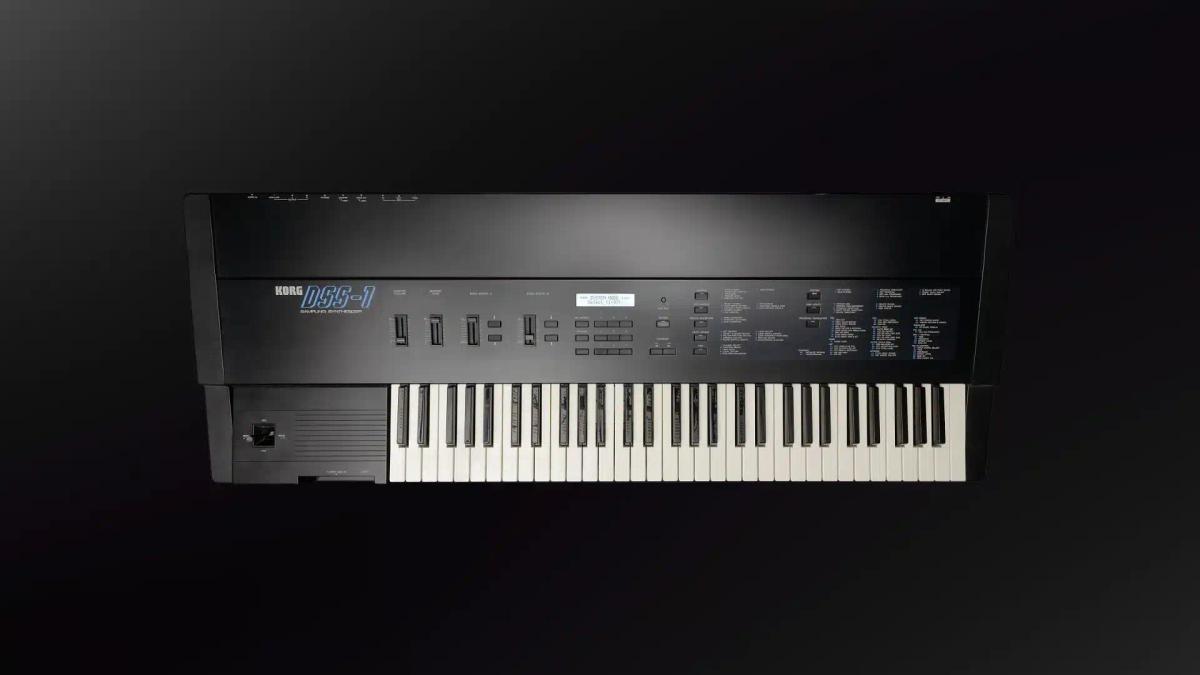
The Korg DSS-1 is an eight-voice sampling synthesizer that Korg introduced in 1986, generally described as the company’s first sampler. It recorded 12-bit samples at rates up to 48kHz into 256K of memory, but it was conceived as a synthesizer that happened to sample: each voice has two digital oscillators that can play samples, hand-drawn single-cycle waves or additive waveforms built from up to 128 harmonics, followed by a resonant analog low-pass filter, six-stage envelopes, two digital delays and EQ. Its 61-key keyboard offered velocity and aftertouch, and sounds loaded from 3.5-inch disks. It matters because it treated sampling as raw material for synthesis, an approach that pointed toward Korg’s later workstations.
Table of Contents
Korg DSS-1 sound and character
The Korg DSS-1 is remembered less as a sampler than as a synthesizer with unusual oscillators. Sound On Sound’s Paul Nagle, revisiting it in 1997, judged it mainly on its synth section and called its low-pass filter one of the best Korg had ever put in a synthesizer, capable of resonant sweeps that compete with all but the mightiest analog instruments. Polynominal reports that the filter is built around NJM2069 chips, the same part found in the Poly-800, and it can be switched between 12dB and 24dB per octave.
The 12-bit sampling itself has a grainy, slightly lo-fi quality by modern standards, and the instrument even lets each patch reduce its playback resolution from 12 bits down to 6, a feature that reads now like a built-in bit crusher. Paul Wiffen, reviewing it for Electronics & Music Maker in 1986, found the factory piano samples uneven while praising the synth sounds, a pattern that matches later opinion.
Where the Korg DSS-1 stands apart is in its non-sampled sources. Additive synthesis with 128 sine harmonics and wave drawing with fine slider control let users build glassy organs, metallic tones, clavinet-like waves and evolving pads, all looped as single cycles and then filtered. With two oscillators per voice, oscillator sync, unison stacking and twin delays that can run in series or as a stereo pair, it produces warm pads, deep basses and drones, the sounds Vintage Synth Explorer highlights.
Its weaknesses follow from its design. It is monotimbral, so split or layered multisamples share one set of synth parameters, and it cannot behave like a multi-output studio sampler. It sits between categories: a mid-1980s digital-analog hybrid, warmer and rougher than the cleaner samplers that followed it.
Features and architecture
- Manufacturer: Korg
- Year introduced: 1986; UK reviews appeared from August 1986
- Production years: 1986 to about 1988; Korg’s rack version, the DSM-1, followed in 1987, and an exact end date and production total for the keyboard are not documented
- Synthesis type: 12-bit sampling, additive synthesis and hand-drawn waveforms, processed by analog subtractive filtering
- Category: sampling synthesizer keyboard
- Polyphony: 8 voices with 2 oscillators each (16 oscillators in total)
- Multitimbrality: none; multisamples can be split or layered across the keyboard but share one set of synth parameters
- Sampling: 12-bit at 16, 24, 32 and 48kHz (some sources list 36kHz), about 16 seconds at 16kHz and 5.5 seconds at 48kHz; mono audio input
- Sample memory: 256K; Wikipedia gives a range up to 2MB, and Sound On Sound mentions a later upgrade with 2MB, SCSI and a faster drive that Korg UK said was not available there
- Sample editing: truncate, reverse, link, mix, crossfade and back-and-forth looping, auto loop search, keyboard zone assignment of up to 16 samples per multisound (up to 30 using both oscillators)
- Original price: £2,259 including VAT in the United Kingdom; a US list price is not consistently documented
- Current market price: Equipboard shows a Reverb listing at about $444, while SoundProgramming’s sample of current asking prices runs from about $444 to $1,744
- Oscillators: 2 digital oscillators per voice playing samples, eight preset waveforms, additive waves of up to 128 harmonics or hand-drawn single-cycle waves; octave, detune, interval and sync; white noise
- Filter: analog resonant low-pass VCF switchable between 12dB and 24dB per octave, with keyboard tracking and bipolar envelope amount
- LFOs: 2 delayed modulation generators, routable to pitch, filter cutoff and delay modulation
- Envelopes: 2 six-stage envelopes (attack, decay, break point, slope, sustain, release) for filter and amplifier, plus auto-bend
- Modulation system: velocity to filter, envelope times, auto-bend and velocity switching between oscillators; aftertouch to LFO, cutoff or level; four-way joystick for pitch bend, vibrato and filter
- Sequencer / arpeggiator: none
- Effects: two digital delay lines of up to 500 ms, in series or parallel, plus programmable bass and treble EQ
- Memory: 32 programs and 16 multisounds in RAM; each disk holds four Systems, giving up to 128 programs per disk
- Storage: built-in 3.5-inch double-sided double-density floppy drive; the operating system sits in ROM, but sounds must be loaded from disk
- Keyboard: 61 keys with velocity and aftertouch
- Inputs / outputs: stereo outputs, mono sampling input, headphones, damper and program-up footswitch inputs
- MIDI / USB: MIDI In, Out and Thru; no USB
- Display: 2 x 20 character backlit LCD, with four sliders and dedicated buttons
- Dimensions / weight: 1171 x 436 x 123 mm, 18.5 kg
- Power: internal power supply; Polynominal lists an Intel 8085 processor at the heart of the control system
Strengths
- Its synthesis options go well beyond a typical sampler of its day. Sampling, additive harmonics and wave drawing all feed the same two-oscillator voice, so one instrument covers realistic sounds and invented timbres.
- The analog filter is excellent. Reviewers from 1986 onward singled out its resonant sweeps, and its 12dB and 24dB modes give it real range.
- The keyboard is expressive and well built. It has velocity and aftertouch, and even the critical Making Music review said the keyboard could not be faulted.
- Onboard delays and EQ make it self-contained. Two delay lines usable for chorus, slapback or stereo echo add width without outboard gear.
- The System concept gave quick access to many sounds. Korg’s advertising stressed that 128 programs could be reached without changing a disk, unusual for samplers of the time.
- Today it is an inexpensive way into a vintage hybrid with a strong filter, with current asking prices often below those of better-known samplers.
Limitations
- Disk loading is slow. Electronics & Music Maker timed over 50 seconds to load a System, and later reviewers repeated the complaint.
- The 256K memory is small, and the expansions described in some sources were not widely available.
- It is monotimbral, with a single main stereo output, which limits it as a MIDI studio sampler.
- The interface is demanding. Making Music’s Paul Colbert warned of a lot of night school, and International Musician’s Paul Fishman found it harder to learn than it should be.
- Modulation is basic in places: the LFOs are simple, and there is no sequencer or arpeggiator.
- At 18.5 kg it is heavy and bulky, and Sound On Sound disliked its loose joystick.
- Original double-density floppy drives are now a weak point, and many owners replace them with floppy emulators.
Historical context
By the mid-1980s sampling had moved from the Fairlight and E-mu’s Emulator toward more affordable instruments such as the Ensoniq Mirage, and Korg needed an answer alongside its DW-series hybrids. Gearnews describes Korg in this period as struggling financially and trying several digital directions at once, including FM instruments and the Korg DSS-1 and DSM-1 samplers. Paul Wiffen wrote that Korg conceived the Korg DSS-1 as an extension of its synthesizer tradition, which explains why its voice architecture borrows much of the DW-8000’s synth section and the six-stage envelope from the Poly-800.
The Korg DSS-1 launched in 1986 at £2,259 in the UK. Reviews were split between enthusiasm for its sound and frustration with its operating system. Wiffen called it one of the most inspiring all-round instruments to appear in quite a while, Fishman wrote that Korg seemed to have studied the Emulator II’s methods without matching its friendliness, and Sound On Sound’s Mark Jenkins concluded in 1987 that it was a true professional’s instrument that takes time to grow to love. Korg’s US advertising presented it as a fusion of sampling and synthesis, with an endorsement from Steve Winwood.