

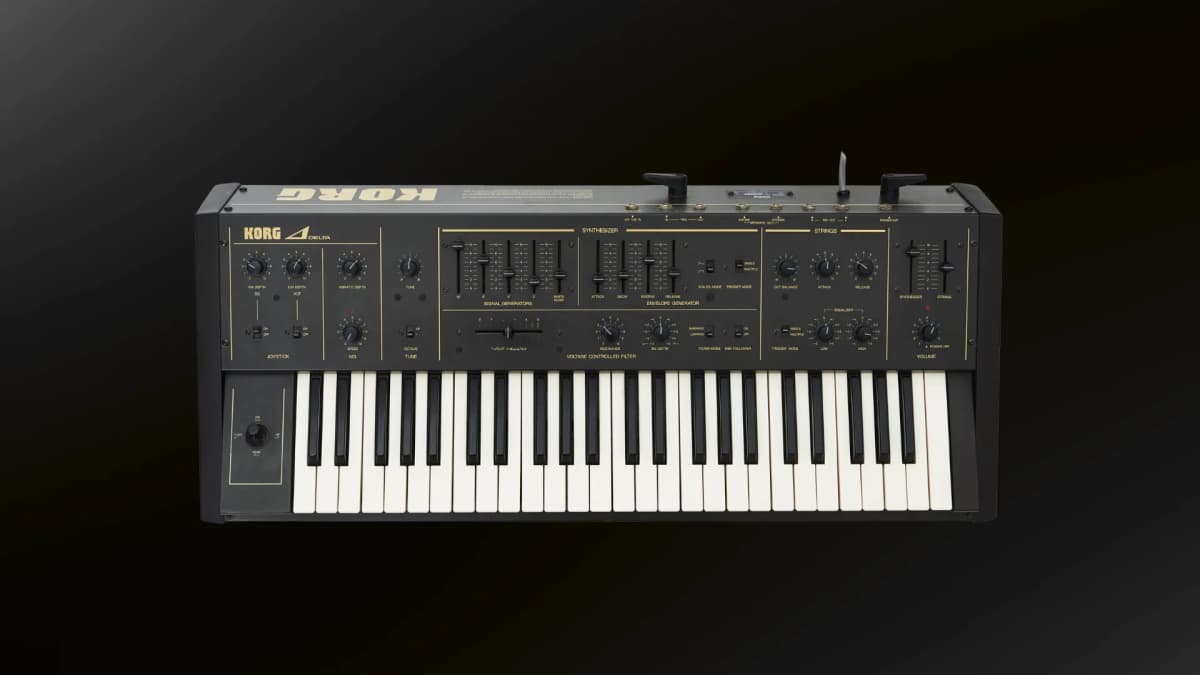
The Korg Delta, model DL-50, is a 49-key analog string synthesizer that Korg introduced in 1979 (some listings give 1980). Like most string machines of its era, it uses divide-down technology: 12 master oscillators generate the top octave and divider circuits derive every other note, so all 49 keys can sound at once. What sets it apart is that it splits that sound into two independent sections, a Strings section with its own envelope and tone controls, and a Synthesizer section with footage sliders, white noise, a 24dB/octave filter and an ADSR envelope, each with its own output. It matters as a cheap, sturdy way to get polyphonic strings and filtered paraphonic pads from the same keyboard.
Table of Contents
Korg Delta sound and character
The Korg Delta’s two sections give it two quite different voices. The Strings section is simple: a balance control between 16′ and 8′ registers, an attack and release envelope and a two-band bass and treble EQ, with no filter at all. The result is a bright, slightly reedy string tone in the mold of late-1970s string machines. Bonedo’s review found the strings lovely, especially with a long release or external reverb, while noting that the midrange can become prominent in some registers.
The Synthesizer section is where the Korg Delta earns its name. Four sliders mix 16′, 8′, 4′ and 2′ footages in a way Bonedo compares to organ registers, and Gearnews suggests a starting setting of 10, 7, 5 and 2 for sweet results. That signal, with optional white noise, goes through a 24dB/octave filter with resonance, a bipolar envelope amount, keyboard tracking and a low-pass or band-pass mode, then through an ADSR envelope. Because every note shares that one filter and envelope, the section is paraphonic: chords sweep as a block rather than voice by voice, which suits slow pads, swells and auto-wah effects.
Played on its own, the synth section can also produce solid basses and clavinet-like grooves, and users have reported convincing acid-style bass and sci-fi noise sweeps. Its limits are just as clear. Bonedo points out that the divide-down design makes expressive, wobbly solo leads difficult, that the overall tone leans mid-heavy, and that modulation is limited to one global sine LFO and a joystick.
The sweet spot is layering. Sending strings and synth to separate outputs, or blending them on the mix output, gives a thick ensemble with filtered movement on top of a steady string bed. None of the sources describing the panel mention a built-in chorus or ensemble effect, and owners routinely recommend a phaser, flanger, delay or tape echo to widen the sound, which is how it comes closest to the lush string-machine records of its time.
Features and architecture
- Manufacturer: Korg (Keio Electronic Laboratories), Tokyo
- Year introduced: 1979, according to Gearnews, KVR and Reverb; some listings give 1980
- Production years: 1979 to around 1983 or 1984; Reverb gives 1983 as the end date, while Vintage Synth Explorer and Bonedo give 1984
- Synthesis type: analog divide-down (top-octave) synthesis with a shared filter and envelope
- Category: string synthesizer with a paraphonic synthesizer section
- Polyphony: full 49-note polyphony; paraphonic, as all notes in each section share one envelope (and, in the synth section, one filter)
- Original price: not consistently documented in the sources consulted
- Current market price: Reverb’s price recommendation is around $980; dealer listings have ranged from about $1,000 in the US to AUD 1,250 in Australia
- Oscillators: 12 master oscillators with octave dividers; synth section with 16′, 8′, 4′ and 2′ footage sliders plus white noise; strings section with 16′ and 8′ balance
- Filter: synth section only; 24dB/octave VCF with cutoff on a horizontal slider, resonance, bipolar envelope amount, keyboard tracking and a low-pass or band-pass switch (Vintage Synth Explorer also lists high-pass); strings section uses bass and treble EQ instead
- LFOs: one global sine LFO with speed and depth, used for vibrato and, via the joystick, for filter modulation
- Envelopes: ADSR for the synth section, shared by filter and amplifier; attack and release for the strings section; single or multiple trigger modes
- Modulation system: joystick for pitch bend and LFO or noise modulation of the filter; the joystick does not spring back to center
- Sequencer / arpeggiator: none
- Effects: none built in
- Memory: no patch memory
- Keyboard: 49 keys, no velocity or aftertouch
- Inputs / outputs: separate synth and strings outputs, mix output with high and low level, headphone output, trigger in and out, and a filter CV input for external sequencing
- MIDI / USB: none, and no official MIDI retrofit exists
- Display: none
- Dimensions / weight: solid, heavy construction on a wooden base; published dimensions and weight figures are not consistently documented
- Power: fixed power cable; units were built for specific mains voltages, so imported examples may need a step-down transformer
Strengths
- Two independent sections make it more versatile than a basic string machine. Strings and synth can be played alone, blended or sent to separate outputs for processing.
- The 24dB/octave filter is musical and well behaved. Reviewers describe it as neither too aggressive nor too soft, which helps the Korg Delta sit easily in a mix.
- Full 49-note polyphony means big chords and sustained pads never steal voices, a natural advantage of the divide-down design.
- The trigger and filter CV inputs let it respond to external sequencers and gates, opening rhythmic filter effects beyond what its panel suggests.
- It is solidly built for the road, with a heavy wooden base and a simple, readable panel.
- It remains one of the more affordable vintage string synths, typically priced below the better-known ARP and Roland string machines.
Limitations
- Paraphony limits articulation. With one envelope per section, notes cannot be shaped independently, so arpeggios and overlapping phrases tend to blur or retrigger together.
- The strings section has no filter, only basic EQ and an attack and release envelope, so its range of tones is narrow.
- There is no built-in ensemble or chorus effect, which many string machines offered, so external effects are almost essential for a lush sound.
- Modulation is basic: one global sine LFO and a joystick, with no delay, no envelope routing to pitch and no memory.
- The divide-down design makes expressive monophonic leads, glide and detuned effects largely impossible.
- There is no MIDI and no official retrofit, so integration with a modern setup relies on CV and trigger conversion or playing it by hand.
- Age-related faults are common, including a filter problem that can silence the synth section until capacitors are replaced, noisy sliders and snapped joystick tops.
Historical context
Divide-down technology has its roots in the transistor organs of the 1960s, and Gearnews traces the top-octave approach used in the Korg Delta back to instruments from Farfisa and Vox. By the late 1970s that technology underpinned a crowded market for string synthesizers, with Bonedo naming the ARP Solina and machines from Moog, Crumar and Siel among the Korg Delta’s competitors. Korg already had experience with fully polyphonic designs through its PS series and its Polyphonic Ensemble instruments, and in 1979 it also introduced the Lambda ES-50, a preset-based divide-down ensemble keyboard.
The Korg Delta took a more synthesizer-like route than the Lambda. It joined a strings section to a synth section with real filter and envelope controls, using knobs similar to those of the MS-20, and Korg’s advertising leaned into the idea with the headline “It’s a STRING synth !!!”. It is often described as a slimmed-down version of the Korg Trident, the more expensive programmable polysynth with synth, brass and strings sections, although the Trident arrived a little later, around 1980 to 1981 depending on the source.