

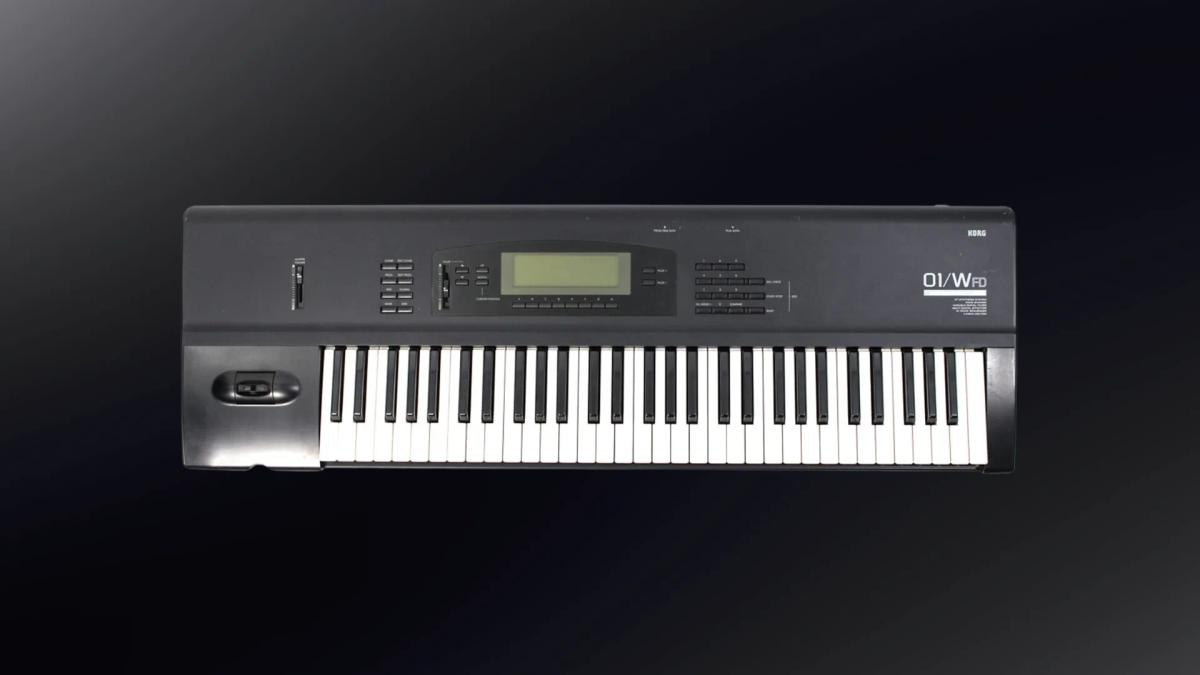
The Korg 01/W is a sample-based digital workstation that Korg introduced in 1991 as the successor to the M1 and T series. Built on what Korg called AI² synthesis, it doubled the M1’s polyphony to 32 voices, expanded the PCM ROM to 6MB, added a 16-track sequencer with 96ppqn resolution, two effects processors with 47 effect types, and a feature its predecessors lacked entirely: a waveshaper on every oscillator. The family included the floppy-equipped 01/W FD, the 76-key 01/W Pro, the 88-key weighted 01/W ProX, and rack versions. It matters as the most fully featured link between the M1 that defined the workstation and the Trinity that rebooted Korg’s flagship line in 1995.
Table of Contents
Korg 01/W sound and character
The Korg 01/W sounds like an M1 with more depth and more body. The ROM holds about 255 multisamples and 119 drum sounds, recorded at a relatively low rate of around 31 to 32kHz, and Wikipedia’s summary notes that owners often describe the samples as warmer and better than those in Korg’s later, cheaper AI² instruments. Sound On Sound’s David Mellor found the raw multisamples harsh and trebly on their own, but rich and impressive once the synthesis section had shaped them, and he singled out the effects as some of the best-sounding he had heard.
Waveshaping is what gives the instrument its own voice. Each oscillator can pass its sample through one of about 60 fixed transfer tables, with names such as Rezzy, Parabola and Comb, with its own envelope controlling the amount over time. The process adds harmonics that the original sample never contained, so a piano can take on an FM-like clang, a pad can turn glassy or gritty, and a drum can be roughened. Music Technology’s Simon Trask called it a suck-it-and-see process, and that is accurate: results depend heavily on the source sample, and many settings simply sound distorted.
The filter is the conservative part. Like the M1, the Korg 01/W uses a digital low-pass filter with no conventional resonance control, so classic squelchy analog sweeps are out of reach without waveshaping tricks. Electric pianos, organs, strings and pads are its strengths; Vintage Synth Explorer rates its organ, pad and string programs highly and its guitars and pianos lower. The Korg 01/W sits firmly in the early 1990s digital camp: polished, slightly grainy, wide in stereo thanks to the effects, and more at home in pop, rock, R&B and smooth jazz than in dance music.
Features and architecture
- Manufacturer: Korg Inc., Japan
- Year introduced: 1991
- Production years: 1991 to about 1995, when the Trinity took over as Korg’s flagship workstation
- Variants: 01/W (61 keys, no disk drive), 01/W FD (61 keys, floppy drive, larger sequencer), 01/W Pro (76 keys, floppy drive, extra piano multisample), 01/W ProX (88 weighted keys, floppy drive, extra piano), 01R/W rack module; the 1U 03R/W is a cut-down relative without waveshaping or sequencer
- Synthesis type: AI² sample-based subtractive synthesis with per-oscillator waveshaping
- Category: digital music workstation (ROMpler with sequencer and effects)
- Polyphony: 32 voices with single-oscillator programs, 16 with double-oscillator programs
- Multitimbrality: 16 parts in sequencer mode; Combinations layer or split up to eight programs
- Original price: in the UK, £1,645 for the Korg 01/W and £1,795 for the 01/W FD at launch, with Sound On Sound listing the ProX at £2,999; US list prices are not consistently documented
- Current market price: Reverb’s price guide suggests around $450 for an 01/W FD, with recent listings for the various models ranging from roughly $600 to $1,100
- Oscillators: one or two per program, drawing on about 255 multisamples and 119 drum sounds in 6MB of 16-bit ROM; the Pro and ProX add a 4MB acoustic piano for 10MB in total
- Waveshaping: one waveshaper per oscillator with about 60 non-editable tables, controlled by its own level envelope
- Filter: digital low-pass filter (VDF) per oscillator with velocity and keyboard tracking; no resonance parameter
- LFOs: modulation generators for pitch and filter, with a random waveform and fade-in; sources count them as two or three depending on how per-oscillator pitch LFOs are treated
- Envelopes: pitch envelope, filter and amplitude envelopes per oscillator, plus a waveshaping envelope per oscillator
- Modulation system: velocity, aftertouch and joystick routings, plus Dynamic Modulation of effect parameters from 13 sources
- Sequencer / arpeggiator: 16-track sequencer with 96ppqn resolution, tempo track, 100 patterns and 10 songs; about 7,000 notes on the Korg 01/W and 48,000 on the FD, Pro and ProX; Standard MIDI File support from later operating system versions; no arpeggiator
- Effects: two stereo multi-effects processors with 47 effect types, routable in serial or parallel
- Memory: 200 programs and 200 combinations internally, doubled with an optional RAM card
- Storage: 3.5-inch double-density floppy drive on FD, Pro and ProX models; RAM card slot; PCM card slot for 2MB waveform cards
- Keyboard: 61 keys with velocity and aftertouch on the Korg 01/W and FD; 76 keys on the Pro; 88 weighted keys on the ProX
- Controllers: joystick for pitch bend and modulation; one data slider; inputs for damper, assignable pedal and switch
- Inputs / outputs: four audio outputs (stereo pair plus two individual), headphones, pedal inputs
- MIDI / USB: MIDI In, Out and Thru; no USB
- Display: 240 x 64 pixel backlit graphic LCD
- Dimensions / weight: about 1,060 x 344 x 116mm and 13.4kg for the 61-key 01/W; the FD weighs slightly more
- Power: internal power supply, about 20W consumption
Strengths
- Waveshaping gives it a sonic identity beyond playback. Bending samples into new harmonic territory lets a programmer reach tones that filtering alone cannot produce.
- It doubled the M1’s polyphony. Thirty-two voices made layered combinations and dense sequencer arrangements far more practical than on its predecessor.
- The effects section was among the best of its time. Two processors, 47 types and dynamic modulation of effect parameters gave its programs a polished, finished sound.
- The sequencer was a genuine step forward. Sixteen tracks, 96ppqn resolution, a tempo track and up to 48,000 notes made it a usable production tool rather than a sketchpad.
- The graphic display made it easier to navigate than many workstations of the period, and the panel was praised in user reviews as logical and easy to read.
- It is now cheap for what it offers. Clean examples sell for a fraction of the price of the M1 itself in the vintage market.
Limitations
- The filter has no resonance control, so analog-style sweeps and acid basslines are not part of its vocabulary.
- Waveshaping is unpredictable. The tables cannot be edited, results depend on the source sample, and many settings simply produce harsh distortion.
- The acoustic piano disappointed reviewers. Sound On Sound’s Julian Colbeck called it a bog-standard grand, and many players preferred the brighter M1 piano.
- Only two effects run at once, and Mellor noted that effects could not be kept per part across a sequence, which limits mixing inside the instrument.
- The basic 01/W’s 7,000-note sequencer was too small for serious work, and the base model sold poorly partly for that reason.
- Aging units suffer from fading LCD backlights, tired floppy drives and old capacitors that can cause display and sound faults.
- It cannot read M1 or T-series cards or data, which limited the upgrade path for existing Korg owners at the time.
Historical context
By 1990 the M1 had become one of the best-selling synthesizers of its era, and Korg had extended it upward with the T1, T2 and T3. The Korg 01/W, announced in 1991, was meant to replace both lines. Rather than reinventing the formula, Korg refined it: more ROM, more voices, a larger display, a better sequencer and a stronger effects section. The new element was waveshaping, implemented on a custom Korg chip. Competition was intense, with Roland’s JD-800 and JV series, Yamaha’s SY77 and SY99 and Kurzweil’s K2000 all appearing around the same time.
The Korg 01/W arrived in two 61-key versions, the plain 01/W and the 01/W FD with a floppy drive and much larger sequencer memory. Sound On Sound reviewed the FD in October 1991 and Music Technology a month later; both described it as a careful evolution of the M1 rather than a revolution, and both recommended it as a serious step up. In 1992 Korg added the 76-key 01/W Pro and the 88-key weighted 01/W ProX, both with an extra piano multisample, followed by the 01R/W rack and the General MIDI 03R/W module, which dropped waveshaping and the sequencer.
The Korg 01/W was the most expensive and most complete AI² instrument. The engine then moved downmarket into the X3, X5, 05R/W, X5D and N-series, generally with smaller displays, cheaper keyboards and no waveshaping, which is why Wikipedia’s summary describes the Korg 01/W as the only full AI² design. Production wound down in the mid-1990s as Korg prepared the Trinity, which arrived in 1995 with 48kHz samples, a touchscreen and the ACCESS engine.