

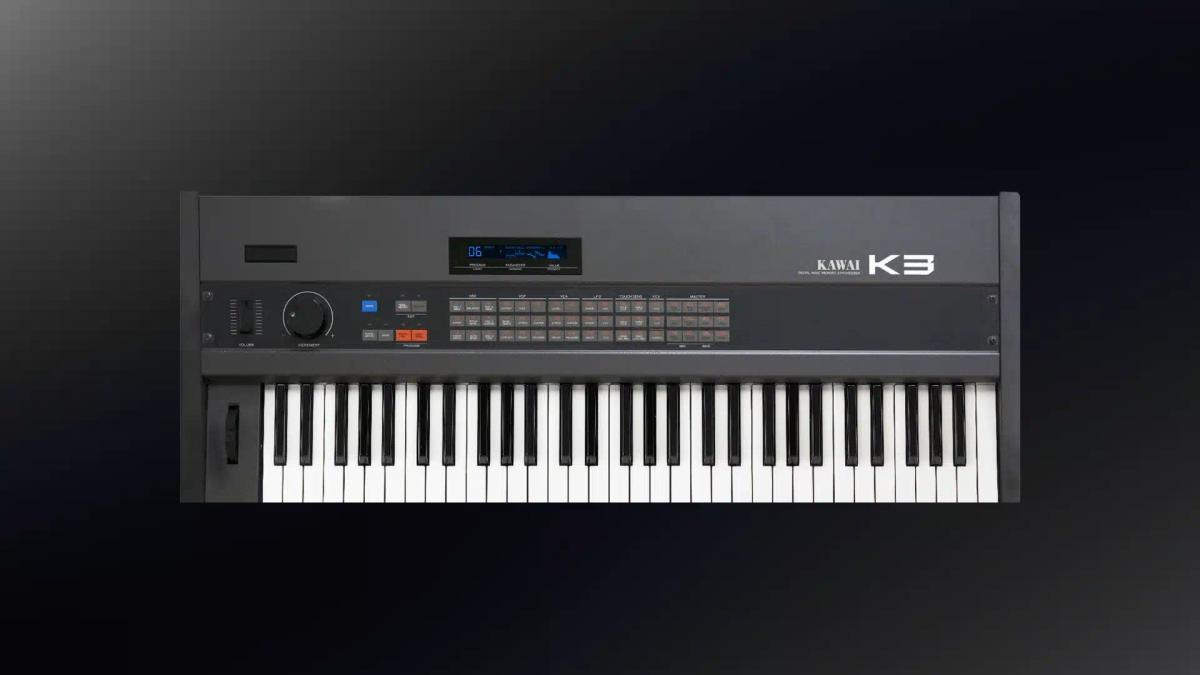
The Kawai K3 is a six-voice hybrid synthesizer that Kawai released in 1986, together with a rackmount version, the K3m. Each voice runs two digital oscillators that read from a set of stored waveforms, some of them derived from acoustic instruments, and passes them through an analog four-pole low-pass filter built on the SSM2044 chip, with analog-style envelopes and amplifiers. Its distinctive feature was a user waveform that players could build additively by setting the levels of individual harmonics. With a velocity- and pressure-sensitive 61-key keyboard and MIDI, the Kawai K3 marked Kawai’s move from the analog SX series toward the digital and additive instruments that followed.
Table of Contents
Kawai K3 sound and character
The Kawai K3 sounds like a bridge between two eras. Its oscillators supply fixed digital waveforms with the bright, slightly gritty edges of 1980s wave memory, while the analog filter rounds them off and adds resonance in the manner of a conventional polysynth. Music Technology’s Rick Davies wrote in December 1986 that the filter brought out the Kawai K3’s analogue character quite well, and that balance is the instrument’s main appeal: digital timbres that still respond like a subtractive synth.
The waveform set covers both synthetic and imitative shapes. Sound On Sound listed piano, bell, oboe, slap bass, glockenspiel, trumpet and several digital harmonic spectra alongside square, sawtooth and sine. Two oscillators can be mixed with a Balance control, and keyboard pressure can shift that balance as a note sustains, a feature Davies singled out as a strong point. The user waveform, built from up to 32 harmonics with individual levels, lets the player design a static spectrum and then shape it with the filter and envelopes.
Its strengths lie in thick strings, organs, basses, bells and slightly hard-edged digital textures. Sound On Sound’s Mark Jenkins liked its string, arco bass, jazz organ and harpsichord patches and a Minimoog-like mono bass, while finding its solo violin, clavinet and flute weak, and he compared some of its digital effects to the PPG. The stereo chorus, with seven fixed modes, adds width.
It is less convincing as an imitative instrument. Jenkins judged its piano and string imitations behind Ensoniq’s ESQ-1, and its waveforms are static, so movement has to come from the filter, the LFO and pressure. The Kawai K3 sits on the warm side of 1980s digital, closer to the Korg DW-8000 and ESQ-1 than to FM or later sample-based workstations.
Features and architecture
- Manufacturer: Kawai Musical Instruments (Hamamatsu, Japan)
- Year introduced: 1986; UK advertisements ran from August 1986 and the first UK reviews appeared in December 1986
- Production years: 1986 to the late 1980s; the end date is not well documented, and the K5 (1987) and K1 (1988) soon overtook it in Kawai’s range
- Synthesis type: hybrid; digital wave-memory oscillators with analog filters and amplifiers, plus an additive user waveform
- Category: hybrid polyphonic keyboard synthesizer, with the K3m rack module
- Polyphony: 6 voices; mono/unison mode with portamento
- Multitimbrality: none; no keyboard splits
- Original price: $1,095 list in the United States according to Soundprogramming; £1,085 for the Kawai K3 and £785 for the K3m in the UK in 1986
- Current market price: Reverb asking prices shown by Soundprogramming run from about $590 to $625 for working keyboards, with K3m listings higher
- Oscillators: 2 digital oscillators per voice at 16, 8 and 4 foot, with coarse and fine tuning on oscillator 2; 31 or 32 factory waveforms (sources differ) plus a user waveform, white noise and silence; Balance control mixes the two
- User waveform: additive design of up to 32 harmonics chosen from the first 128, each with a level from 0 to 31; one user wave in memory, a second storable on cartridge
- Filter: analog four-pole resonant low-pass VCF using SSM2044 chips, self-oscillating at maximum resonance, plus a low-cut (high-pass) filter with amount control only
- LFOs: 1, with triangle, sawtooth, reverse sawtooth, square, inverted square, random and chromatic random shapes; delay and separate depths for oscillators, filter and amplifier
- Envelopes: 2 ADSR (filter and amplifier); an Auto Bend function adds a pitch sweep at note start
- Modulation system: velocity to filter and amplifier; pressure to oscillator balance, filter, amplifier and vibrato depth; keyboard tracking for filter and amplifier
- Sequencer / arpeggiator: none
- Effects: stereo chorus with seven fixed modes
- Memory: 50 internal patches plus 50 on a RAM cartridge; Link function chains up to 31 patches for performance
- Keyboard: 61 keys with velocity and aftertouch; sprung pitch bend wheel, no modulation wheel
- Inputs / outputs: audio outputs (published configurations vary), headphone jack, Program Up and Release footswitch inputs (normally-closed switches required), memory protect switch
- MIDI / USB: MIDI In, Out and Thru; independent send and receive channels; SysEx dumps for patches and user waveform; no Local Off or Mono mode
- Display: six-digit LED display showing patch number, parameter and value; no patch names
- Dimensions / weight: K3 964 x 373 x 118 mm, 15 kg; K3m two-unit rack, 482 x 323 x 90 mm, 5.5 kg
- Power: internal power supply; about 38 W consumption
Strengths
- The hybrid architecture is its identity. Digital waveforms through analog SSM2044 filters give it a tonal blend that neither pure analog nor pure digital instruments of 1986 offered in the same way.
- The additive user waveform was unusual at the price. Building a spectrum harmonic by harmonic gave players a degree of timbral design that most mid-1980s polysynths lacked.
- Pressure control is deep. Aftertouch can move the oscillator balance, filter, amplifier and vibrato, so sustained notes can evolve under the fingers.
- The keyboard and build were praised. Sound On Sound admired its build, styling, keyboard touch and fast patch recall.
- The filter and envelopes behave like a conventional analog synth, which makes it quick to program for anyone familiar with subtractive synthesis.
- The K3m packed the same engine into a two-unit rack, a practical option for MIDI studios that already had a controller keyboard.
Limitations
- Six voices are few, and Sound On Sound found that note assignment cut off sustained notes when many keys were played.
- There is no modulation wheel, only a pitch bend wheel, and Music Technology noted that the data dial sits too far away to substitute for one.
- Editing the user waveform is slow. The Kawai K3 recalculates the wave after each change, so harmonics cannot be adjusted while listening, and Davies found changes above the 60th harmonic hard to hear.
- The six-digit LED display shows no patch names, and every parameter is reached through a single incrementor.
- MIDI is limited: no Local Off, no Mono mode and no multitimbral operation, so it cannot easily serve as a controller or a multi-part sound module.
- The waveforms are static, so the Kawai K3 cannot produce the evolving digital timbres of wavetable scanning or Kawai’s later additive K5.
- The chorus is not programmable per patch beyond its fixed modes, and the footswitch inputs need normally-closed pedals or notes will drone.
Historical context
Kawai, the Hamamatsu piano maker founded in 1927, had built analog synthesizers since the early 1980s, first under its Teisco name in Japan, culminating in the eight-voice SX-240 of 1984. By 1986 digital synthesis dominated the market. Yamaha’s FM instruments had changed expectations, and competitors such as Korg’s DW-8000 and Ensoniq’s ESQ-1 combined digital waveforms with analog or analog-style filtering. Paul Wiffen’s 1987 Sound On Sound review of the K5 described Kawai as having only recently entered high-tech electronic instruments, a measure of how new this territory was for the company.
The Kawai K3 and the K3m appeared in 1986. UK advertisements ran in International Musician, Electronics & Music Maker, Sound On Sound and Music Technology from August to December 1986, and both Sound On Sound and Music Technology reviewed it in their December 1986 issues. Jenkins in Sound On Sound was lukewarm, finding it exciting in some respects and very ordinary in others, while Davies in Music Technology was more positive, suggesting that its distinctive features might indicate Kawai’s future direction. Hybrid Arts produced a wave table editor for Atari’s 8-bit computers.