

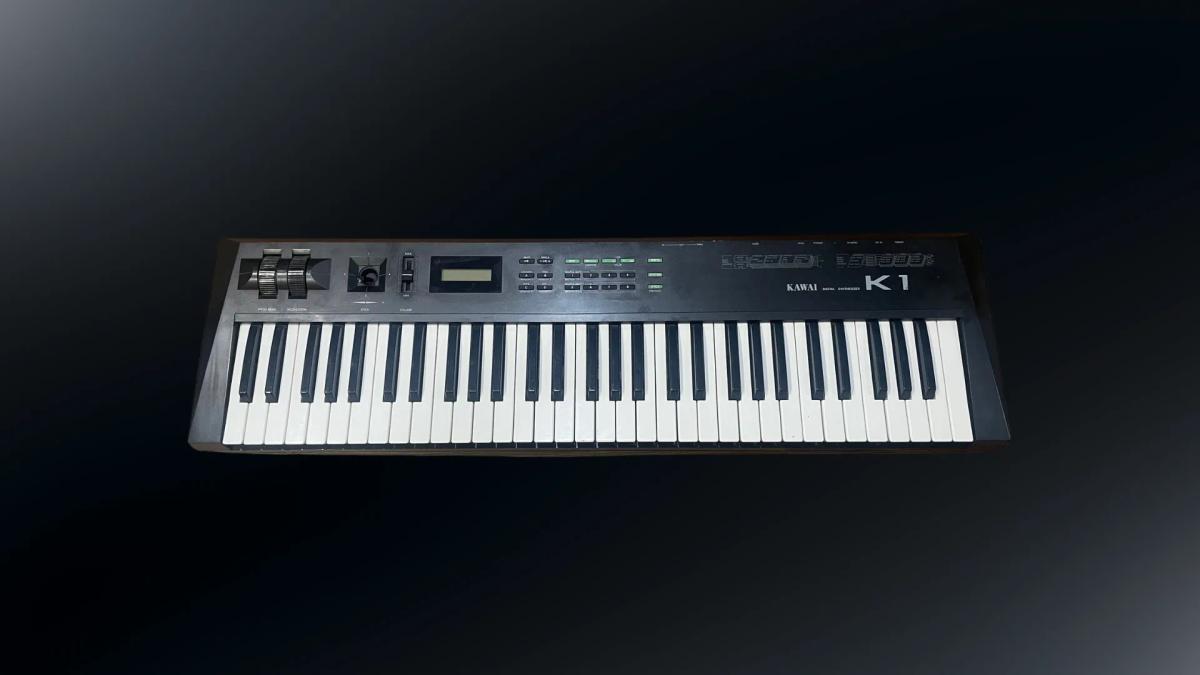
The Kawai K1 is a 61-key digital multitimbral synthesizer introduced in 1988, built around 256 short ROM waveforms that can be combined in groups of two or four “Sources” per patch, with a joystick to balance them in real time. It arrived in the shadow of the Roland D-50 and at a fraction of its price, with no filter and no effects, yet it became one of Kawai’s most successful synthesizers, spawned the K1m, K1r and K1 II variants, and later turned up as a source of floating chords in early-’90s British electronic music.
Table of Contents
Sound and character
The Kawai K1 sounds bright, glassy and slightly grainy, with a character that reviewers at the time struggled to name. Simon Trask, writing in Music Technology, described it as a “translucent warmth” rather than an analog warmth, and that phrase still fits. The waveforms are short and low in resolution, which gives sustained tones a fine digital texture and transients a hard, clicky edge. It is not a smooth instrument, and much of its appeal comes from that rough grain sitting underneath otherwise clean, stable tones.
Its strongest territory is pads, strings, breathy vocal sounds and layered textures. Sound On Sound singled out its arco strings, breathy vocals, pan flute and jazz organ, while the factory choir preset “Aah” is still remembered as one of its signature sounds. Pianos and woodwinds were the weaker areas in period reviews. The reason for this split lies in the architecture: 204 of the 256 waveforms are single-cycle waves built additively from the first 128 harmonics, which suits sustained, evolving material, while the 52 PCM samples are mostly one-shot attacks and drum sounds, useful for adding a percussive front to a patch but limited for realistic acoustic imitation.
The absence of a filter shapes everything. Tone is changed by choosing and layering waveforms, by per-Source envelopes, by velocity and aftertouch crossfades, and by ring modulation between Source pairs, not by sweeping a cutoff. That makes the K1 poor at classic analog-style filter movement but good at shifting, layered timbres, and its ring modulation gave it a metallic, clangorous side that later appealed to industrial and experimental musicians. The overall lean is digital, airy and slightly lo-fi, closer to a late-’80s rompler than to a warm subtractive polysynth.
Features and architecture
- Manufacturer: Kawai
- Year introduced: 1988 (previewed at the NAMM show early that year)
- Production years: 1988 onward; the K1 II followed in 1989 and was sold alongside the original; an exact end of production is not well documented
- Synthesis type: digital sample and waveform playback combining additive single-cycle waves and PCM samples, often grouped with Roland’s LA approach as a budget alternative
- Category: digital multitimbral keyboard synthesizer
- Polyphony: 16 voices with two-Source patches, 8 voices with four-Source patches, allocated dynamically
- Multitimbrality: up to 8 parts in Multi mode, each with its own MIDI channel, key zone, velocity switch, transpose, tuning, level, pan and voice allocation
- Original price: £595 including VAT in the UK; the keyboardless K1m was announced at £395, and the 1U K1r was reviewed at £435
- Current market signal: generally inexpensive on the used market; Polynominal lists a trend price of around €100
- Oscillators: up to 4 Sources per Single patch, chosen from 256 ROM waveforms (204 additive “VM” waves and 52 PCM samples), commonly described as 8-bit
- Waveform content: additive waves grouped into basic shapes and spectral families; PCM samples include drum sounds from Kawai’s R50 and R100 drum machines, plus guitar, string, shakuhachi, pan flute, voice and noise
- Filter: none
- LFOs: 1 LFO with triangle, sawtooth, square and random shapes, used mainly for vibrato and controllable from mod wheel and aftertouch
- Envelopes: one DADSR amplitude envelope per Source, with an initial delay stage
- Modulation system: ring modulation (AM) between Sources 1 and 2 and Sources 3 and 4, auto pitch bend, 8 velocity curves, key scaling, aftertouch, and a joystick that balances the four Sources in real time
- Sequencer / arpeggiator: none
- Effects: none on the original K1; the K1 II added 8 reverbs and 8 delays
- Memory: 64 Single and 32 Multi patches internally, battery-backed; DC-8 RAM cards double the capacity, and ROM cards with additional sounds were available
- Keyboard: 61 keys with velocity and channel aftertouch
- Inputs / outputs: left and right/mono outputs, stereo headphone output, sustain pedal input, memory card slot
- MIDI / USB: MIDI In, Out and Thru; SysEx dumps of single patches or full banks; no USB
- Display: 16 × 2 character backlit LCD
- Dimensions / weight: approximately 936 × 260 × 80 mm; weight listed between about 6.8 kg and 8 kg depending on the source
- Power: external 12V DC adaptor
Strengths
- It offered a combinatorial digital architecture at a much lower price than the Roland D-50, and even below the Roland D-10, which put layered, multi-source digital sounds within reach of a much wider group of players.
- The joystick gives real-time control over the balance of four Sources. It turns static layered patches into moving textures and anticipates the hands-on vector control of later instruments.
- Its pads, strings, choirs and breathy sounds have a recognizable texture that remains useful precisely because it does not sound like modern high-resolution sample playback.
- Eight-part multitimbrality with per-part voice allocation, zones and panning made it a capable sound module for sequencer-based studios of the late 1980s.
- Programming was considered approachable. Parameters are organized into Common, Frequency, Wave and Envelope groups, and the K1r reviewer in Micro Music called the organization “masterful.”
- Ring modulation between Source pairs gives it a metallic and noisy side that extends its range beyond conventional presets.
- The voice architecture is well documented, and full SysEx support means patches can still be edited, archived and exchanged with software tools today.
Limitations
- There is no filter, so classic cutoff sweeps and resonant tones are impossible. Both Sound On Sound and Music Technology identified this as the main limitation.
- Polyphony drops to 8 voices with four-Source patches, which quickly becomes restrictive when layering several parts in Multi mode.
- The original K1 has no onboard effects, so its dry sound usually needs external reverb or chorus to sound finished.
- Waveforms are shown by number rather than name, which made programming dependent on a printed reference booklet.
- Editing a Single patch changes every Multi that uses it, a design choice that reviewers found awkward.
- There are no individual outputs on the Kawai K1, no volume pedal input, and the pitch bend, modulation and joystick controllers cannot be freely reassigned over MIDI.
- The low-resolution waveforms make acoustic piano and woodwind imitations noticeably dated.
- It relies on an external power adaptor and a memory backup battery, both of which are common points of attention on old units.
Historical context
The K1 appeared at a turning point for Kawai’s synthesizer line. The company’s earlier digital instruments, the K3 of 1986 and the additive K5 of 1987, had been technically interesting but made limited commercial impact. The K5 in particular exposed additive synthesis in a way that was powerful but demanding. The Kawai K1 took a different route: it reused the idea of additive waveforms, but froze them into ready-made single-cycle waves stored in ROM and combined them with short PCM samples, much as Roland had paired sampled attacks with synthesized sustains in the D-50.
The timing was decisive. In 1988 the D-50 had defined the sound of digital synthesis for many players, the Korg M1 was emerging, and manufacturers were racing to bring multi-source digital sounds to lower price points. Contemporary reviews placed the Kawai K1 among instruments such as the Korg 707, Yamaha DX11 and Roland D-10 and D-110, and Sound On Sound noted that it undercut the forthcoming D-10 by around £250. Music Technology’s Bob O’Donnell, previewing it after hearing it at NAMM, expected its price to make it a strong competitor; Simon Trask later called it “a serious contender for best synth of the year.”
Kawai then built a family around the engine. The K1m tabletop module and K1r 1U rack offered the same sound set without the keyboard (the K1r also lost the joystick), and in 1989 the K1 II added a 32-sound drum section and 16 global effects, with K1 II patches remaining compatible with the original. The same year the K4 added a resonant digital filter and higher-resolution samples, effectively answering the K1’s biggest criticisms.