

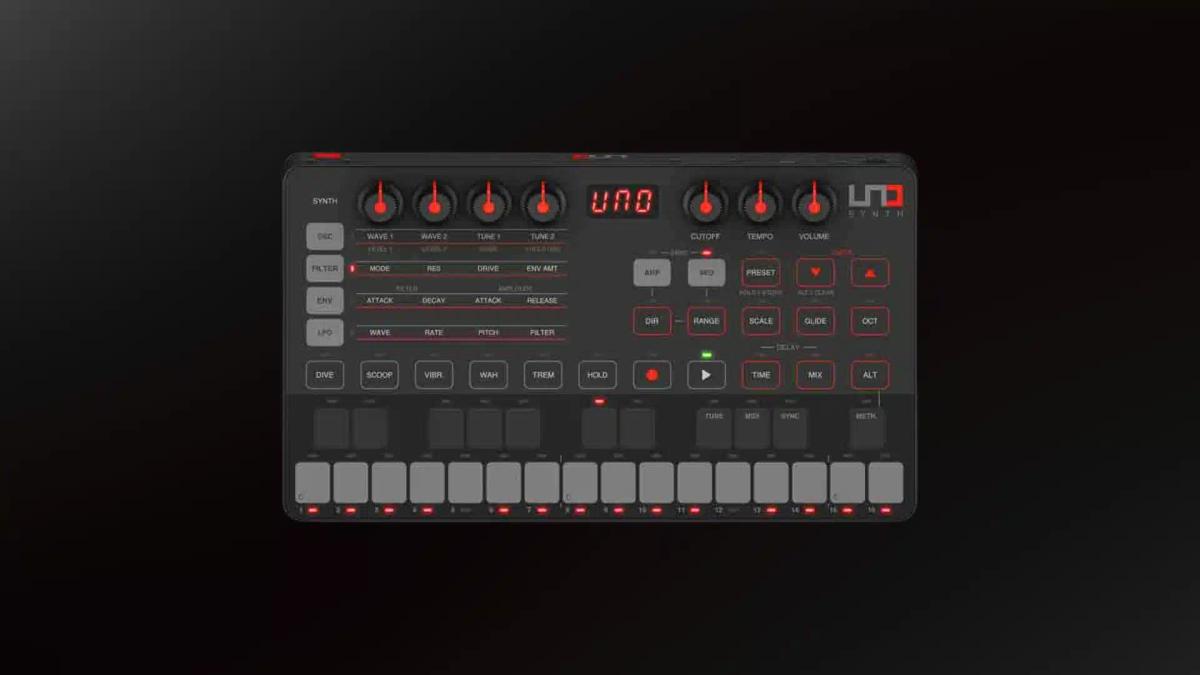
The IK Multimedia UNO Synth is a portable monophonic analog synthesizer that IK Multimedia announced at Superbooth in May 2018 and began shipping that July for $199.99 or 199.99 euros before tax. It was the Italian software company’s first hardware synthesizer, developed with the boutique maker Soundmachines and with Erik Norlander, the designer associated with the Alesis Andromeda. Inside a plastic case weighing about 400 g it put two VCOs, a noise source, a 2-pole OTA multimode filter with overdrive, two envelopes, an LFO, a delay, a 16-step sequencer, and an arpeggiator, played from a 27-note capacitive touch keyboard and powered by four AA batteries or USB. Its significance lies in how much real analog sound and deep MIDI control it delivered at the very bottom of the price range.
Table of Contents
IK Multimedia UNO Synth sound and character
Reviewers agreed on one thing: the IK Multimedia UNO Synth sounds bigger than it looks. MusicRadar’s Si Truss called it a great-sounding source of analog basses and leads, MusicTech’s Andy Jones described a rich analog character from the first preset, and Recording magazine singled out the low end of its basses. Sound On Sound summed up the surprise with a two-word verdict on its tone: “It sounds proper!” The core of that sound is a pair of oscillators whose waveshape sweeps continuously from triangle through sawtooth and square to narrow pulse, so the raw material can be thinned, fattened, or animated with pulse-width modulation without switching waveforms.
The filter gives the IK Multimedia UNO Synth its particular color. It is a 2-pole, OTA-based resonant design with low-pass, high-pass, and band-pass modes, which CDM described at launch as closer to Roland-style OTA filters than to a Moog ladder. At 12dB/octave it is gentler than a 4-pole filter, so basses stay buzzy and articulate rather than round and heavy, and the dual-stage overdrive at the filter input adds grit that suits acid lines and aggressive leads. Mixdown’s reviewer heard everything from acid to Moog-style bass and lead tones in it.
The weaknesses are equally specific. There is no oscillator sync, no FM or cross-modulation, and no envelope-to-pitch routing, so the metallic and sweeping sounds of larger monosynths are out of reach. The LFO cannot run at audio rate. The delay is useful for movement but awkward to set, and Sound On Sound noted low-level noise at headphone volume, audible self-calibration tones, and USB interference when the IK Multimedia UNO Synth shared a computer with an audio interface. In character it is a modern, compact, slightly raw analog voice, closer to a sequenced groovebox than to a vintage-style lead instrument.
Features and architecture
- Manufacturer: IK Multimedia, developed with Soundmachines and Erik Norlander; built in IK’s own facility in Italy
- Year introduced: 2018 (announced May 2, 2018, ahead of Superbooth; shipping from July 19, 2018)
- Production years: 2018 onward; IK has not published a formal end date, and new stock was still listed by some US dealers in October 2026
- Synthesis type: analog subtractive with an all-analog audio path and digital control
- Category: ultra-portable desktop monosynth with touch keyboard and sequencer
- Polyphony: monophonic
- Original price: $199.99 / 199.99 euros excluding tax; £199 including VAT in the UK according to Sound On Sound, with MusicRadar listing £210 / €229 / $199
- Current market price: new units listed at $229.99 by Full Compass and on Reverb; Reverb’s recommended used price is around $113
- Oscillators: 2 VCOs with continuously variable waveshape (triangle, sawtooth, square, pulse), pulse-width modulation, and detune; separate white noise generator; no sync or FM
- Filter: 2-pole (12dB/octave) OTA-based resonant multimode filter with low-pass, high-pass, and band-pass modes, key tracking, and dual-stage overdrive
- LFOs: 1 LFO with seven waveforms (sine, triangle, square, up saw, down saw, random, sample and hold), tempo-syncable, routable to pitch, filter, amplitude, and oscillator shape
- Envelopes: 2 ADSR envelopes (filter and amplifier); at launch the panel exposed only AD for the filter and AR for the amplifier, with full ADSR via MIDI CC, the editor, and later panel shortcuts
- Modulation system: LFO and filter envelope routing, plus five momentary performance effects: Dive, Scoop, Vibrato, Wah, and Tremolo
- Sequencer / arpeggiator: 16-step sequencer with step and real-time recording, forward, backward, and back-and-forth playback, and automation of up to 20 parameters per step; 10-mode arpeggiator with a four-octave range and hold
- Effects: built-in delay with time and mix settings; the audio input can feed external sources into it
- Memory: 100 presets in banks of 10, 20 fixed factory slots and 80 rewritable; each stores a sound with its sequence
- Keyboard: 27-note capacitive multi-touch keyboard (just over two octaves) with 13 selectable scales; no velocity; some retail listings give 28 keys
- Inputs / outputs: 3.5mm audio output (mono summed, doubling as headphone output) and 3.5mm audio input
- MIDI / USB: MIDI in and out on 2.5mm minijacks with DIN adapter cables included; micro-USB for USB MIDI and power; MIDI CC control of all parameters
- Software: free UNO Synth Editor for Mac, Windows, and iOS, also as a VST, AU, and AAX plug-in, with a librarian added in 2019
- Display: small LED display
- Dimensions / weight: about 400 g without batteries; Full Compass lists 25.6 x 15 x 4.9 cm, though retailer imperial figures vary
- Power: four AA batteries (about two to three hours per set, according to reviews) or USB bus power
Strengths
- The sound outclasses the price. Two shape-morphing VCOs into a driven OTA filter produce basses and leads that every major review praised as properly analog.
- Its sequencer is deeper than the case suggests. Sixteen steps with per-step parameter automation, three playback directions, and a capable arpeggiator make it a small motion-sequencing instrument, an area where Sound On Sound felt it outgunned the Korg monologue and Arturia MicroBrute.
- It is genuinely portable. At about 400 g and with battery power, it fits in a laptop bag and runs anywhere.
- Software integration is strong for a budget synth. Every parameter responds to MIDI CC, and the free editor works as a DAW plug-in that recalls the IK Multimedia UNO Synth’s patch with the project.
- The scale mode and touch keyboard make it approachable for beginners, who can play in key without a conventional keybed.
- Patch memory with stored sequences is unusual at this price, and the 80 user slots make it practical for live sets.
Limitations
- The touch surface is not a real keyboard. It offers no velocity, the editing buttons double as keys, and Mixdown suggested an external MIDI keyboard to use the IK Multimedia UNO Synth to its full potential.
- Many parameters are hidden. Full envelopes, pulse-width settings, and other functions sit behind button combinations, MIDI CC, or the editor rather than on the panel.
- The modulation is basic: no oscillator sync, FM, cross-modulation, or envelope to pitch, and the LFO tops out well below audio rate.
- Noise can be a problem. Sound On Sound reported low-level interference at headphone levels, audible calibration tones, and USB ground noise, and MusicRadar flagged calibration noise that a firmware update reduced.
- Connections are minimal: a mono-summed 3.5mm output, a 3.5mm input, and nonstandard 2.5mm MIDI jacks whose included cables fix the cable length.
- The build is light and plasticky, which helps portability but does not inspire confidence; MusicRadar called it lightweight and plasticky, and MusicTech noted that the budget went into the sound rather than the build.
- Battery life is short, around two to three hours on a set of AA cells.
Historical context
By 2018 IK Multimedia was known for software and mobile hardware: AmpliTube, SampleTank, the Syntronik virtual synths, iOS apps, and iRig interfaces. The IK Multimedia UNO Synth was its first hardware synthesizer. To build it, IK partnered with Soundmachines, the Italian boutique maker, through Davide Mancini, and with Erik Norlander, the IK Multimedia UNO Synth designer who had worked on the Alesis Andromeda and whom MusicTech described as having taken advice from Bob Moog. The target was the budget analog market in which Arturia’s MicroBrute and Korg’s monologue already competed, at a lower price than most.
IK announced the IK Multimedia UNO Synth on May 2, 2018, and showed it at Superbooth in Berlin, with pre-orders at $199.99 or 199.99 euros before tax. It shipped on July 19, 2018, built in IK’s own facility in Italy. The free editor, demonstrated at Knobcon in September 2018, followed as a standalone app for Mac, Windows, and iOS and as a DAW plug-in, and IK added a librarian to it at Superbooth 2019. Firmware updates addressed early complaints, including the calibration noise MusicRadar noted, and by the time of Sound On Sound’s review full ADSR envelopes could be reached from the panel with long presses.
The IK Multimedia UNO Synth became the seed of a product line. The UNO Drum followed in 2019, and the UNO Synth Pro, with three oscillators, two filters, and keyboard and desktop versions, was on pre-order by April 2021. The desktop UNO Synth Pro X arrived in 2023. By October 2026 the original IK Multimedia UNO Synth sat at the entry point of the family it had launched, with new units still listed by some dealers and most sales happening on the used market.