

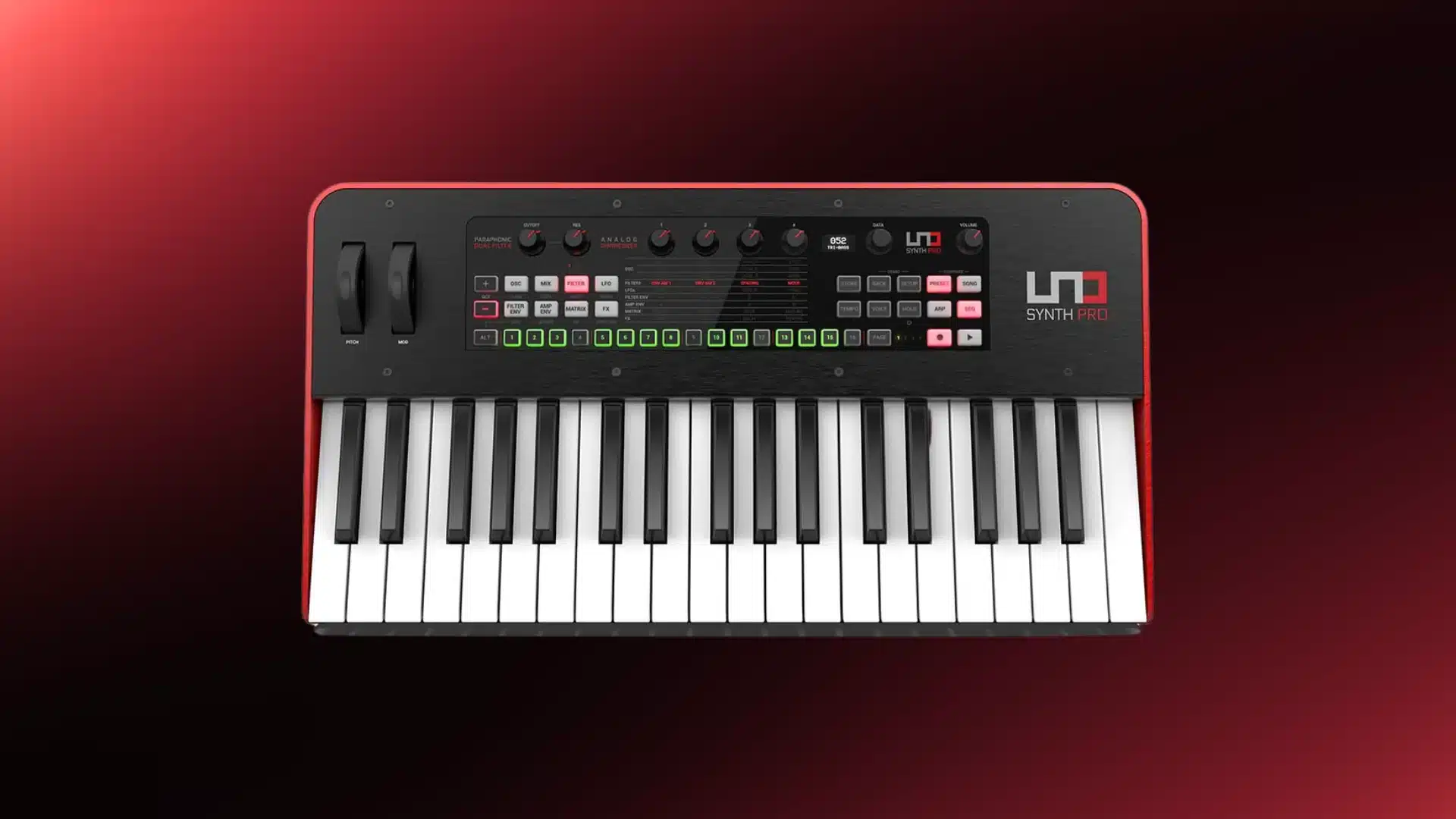
The UNO Synth Pro is a paraphonic analog synthesizer that IK Multimedia announced in January 2021 and shipped that spring in two forms: a 37-key keyboard with a semi-weighted Fatar keybed and a lightweight Desktop model with a flat capacitive keyboard. It took the compact two-oscillator UNO Synth of 2018 and expanded it into a three-oscillator instrument with two different analog filters, two envelopes, two LFOs, a 16-slot modulation matrix, a 64-step sequencer and three slots of digital effects. At a glance it matters as the point where IK, best known for software such as AmpliTube and T-RackS, moved from an entry-level gadget to a serious mid-priced analog synth with modular-friendly CV and gate connections.
Table of Contents
UNO Synth Pro sound and character
The core of the UNO Synth Pro is a set of three analog wave-morphing oscillators, each sweeping continuously through its waveforms rather than switching between fixed shapes. They offer pulse width modulation, hard sync, ring modulation and FM, plus a noise generator. Sound On Sound’s William Stokes found the oscillators clean, perhaps cleaner than he would personally choose, and that description fits the instrument as a whole: it sounds solid and modern rather than vintage or unstable, with the character arriving mostly from the filters and the analog overdrive.
The filter section is what separates it from the original UNO. The first filter is the two-pole OTA multimode design inherited from the UNO Synth, switchable between low-pass and high-pass. The second is a new low-pass filter built around the SSI2164 chip, with two-pole and four-pole modes and self-oscillation; MusicTech connected it to the same family of parts used in Sequential’s current Prophet-5. The two can run in series or parallel, and IK counts 24 combined modes. Sound On Sound noted that this breadth comes at some cost to the quality of each individual mode, but the combinations are useful for squelchy basses, hollow band-limited tones and sharper leads.
Paraphony extends the range. In paraphonic mode each oscillator is assigned to a separate key, so three-note chords are possible as long as all voices share the filters and amplifier envelope. MusicTech’s Robbie Stamp observed that with matched oscillator settings this behaves like three-voice polyphony, while detuned or mismatched oscillators produce stranger chordal textures. A chord mode can also tune the oscillators into triads under a single key.
The digital effects broaden the palette further. Reverb, delay and chorus, flanger and phaser types sit in three slots after the analog drive, and both Sound On Sound and MusicRadar singled out the reverb and the drive as the strongest parts of the chain. The result is a synth best suited to basses, sequenced lines, leads and small pad or arpeggio parts, in a clean, contemporary analog voice.
Features and architecture
- Manufacturer: IK Multimedia (Modena, Italy), developed in collaboration with the Italian boutique maker Soundmachines according to MusicTech
- Year introduced: announced in January 2021, shipping from spring 2021
- Production years: 2021 to the mid-2020s; Synthanatomy described the Pro as end-of-life by April 2024, and IK’s product page now lists it as sold out
- Synthesis type: analog subtractive with digital control and digital effects
- Category: compact paraphonic analog synthesizer, keyboard and Desktop versions
- Polyphony: monophonic, with three-voice paraphony and unison modes
- Voice modes: mono (retriggering), legato, paraphonic, unison and chord tuning; glide in constant-time or constant-speed modes
- Original price: $649.99 for the keyboard and $399.99 for the Desktop in the US at launch; Sound On Sound’s news report listed £699.99 and £429.99 in the UK
- Current market price: IK’s own page shows a list price of $699.99 and sold out; used keyboard units have recently appeared from roughly $280 to $550
- Oscillators: 3 analog wave-morphing VCOs with PWM, hard sync, ring modulation and FM, plus white noise
- Filter: two analog filters, a 2-pole OTA multimode filter (low-pass or high-pass) from the original UNO and a 2/4-pole SSI2164-based self-oscillating low-pass; series or parallel routing for 24 modes
- LFOs: 2, with waveform, rate, fade-in and sync controls
- Envelopes: 2 ADSR envelopes, one for the filter and one for the amplifier, both also available in the matrix
- Modulation system: 16-slot modulation matrix with sources including velocity, aftertouch, LFOs, envelopes, CV, gate and sequencer data
- Sequencer / arpeggiator: 64-step sequencer with per-step automation of more than 80 parameters, ties, accents and song mode; 10-mode arpeggiator
- Effects: analog overdrive plus 12 digital effects (modulation, delay, reverb) in three slots
- Memory: 256 user-editable preset slots, with 128 factory presets according to several reviews
- Keyboard: 37-key Fatar semi-weighted keybed with velocity and aftertouch and physical pitch and mod wheels on the keyboard model; 32 flat capacitive keys with touch strips on the Desktop
- Inputs / outputs: two balanced 1/4-inch outputs (stereo effects), headphone output, audio input routable to the filters, effects or straight through, two pairs of assignable CV and gate connections
- MIDI / USB: 5-pin DIN MIDI in and out, micro USB for MIDI and power; free editor/librarian as a standalone application or plug-in
- Display: small OLED display with menu navigation; automatic calibration at power-up
- Dimensions / weight: keyboard 55 x 30 x 7 cm and 5.8 kg in a metal and plastic enclosure; Desktop 33 x 15 x 5 cm and about 700 g
- Power: keyboard model ships with a power supply; the Desktop draws about 1.5A over USB and has no bundled adapter, with IK recommending a USB power bank for lower noise
Strengths
- Three analog oscillators with sync, ring modulation and FM give it real tonal range. That was a notable step up from the two-oscillator original and unusual at its price.
- The two contrasting filters are a genuine feature. Running the OTA and SSI-based filters in series or parallel makes basses, band-pass sweeps and resonant leads possible from one panel.
- Paraphony and chord tuning extend it beyond monophonic lines. With matched oscillators it can play simple three-note chords, which few compact analog monosynths offered.
- The sequencer is unusually deep for the class. Sixty-four steps with per-step parameter automation, ties, accents and song mode drew praise from MusicRadar and Digital DJ Tips alike.
- The keyboard version has a proper instrument feel. The semi-weighted Fatar keybed with aftertouch, real wheels and a metal case won consistent approval from reviewers.
- Integration is broad. MIDI on DIN and USB, two pairs of CV and gate connections, an audio input and a plug-in editor make it easy to fit into a DAW or a modular rig.
Limitations
- It is paraphonic, not polyphonic. Chords share one filter path and one amplifier envelope, so pads and sustained chords articulate as a single block.
- Much of the depth sits behind menus. Reviewers repeatedly mentioned menu diving on the small OLED display, and MusicTech later wrote that the Pro’s power was hidden behind a lacklustre physical interface.
- The knobs do not show stored values, and the power-up calibration takes noticeably long, two points Sound On Sound raised in its review.
- Some effects are weaker than others. Sound On Sound found the phaser and flanger short of the excellent reverb.
- The Desktop model is a compromise. Its capacitive keys and touch strips suit sketching rather than playing, the build feels lighter, and it ships without a power supply.
- Firmware support has ended. Synthanatomy reported in 2024 that the product was end-of-life and no longer receiving updates, and patches are not compatible with the later UNO Synth Pro X.
Historical context
IK Multimedia, founded in Modena, built its name on software (AmpliTube, T-RackS, SampleTank) and mobile interfaces before moving into hardware synthesizers. Its first was the UNO Synth, shown at Superbooth in May 2018 at $199.99: a battery-powered, roughly 400 g monosynth with two VCOs, a 2-pole OTA multimode filter and overdrive, designed with Soundmachines and IK’s Erik Norlander. A drum machine, UNO Drum, followed in the same product family.
The UNO Synth Pro was announced in January 2021, with Sound On Sound reporting UK prices of £699.99 and £429.99 and availability expected by spring. It added a third oscillator, a second LFO, a second envelope, the SSI-based filter, the modulation matrix, a 64-step sequencer, digital effects and CV, and dropped battery power. Reviews through 2021 were consistently positive: MusicTech gave it 9/10, MusicRadar wrote that it shamed some much more expensive instruments, and Sound On Sound concluded that it would stand up in any synth array. In May 2022 IK showed a limited Black Edition of the Desktop at Superbooth, technically unchanged, at $/€349.99.