

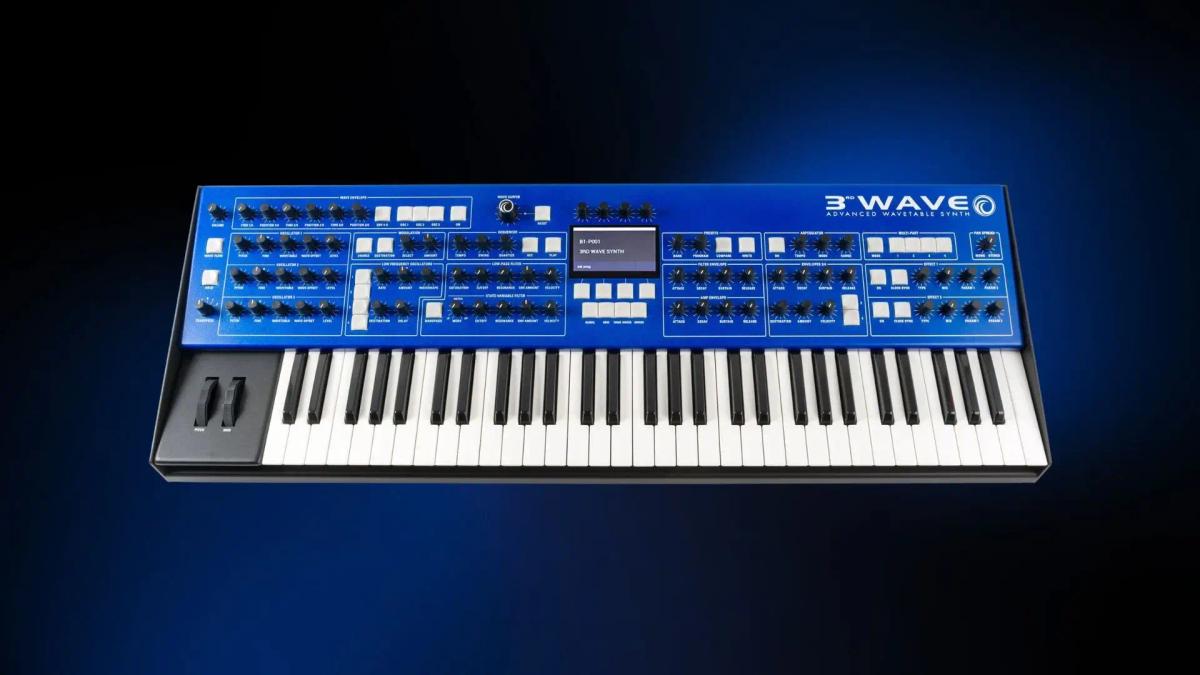
Introduced in 2022, the Groove Synthesis 3rd Wave Keyboard is a 24-voice, four-part multitimbral hybrid wavetable synthesizer built around a five-octave semi-weighted Fatar keyboard. It combines three digital oscillators per voice with analogue Rossum filter circuitry, extensive modulation, a sequencer, effects, and later firmware additions including MPE reception and sample playback. Its importance lies in the fact that it does not merely imitate the PPG Wave lineage: it translates its digital roughness, wavetable movement, and hybrid architecture into a contemporary flagship instrument designed for performance and deep sound design.
Table of Contents
Groove Synthesis 3rd Wave sound and character
The Groove Synthesis 3rd Wave is defined by contrast. Its sound can move from deliberately coarse PPG-style wavetable behavior to clean, high-resolution digital motion and then into recognizably analogue territory through its filters and modeled oscillator waveforms. That range gives it a broader identity than a vintage recreation.
At its most historically minded, the Groove Synthesis 3rd Wave can reproduce the stepped movement and grainy edges associated with early wavetable synthesis. The option to work with legacy PPG-style waves and reduced interpolation matters because it preserves the instability and digital abrasion that made early hybrid instruments distinctive. Those imperfections are not flaws to be corrected; they are part of the musical vocabulary.
At its most modern, the Groove Synthesis 3rd Wave can be smooth, expansive, and highly controlled. High-resolution wavetable operation, linear FM, oscillator sync, wave envelopes, and analogue filtering allow it to build evolving pads, glassy electric-piano-like textures, metallic attacks, shifting basses, cinematic drones, and aggressive digital leads.
Its strongest sounds tend to be those that evolve rather than simply sit in a mix. The six-stage Wave Envelopes can move through wavetable positions over time, while the analogue filter section gives those motions weight and contour. A pad can begin crystalline and gradually become darker, denser, and more saturated; a bass can move from precise harmonic detail into a heavier analogue-filtered body.
The result is a synth that can sound recognizably vintage without being trapped in vintage behavior. It is capable of PPG-inspired bells, choirs, brass-like stabs, and glassy pads, but it is equally suited to modern soundtrack work, dark electronic music, hybrid scoring, progressive synth-pop, and sound design that depends on movement rather than static timbre.
Features and architecture
- Manufacturer: Groove Synthesis.
- Year introduced: 2022.
- Production and support status: Current product line as of 2026, with official firmware documentation continuing through version 1.9.
- Synthesis type: Hybrid wavetable synthesizer with digital oscillators and analogue filters.
- Category: Premium keyboard flagship polysynth.
- Polyphony: 24 voices.
- Multitimbrality: Four independent parts, each capable of its own patch, sequencing, output routing, and effects configuration.
- Original launch price: US$3,795 introductory price in 2022.
- Current new-market signal: Around US$4,995 at major United States retail listings during the period reviewed.
- Oscillators: Three digital oscillators per voice, with legacy PPG-style waves, high-resolution wavetable operation, modeled analogue waveforms, oscillator sync, and linear FM.
- Wavetable system: Includes original-style 8-bit PPG tables, higher-resolution wavetable modes, user wavetable support, WAV import, Serum wavetable import, and Audio In capture through the Wavemaker function.
- Sampling: Later firmware added an S oscillator for sample playback, with approximately 3.3 MB of memory and up to roughly 35 seconds of mono audio at 48 kHz.
- Filters: Rossum-designed 2140 analogue 24 dB-per-octave low-pass filter with saturation and resonance compensation, plus a second 12 dB state-variable filter with low-pass, notch, high-pass, and band-pass behavior.
- LFOs: Four LFOs with multiple waveforms, delay, reset behavior, BPM synchronization, and modulation-matrix integration.
- Envelopes: Four delay-ADSR envelopes, including dedicated filter and amplifier envelopes plus two additional modulation envelopes; three oscillators also have six-stage loopable Wave Envelopes.
- Modulation system: Sixteen user-programmable modulation slots per part, 27 modulation sources, 114 destinations, 12 fixed modulation paths, and audio-rate modulation options.
- Sequencer: Four-part note and parameter sequencer, up to 24 sequences per preset, with up to 32 measures per sequence.
- Arpeggiator: One arpeggiator per multitimbral part, with directional modes, assignment modes, octave ranges, clock divisions, and synchronization.
- Effects: Two digital effects processors per part, including delays, chorus, phaser, flanger, distortion, rotating speaker, ring modulation, and several reverb types.
- Memory: 500 user-rewritable factory program locations arranged in five banks of 100 programs.
- Keyboard: Five-octave, 61-note semi-weighted Fatar keyboard with velocity sensitivity and aftertouch.
- MPE: Receives MIDI Polyphonic Expression data from compatible controllers, but does not transmit MPE from its own keyboard.
- Controls: 77 knobs, 39 buttons, pitch and modulation wheels, and a central display with soft-control navigation.
- Audio inputs and outputs: Audio input, four stereo output pairs, dedicated headphone output, sustain input, footswitch input, expression input, and volume pedal input.
- MIDI and USB: MIDI In, Out, and Thru, plus bidirectional USB MIDI.
- Dimensions and weight: Approximately 38.5 inches wide, 14.25 inches deep, 5 inches high, and 27 pounds.
- Power: Internal universal power supply, 100–240V operation, with a maximum draw of 65 watts.
Strengths
- A genuinely broad wavetable identity: The Groove Synthesis 3rd Wave can access legacy 8-bit PPG character, smoother high-resolution wavetable scanning, and modeled analogue waveforms without forcing the player into one historical aesthetic.
- Four-part multitimbrality with physical outputs: The ability to create separate parts, route them independently, and send them through dedicated stereo outputs makes it more useful for stage setups, complex studio arrangements, and layered live performance than a typical single-timbral polysynth.
- A strong relationship between digital motion and analogue contour: The digital oscillator section provides detailed harmonic movement, while the analogue Rossum filters add weight, saturation, resonance behavior, and a more physical sense of contour.
- Deep modulation without abandoning hands-on control: Its modulation matrix is extensive, but the panel offers substantial direct control. This matters because wavetable instruments become less expressive when their movement is hidden behind menu systems.
- Wave Envelopes as a compositional tool: The six-stage Wave Envelopes allow wavetable position to become part of the phrase itself. Rather than applying movement after the fact, the player can build timbral development into the core structure of a sound.
- A meaningful firmware trajectory: MPE reception, sample playback, program-management improvements, and later factory banks show that the Groove Synthesis 3rd Wave expanded after launch rather than remaining frozen as a nostalgia-focused design.
Limitations
- Premium pricing: Its current new price places it firmly in flagship territory. The Groove Synthesis 3rd Wave is difficult to justify for players who only need occasional wavetable color or a compact secondary keyboard.
- Substantial physical footprint: At roughly 27 pounds and nearly 39 inches wide, it is portable in the broad sense but not especially convenient for small desks, lightweight live rigs, or frequent travel.
- Voice allocation can become restrictive in complex setups: Twenty-four voices are generous for a single-timbral polysynth, but four-part arrangements, layered programs, unison stacks, and long-release sounds can consume voices quickly.
- Sample playback remains limited by design: The S oscillator expands the Groove Synthesis 3rd Wave, but its sample memory and mono-sample focus do not turn the Groove Synthesis 3rd Wave into a deep workstation sampler.
- MPE is receive-only: Players using expressive MPE controllers can benefit, but the built-in keyboard does not send MPE performance data.
- Effects can involve practical compromises in dense multitimbral arrangements: The manual warns that some four-part effect combinations can reach processing limits, which matters for elaborate layered performances.
- Its depth can exceed the needs of simple preset-based workflows: The panel is approachable for its class, but its real value appears when the player is willing to program modulation, tables, envelopes, routing, and multitimbral structures.
Historical context
The historical reference point is the PPG Wave, a digital-and-analogue hybrid instrument first developed in the early 1980s. Its wavetable oscillators created a type of harmonic motion that differed from the subtractive analogue norm, while analogue filtering prevented the result from becoming entirely brittle or impersonal.
The Groove Synthesis 3rd Wave emerged at a moment when the Groove Synthesis 3rd Wave market was crowded with analogue revivals, compact polysynths, and software-derived wavetable instruments. Its response was not to compete as a low-cost retro clone. Instead, it treated PPG’s ideas as a starting point for a larger architecture: three oscillators per voice, four multitimbral parts, extensive modulation, modern storage, performance sequencing, audio input, and a full control surface.
That distinction matters. Many heritage instruments reduce their source material to visual references, famous presets, or fixed emulations. The Groove Synthesis 3rd Wave preserves the underlying tension that made the PPG lineage important: digital wavetable complexity shaped through analogue filtering and performance control.