

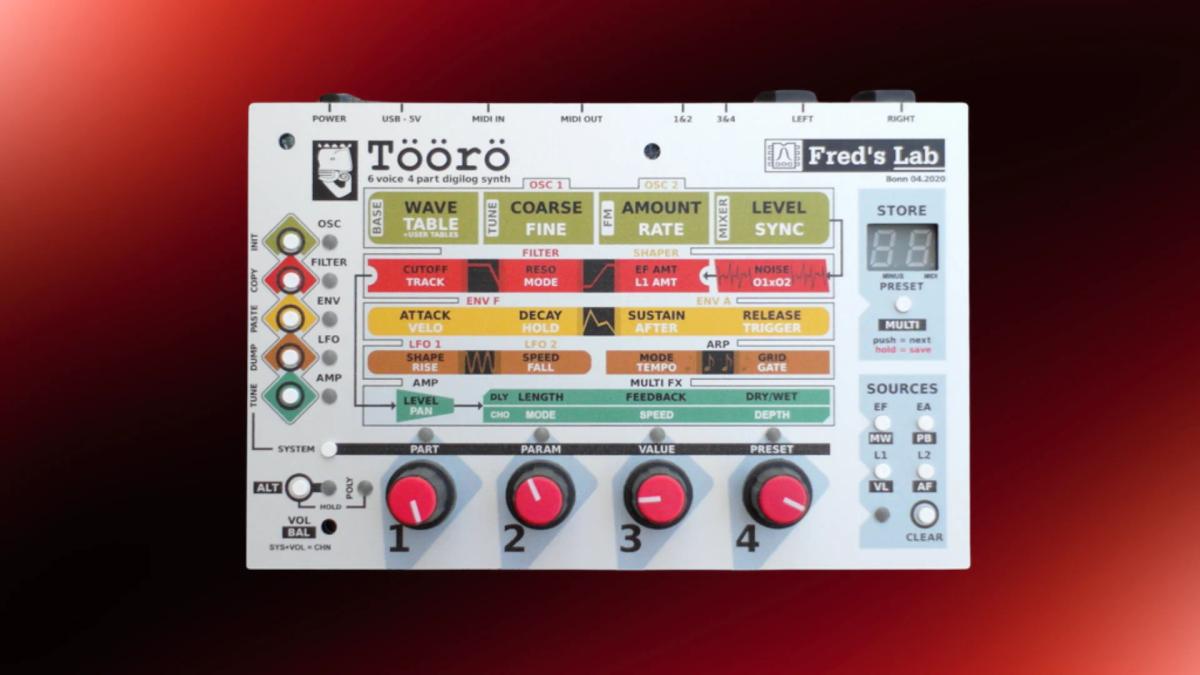
The Fred’s Lab Töörö mkII is a six-voice, four-part multitimbral hybrid desktop synthesizer from Fred’s Lab, the small company run by developer Frédéric Meslin. Reported by Synth Anatomy on October 16, 2026, it is the second generation of the Töörö first presented at SynthFest France in 2020, a model Meslin later withdrew because some of its components were no longer available. Each voice pairs two digital oscillators, now running at 16-bit rather than 12-bit resolution, with the FL A847 analog low-pass filter, and the voices feed a stereo effects section of delays, chorus and flanger. New to this version are balanced main outputs, a revised color scheme and an MPE mode with two zones. The Fred’s Lab Töörö mkII costs €499 including VAT and is sold on pre-order, with a first batch shipping from Germany in October 2026. It matters as a rare case of a boutique maker revising a discontinued instrument instead of letting it disappear.
Table of Contents
Fred’s Lab Töörö mkII sound and character
The voice architecture of the Fred’s Lab Töörö mkII follows the original closely. Each of the six voices has two complex digital oscillators with waveform morphing, two-operator linear phase modulation and self-sync, so a single patch can move from plain wavetable tones to clangorous, FM-style spectra. Synth Anatomy lists a noise source and a ring modulator as additions on the mkII, although its own 2020 coverage of the Kickstarter model, and Gearnews in Germany, already described both on the first Töörö. The safest reading is that the mkII keeps them, whatever their status on the earlier hardware.
The main change inside the oscillators is resolution. The first Töörö used 12-bit digital oscillators, and that low-resolution edge was part of its identity; Synth Anatomy described the instrument as having digital grit and punch. The Fred’s Lab Töörö mkII moves to 16-bit, which, according to the same report, lowers the noise floor and reduces zipper noise when parameters are swept. How much of the older character survives the change is not yet documented, because no independent hands-on review of the new hardware had been published at the time of writing.
After the oscillators comes the analog stage. The FL A847 is a 12 dB per octave low-pass filter designed by Fred’s Lab, described in 2020 coverage as optocoupler-based and inspired by the Korg MS-10, and it can self-oscillate and saturate. On the mkII a digital shaper adds further crunch. Modulation comes from two multi-wave LFOs and two ADSR envelopes with velocity and hold controls, routed through an eight-slot modulation matrix that reaches almost every synthesis parameter.
The playing experience is shaped by a compact panel. On the original, parameters were printed on the case and selected through a grid of switches with four knobs for values, a layout that Synth Anatomy compared to the matrix editing of the Waldorf Blofeld and that Gearnews likened to the microKorg and the DSI Mono Evolver. The mkII keeps the overall look but shifts the green to a darker shade and colors the controls in the lower section and on the right-hand side blue, so the two generations can be told apart at a glance.
Multitimbrality is central to how the Fred’s Lab Töörö mkII is meant to be used. In its default mode the six voices can be split across four parts, each with its own patch and voice allocation, so one unit can cover pads, bass and lead lines in a sequenced arrangement. A separate MPE mode creates lower and upper zones, giving two simultaneous patches with three-axis per-note expression. The first Töörö already responded to polyphonic aftertouch, and Perfect Circuit notes that it became MPE compatible with firmware version 1.60, so the new mode builds on a direction the original had already taken.
The effects section finishes the sound in stereo. It offers a ping-pong delay, chorus and flanger built around vintage-style modulated delay lines, which widen the otherwise compact voice path. Together with the new balanced outputs and the two dual-voice outputs, this makes the instrument easier to place in a studio mix than its small size might suggest.
Features and architecture
- Manufacturer: Fred’s Lab (Frédéric Meslin), with instruments built and shipped from Germany
- Year introduced: 2026 (reported by Synth Anatomy on October 16, 2026); the original Töörö dates from 2020
- Production years: 2026 to present (first batch shipping October 2026)
- Synthesis type: hybrid, with digital oscillators feeding an analog filter
- Category: desktop polyphonic and multitimbral synthesizer module
- Polyphony: 6 voices
- Multitimbrality: 4 parts in the default mode; MPE mode with two zones (two simultaneous patches)
- Original price: €499 including VAT; US and UK prices not specified by the manufacturer at the time of writing
- Current market price: €499 on pre-order from Fred’s Lab (October 2026)
- Oscillators: two 16-bit digital oscillators per voice with waveform morphing, two-operator linear phase modulation and self-sync; noise source and ring modulator
- Filter: FL A847 analog 12 dB per octave low-pass per voice, with auto-oscillation and saturation; digital shaper
- LFO: two multi-wave LFOs
- Envelopes: two ADSR envelopes with velocity and hold controls
- Modulation system: eight-slot modulation matrix; three-axis MPE in MPE mode
- Sequencer / arpeggiator: no sequencer; an arpeggiator is not listed in the mkII announcement (the original offered one per part)
- Effects: stereo digital effects with ping-pong delay, chorus and flanger based on modulated delays
- Memory: not specified by the manufacturer for the mkII (the original stored 100 user presets and 10 multis)
- Keyboard: none (desktop module)
- Inputs / outputs: balanced stereo main outputs; two independent dual-voice outputs (voices 1 and 2, voices 3 and 4)
- MIDI / USB: 5-pin DIN MIDI in and out; USB for MIDI data and power
- Display: not specified by the manufacturer for the mkII; on the original, parameters were printed on the panel and selected with a switch matrix and four knobs
- Dimensions / weight: not specified for the mkII; 2020 coverage of the original gave 70 × 120 × 45 mm and 750 g, while Perfect Circuit and Music Store list 170 × 120 × 45 mm (Music Store gives 0.55 kg)
- Power: 5 V over USB
Strengths
- Four parts from six voices. The engine can be split into four independent patches with their own voice allocations, which lets one small unit play several roles in an arrangement.
- Cleaner oscillators. The move from 12-bit to 16-bit resolution lowers the noise floor and reduces zipper noise, according to Synth Anatomy’s report.
- An analog filter on every voice. The FL A847 low-pass can self-oscillate and saturate, and a digital shaper adds further drive after it.
- Built-in expressive control. The MPE mode provides two zones with three-axis per-note modulation, extending the polyphonic aftertouch support of the original.
- Studio-ready outputs. Balanced main outputs and two dual-voice outputs make it easier to process parts separately or run long cables.
- A lower price than before. At €499 including VAT, the mkII costs less than the €539 regular price the original carried in 2023.
- Simple power. The unit runs on 5 V over USB, so a computer, a USB adapter or a power bank can supply it.
Limitations
- No independent reviews yet. Coverage of the Fred’s Lab Töörö mkII so far comes from the launch announcement, so claims about sound and build have not been tested by outside reviewers.
- Limited availability. Sales start as a direct pre-order, and Synth Anatomy reported that the first batch was almost sold out before shipping began.
- No published US or UK pricing. Only the euro price including VAT had been reported at the time of writing.
- A compact, matrix-based panel. On the original, editing ran through a switch grid and four knobs, which is slower for hands-on tweaking than a one-knob-per-function layout.
- A single filter type. The analog stage is a 12 dB per octave low-pass, with no high-pass or band-pass analog modes listed.
- Gaps in the specifications. Memory size, dimensions and the arpeggiator are not restated for the mkII, so buyers have to rely on the original’s figures for now.
- A very small manufacturer. Fred’s Lab is essentially one developer, and the original Töörö was withdrawn when parts became unavailable, which shows how exposed small production runs are to supply problems.
Historical context
Frédéric Meslin, described by Synth Anatomy as a French developer running a one-man garage synth company, worked in the wider industry before building his own instruments. MusicTech credited him with contributions to the Arturia MicroFreak and MiniBrute 2 and to the Waldorf Pulse 2 and Streichfett, and Synth Anatomy also mentioned work on the Waldorf NW1 wavetable module. Gearnews in Germany reported that he left Waldorf to found Fred’s Lab, a company that Synth Anatomy said was marking its tenth anniversary in 2026.