

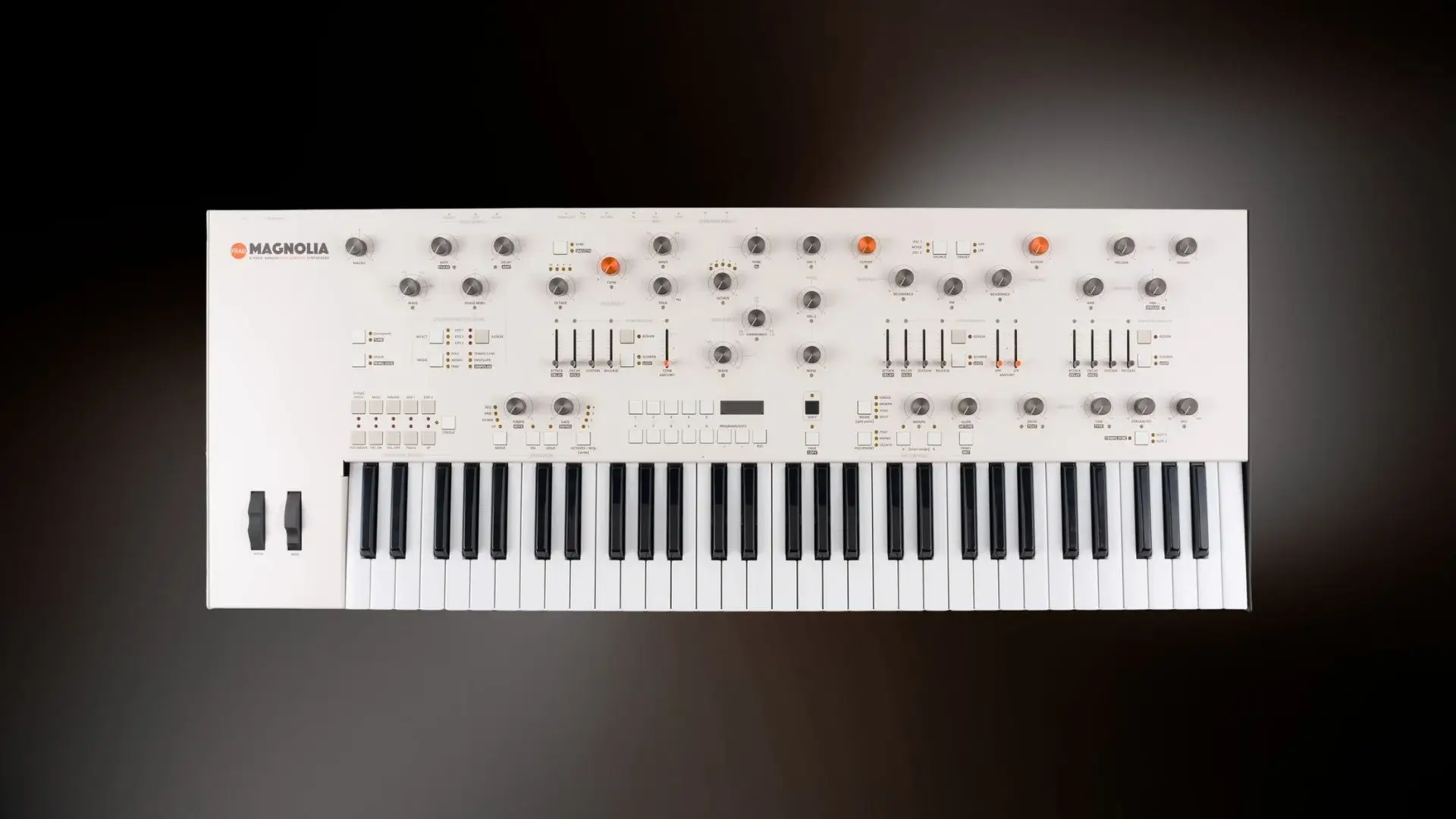
The Frap Tools Magnolia is an eight-voice, bi-timbral analog keyboard synthesizer introduced as a pre-production instrument at Superbooth 2025 and released commercially in 2026. Built by the Italian Eurorack manufacturer Frap Tools, it translates the company’s modular vocabulary, especially through-zero linear FM, wavefolding, complex-oscillator thinking, and resonant filter animation, into a five-octave polysynth with a Fatar keybed and polyphonic aftertouch. Its importance is not that it simply adds another analog polysynth to a crowded field, but that it brings a distinctly modular, West Coast-influenced method of sound generation into a playable keyboard format without abandoning conventional subtractive synthesis.
Table of Contents
Frap Tools Magnolia sound and character
Frap Tools Magnolia is not a polite vintage polysynth with a few experimental extras attached. Its voice architecture starts from a more volatile premise: complex tone creation happens early in the signal path, before the filter is asked to tidy things up. Oscillator 1 carries the more explicitly West Coast side of the instrument, with analog through-zero FM, wavefolding, and flip sync. Oscillator 2 is more conventional, with pulse-width modulation and harmonic shaping, but it is still part of a system designed for interaction rather than simple stacking.
The result is a synth that can move from broad analog pads and brass-like polysynth material into metallic clusters, glassy electric-piano-like attacks, animated drones, unstable harmonic swells, and aggressive folded textures. Its identity is not only “warm analog.” It is analog under tension: capable of smoothness, but repeatedly inviting the player toward saturation, audio-rate movement, filter FM, resonance, and global drive.
The filters matter because they prevent Frap Tools Magnolia from becoming a one-dimensional FM machine. The 18 dB/oct high-pass and 24 dB/oct low-pass arrangement gives the Frap Tools Magnolia a more sculptural voice path than a single low-pass design. In musical terms, that means complex oscillator tones can be narrowed, hollowed, sharpened, or framed rather than merely darkened. The analog distortion and digital chorus/delay effects then place the instrument between raw modular immediacy and performance-ready polysynth polish.
Its character is therefore modern, but not clinically modern. It is not trying to recreate a Prophet, Jupiter, OB, or CS lineage. It belongs to a newer cultural moment in which musicians want the instability, friction, and personal discovery of modular synthesis, but often need the immediacy, memory, tuning discipline, and harmonic playability of a keyboard instrument.
Features and architecture
- Manufacturer: Frap Tools, Italy.
- Year: Shown publicly as a pre-production instrument in 2025; commercially available from 2026.
- Production years: 2026 to present.
- Synthesis type: Analog polyphonic synthesizer with through-zero linear FM, wavefolding, subtractive filtering, modulation matrix, analog distortion, and digital time/modulation effects.
- Category: High-end analog keyboard polysynth; West Coast-influenced polyphonic FM/subtractive hybrid.
- Polyphony: 8 voices.
- Timbrality: Bi-timbral, with Single, Morph, Dual, and Split modes.
- Original price and current market price: Early reported street pricing was around $4,830 / €4,199 / £3,685. Current European retail listings vary by store and region, with prices around €3,899 to €4,199. Used pricing is still immature because the Frap Tools Magnolia is very new.
- Oscillators: Two analog oscillators per voice. Oscillator 1 is the more experimental “West Coast” oscillator, with through-zero linear FM, wavefolder, and flip sync. Oscillator 2 is the more subtractive “East Coast” oscillator, with PWM and harmonic shaping. Both use continuously variable waveform selection.
- Noise and mixer: Oscillators and noise can be mixed before the filter section.
- Filter: 18 dB/oct resonant high-pass filter and 24 dB/oct resonant low-pass filter, with linear FM available in the filter architecture.
- Saturation and drive: Analog pre-filter saturation plus analog global distortion.
- LFOs: Three digital LFOs with continuously variable waveforms.
- Envelopes: Three digital DAHDSR envelopes with loop mode.
- Modulation system: 16 modulation sources, 38 destinations, and 64 modulation slots per part. The system includes hands-on assignment with visual feedback, velocity-off modulation, polyphonic aftertouch as a modulation source, a Macro knob assignable to parameters, and Polymove for polyphonic random variation.
- Sequencer / arpeggiator: Per-part arpeggiator and per-part 16-step sequencer.
- Effects: Analog global distortion plus two global digital effect slots with chorus and delay algorithms.
- Memory: 200 preset memory slots.
- Keyboard: 61-key Fatar keybed with velocity sensitivity and polyphonic aftertouch.
- Controls: Pitch wheel, modulation wheel, Macro knob, Hold button, sustain pedal input, and two expression pedal inputs.
- Inputs / outputs: Stereo main outputs, stereo headphone output, sustain pedal input, two expression pedal inputs.
- MIDI / USB: MIDI In, Out, and Thru on 5-pin DIN, plus USB-C.
- Display: Numeric/display-based value feedback with dynamic and static value display functions for parameter inspection and fine editing.
- Dimensions / weight: Approximately 990 × 380 × 110 mm, about 15 kg.
- Power: 100–240 VAC, 50/60 Hz, maximum power consumption of 105 W.
Strengths
- It brings analog through-zero FM into a polyphonic keyboard context in a way that is central to the Frap Tools Magnolia rather than treated as a secondary oscillator trick.
- The combination of wavefolding, flip sync, filter FM, saturation, and global drive gives it a wide harmonic range, from mellow analog tones to dense, unstable, metallic, and abrasive material.
- The bi-timbral architecture makes the eight voices more flexible than a simple one-part polysynth, especially for splits, layered sounds, and morphing relationships between two parts.
- Polyphonic aftertouch is not a decorative feature here; it fits the instrument’s design logic because many of Frap Tools Magnolia’s best sounds depend on continuous timbral pressure rather than static chord playback.
- The modulation matrix is deep without becoming purely menu-based, using a tactile assign-and-indicate approach that preserves some of the directness associated with modular patching.
- Polymove is musically important because it lets repeated notes and chord voices differ from one another, reducing the overly static behavior that can affect some tightly controlled modern polysynths.
- The dual-filter structure gives the Frap Tools Magnolia a more architectural sound-shaping system than a standard one-low-pass polysynth voice.
- Its design connects Frap Tools’ Eurorack identity to a larger keyboard market without simply repackaging a vintage analog template.
Limitations
- Eight voices are expressive but not abundant for a bi-timbral instrument; layered or split programs can reduce practical polyphonic headroom.
- Its price places it firmly in boutique flagship territory, which limits its cultural reach compared with more affordable analog polysynths.
- The instrument is physically large and heavy, which makes it less convenient for small studios, frequent transport, or users who prefer desktop modules.
- It has 200 preset memory slots, which may feel conservative in a modern flagship context, especially for players who build large live or studio libraries.
- The interface is intentionally hands-on, but the depth of FM, modulation, morphing, and part behavior means it is not a casual preset machine.
- Players looking mainly for classic Prophet, Jupiter, Oberheim, or Juno behavior may find Frap Tools Magnolia’s personality too complex, angular, or harmonically unstable.
- Its long-term reliability, resale stability, firmware evolution, and artist adoption are still forming because the Frap Tools Magnolia is very new.
- There is no widely established used-market baseline yet, so early second-hand listings should be treated as isolated signals rather than a stable valuation.
Historical context
Frap Tools emerged from the Italian Eurorack world rather than from the traditional keyboard-synth industry. That matters. Most major analog polysynth lineages descend from performance keyboards, studio workstations, or vintage subtractive instruments. Magnolia comes from a different culture: modular synthesis, where the Frap Tools Magnolia is often built from interacting functions, and where the sound begins with modulation, instability, voltage behavior, and patch relationships.
This background explains why Frap Tools Magnolia does not behave like a normal subtractive polysynth with FM added later. Frap Tools’ own account connects the project to the Brenso complex oscillator and the Cunsa filter. The idea was to take the West Coast approach to analog sound design, usually associated with modular instruments and complex oscillators, and place it inside a polyphonic keyboard format.
The timing also matters. By 2025 and 2026, the analog polysynth market was already crowded with vintage reissues, boutique hybrids, digitally controlled analogs, and modern performance instruments. In that context, Magnolia responded to a different opportunity: not another recreation of a familiar late-1970s or early-1980s voice, but a polyphonic instrument shaped by modular-era expectations. Its appearance suggested that the next frontier for high-end analog keyboards might not be more nostalgia, but the translation of modular complexity into playable form.