Formanta Polivoks: Sound, history, and why the Soviet Union’s cult analog synth still matters
The Formanta Polivoks is a duophonic analog keyboard synthesizer designed by Vladimir Kuzmin at the Urals Vector plant in Sverdlovsk around 1980 and produced at the Formanta radio factory in Kachkanar from 1982 to 1990.
The Formanta Polivoks is a duophonic analog keyboard synthesizer designed by Vladimir Kuzmin at the Urals Vector plant in Sverdlovsk around 1980 and produced at the Formanta radio factory in Kachkanar from 1982 to 1990. With two oscillators, a capacitor-free filter built around programmable op-amps, two looping envelopes, and a heavy case styled after Soviet military radio equipment, it was made for musicians who had almost no access to Western synthesizers.
What makes it matter today is that it never sounded like the instruments it was meant to replace: its rough, unstable, aggressive voice became a cult reference point after the Soviet Union collapsed and the Formanta Polivoks found its way west.
The Formanta Polivoks sounds raw, gritty, and slightly volatile. Sound On Sound’s 2010 retrospective called it unsurpassed for “wicked screams and aggressive bass patches,” while noting just as plainly that it is poor at brass, flute, and creamy lead sounds. That split sums up its personality: this is not a smooth, all-purpose synth, but an instrument with an abrasive point of view.
Most of that character comes from the filter. Kuzmin’s design uses K140UD12 programmable op-amps in place of a conventional capacitor-based integrator stage, so the cutoff is moved by changing the op-amps’ internal behavior rather than by a textbook ladder or OTA circuit. The result offers low-pass and band-pass responses, distorts readily when driven, and self-oscillates hard at high resonance. People who have built or studied clones describe it as dirty, gritty, and prone to drift until it warms up.
The rest of the voice reinforces that identity. The two oscillators are buzzy and, in practice, not perfectly stable, which adds movement when they are detuned against each other. The envelopes can loop their attack and decay stages, turning them into extra modulation sources that produce pulsing, mechanical textures. Bonedo’s vintage review also points out that some cross-talk between sections is part of the sound, for instance noise bleeding into the filter in certain settings. Will Gregory, recording Goldfrapp’s Black Cherry, summed up the experience by saying that “things don’t do the same thing twice.”
Features and architecture
Manufacturer: Formanta radio factory (Kachkanar, Soviet Union), from a design developed at the Urals Vector plant in Sverdlovsk
Designer: Vladimir Kuzmin, with Olimpiada Kuzmina responsible for the physical design and panel styling
Year introduced: 1982 (design work dated to around 1980)
Production years: 1982 to 1990
Synthesis type: analog subtractive
Category: duophonic keyboard synthesizer
Polyphony: 2 voices, with a switch for monophonic or duophonic operation
Original price: 920 roubles, described by The Moscow Times as roughly eight months’ salary at the time
Current market signal: vintage and relatively scarce outside the former Soviet Union, with serviced units commonly listed around $1,000 to $1,600
Oscillators: 2 VCOs, each with triangle, sawtooth, square, and two pulse waveforms across five footages (32′ to 2′); VCO 2 can be detuned and can modulate VCO 1; glide acts on VCO 1 only
Mixer: levels for both oscillators, noise, and an external audio input
Filter: resonant 2-pole design with switchable low-pass and band-pass modes, built around K140UD12 programmable op-amps with no conventional filter capacitors
LFOs: 1 modulator with triangle, square, noise, and random (sample and hold) shapes, routable to pitch, filter, and amplitude
Envelopes: 2 ADSR envelopes, one for the filter and one for the amplifier, each with a repeat mode that loops the attack and decay stages
Modulation system: fixed front-panel routing, VCO cross-modulation, looping envelopes, and a gate switch that holds the amplifier open for drones and repeating patterns without playing keys
Sequencer / arpeggiator: none
Effects: none onboard
Memory: none
Keyboard: 48 keys (F to E) using magnetic reed switch contacts; some listings give 49; no pitch or modulation wheels, no velocity or aftertouch
Inputs / outputs: five-pin DIN sockets, including a balanced main output, headphone output, and external audio input
MIDI / USB: none on original units; MIDI retrofits are common on the used market
Display: none
Dimensions / weight: commonly cited at around 18 kg; the aluminium case doubles as the Formanta Polivoks’s base
Power: mains-powered; units offered on the used market are typically listed as 220V
Strengths
Its filter is genuinely distinctive. The op-amp-based, capacitor-free design produces a gritty, distorted, aggressively resonant tone that has been widely cloned precisely because it does not resemble the familiar Moog, Roland, or Korg templates.
It excels at bass and screaming leads. Reviewers consistently single out heavy basslines and harsh, cutting lead sounds as the areas where it outperforms more polished instruments.
The looping envelopes add real motion. Being able to turn both ADSRs into repeating attack-decay cycles gives the Polivoks rhythmic and textural options that go beyond its single LFO.
The external input turns it into a processor. Drum loops, vocals, or other synths can be run through its filter, which extends its usefulness well beyond its own oscillators.
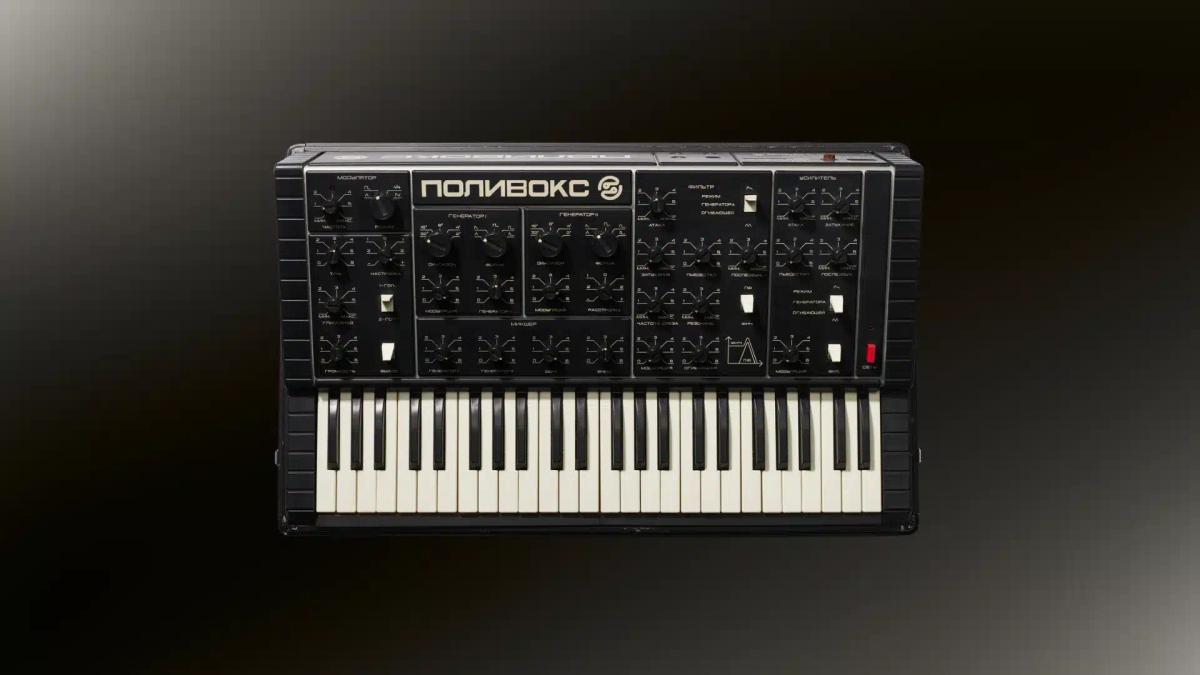
It is a strong visual object. The military-inspired design and Cyrillic panel are part of why bands and producers have sought it out.
Limitations
Build quality is uneven. Sound On Sound describes a flimsy case, fragile clips, and cracking plastic end-pieces, and Kuzmin himself acknowledged component quality problems in production.
The keyboard is widely criticized. Both Sound On Sound and Bonedo rank its shallow, clattering keybed among the worst they have played.
Tuning and stability demand patience. The oscillators drift, and trimmers under the nameplate are needed for calibration.
There are no performance controllers. With no pitch bend, mod wheel, velocity, or aftertouch, expressive playing depends almost entirely on the panel.
Connectivity is awkward for modern setups. DIN audio sockets and the absence of MIDI on unmodified units mean adapters or retrofits are usually required.
It is heavy and bulky. At around 18 kg and more than twice the size of an original Korg MS-20, it is not a casual instrument to move.
Its tonal range is narrow by design. It is not the right tool for gentle, polished, or traditional imitative sounds such as brass and flute.
Historical context
The Formanta Polivoks emerged from a very specific gap. In the early 1980s, few Western synthesizers reached the Soviet Union, and Soviet musicians heard Moog, Korg, and Roland sounds mostly on imported records. Kuzmin, an electronics engineer from Sverdlovsk, set out to give those musicians access to comparable sounds. In an interview with Red Bull Music Academy he said he wanted to invent “something close to Peter Zinovieff’s Synthi 100.” Bonedo notes that he had seen synthesizers only on television, so the Formanta Polivoks was designed from scratch rather than copied from a Western model.
The Formanta Polivoks was developed at Vector, a former military factory that had shifted toward electronic instruments under the Soviet planning system, and manufactured at Formanta in Kachkanar. It sold only within the USSR. At 920 roubles it was expensive for individuals, a point Kuzmin acknowledged, though he considered it reasonable for the cultural organizations that bought many of them. Later revisions improved stability and tuning, and Sound On Sound notes that an update around 1985 softened some of the original harshness.
Production figures are genuinely uncertain. Kuzmin has given numbers that point to roughly 20,000 to 30,000 units in total, Red Bull Music Academy cites about 25,000, and The Moscow Times reported more than 100,000. What is clearer is how the story ended. Once American and Japanese synthesizers became available to Soviet musicians, the Formanta Polivoks lost much of its appeal at home, and production stopped in 1990 as the economic system around it collapsed.
Legacy and significance
The Formanta Polivoks matters because it is one of the few vintage synthesizers whose character came from isolation rather than imitation. It was meant to stand in for Western instruments, yet Soviet components and a designer working largely without reference models produced something that sounded nothing like them. That is why later writers resist the old nickname “the Russian Minimoog.”
Its second life is just as important as its first. After 1991, units moved west, especially into Germany and Poland, and the instrument became part of hard techno and industrial music. A synthesizer built as a practical substitute turned into a sought-after source of a sound Western gear could not easily reproduce. Artemy Troitsky, quoted by The Moscow Times, attributed this revival both to the general fashion for vintage analog and to the fact that the Formanta Polivoks makes sounds Western instruments cannot.
The filter in particular has outlived the Formanta Polivoks. Erica Synths, The Harvestman, and Papareil Synth Labs have all produced Eurorack or DIY versions, with Erica’s Black Polivoks VCF still using original K140UD12 chips. A desktop Polivoks Pro was hand-built in Moscow in a run of 100 units, Elta Music worked with Kuzmin on a smaller Polivoks Mini, and Cherry Audio’s Atomika brought the concept into software. In 2021 Behringer announced a partnership with Kuzmin to develop a new Polivoks-inspired instrument. The Formanta Polivoks became a reference point for what a filter can sound like when it ignores the usual rules.
Artists, users, and curiosities
Goldfrapp’s Black Cherry is one of the best-documented uses. In Sound On Sound’s account of the album’s production, Will Gregory used the Formanta Polivoks for the “submarine bass sound” on the title track and for the “throbbing, metallic growl” of “Train,” while admitting that with a Cyrillic panel he did not know what every control did.
Franz Ferdinand used the Formanta Polivoks on their 2009 album Tonight: Franz Ferdinand. Alex Kapranos told The Moscow Times that the band was drawn in part by its look, which he compared to the control panel of a Soviet tank. Composer Mick Gordon also used an original Formanta Polivoks for synth sounds on the 2016 Doom soundtrack, and Gearnews reported that because everything was labelled in Russian, much of what he got from it was accidental.
The curiosities are almost as memorable as the sound. The name refers to multiple timbres or voices rather than polyphony, and Kuzmin told Sound On Sound that the logo, often read as a yin-yang, actually represents two solder points on a circuit board. The military appearance was deliberate: Olimpiada Kuzmina, who trained in design, drew on Soviet military radios, and Kuzmin said the ATTACK knob was meant to give it the feeling of a military synthesizer.
In 2016, when asked about reviving the Polivoks, Kuzmin quoted a proverb about not stepping into the same water twice; five years later he approached Uli Behringer about a new version. The Moscow Times also reported that German musician Kai Niggemann bought his Formanta Polivoks in a Polish pawn shop for about 70 euros.
Formanta Polivoks market value
Current market position: a collectible vintage analog synthesizer valued for its filter, its history, and its Soviet design rather than for versatility
New price signal: no new original units; the closest new options are reissues and clones such as the desktop Polivoks Pro, Eurorack modules, and software emulations
Used market signal: Red Bull Music Academy and Bonedo both reported roughly $800 to $1,500 or €700 to €1,000 around 2016; more recent listings tracked by Soundprogramming cluster around $1,000 to $1,640 for complete units, with MIDI-retrofitted and serviced examples often at the higher end
Availability: not common outside Russia and Eastern Europe; Bonedo notes that searching in Cyrillic and buying from Russian sellers has historically produced the best deals
Buyer notes: check the keyboard contacts, case clips and end-pieces, tuning stability, switch condition, and whether a MIDI retrofit has been installed; confirm mains voltage and allow for DIN-to-jack audio adapters
Support ecosystem: Russian-language manuals and schematics circulate online, specialist technicians service the Formanta Polivoks, and Sound On Sound’s reviewer reported never hearing of an irreparable unit
Market character: collectible and steadily sought after, with condition and servicing history mattering more than cosmetic perfection
Long-term position: likely to remain a cult classic, sustained by its documented use, its distinctive filter, and a growing family of clones that keep the original name in circulation
Conclusion
The Formanta Polivoks represents a rare case in synthesizer history: an instrument shaped as much by political and industrial isolation as by engineering intent. It was built to give Soviet musicians the sounds they heard on Western records, and instead it produced a voice entirely its own, rough, unstable, and unmistakably aggressive. The Formanta Polivoks matters because it proved that a synthesizer made far from the industry’s centers could still define a sound the rest of the world would later chase.
His connection with music began at age 6, in the 1980s, when his father introduced him to Jean-Michel Jarre's Rendez-Vous on vinyl. He works professionally in the legal field, while synthesizers became his space for abstraction and creative exploration. Founder of The Synth Source.