Home›Articles›What was the first song to use a synthesizer? It depend…
Articles

What was the first song to use a synthesizer? It depends on what you count

There is no single first synth song. Here are the real candidates, from RCA Mark II works and 1967 Moog rock to Switched-On Bach, and what each was first at.

Bernardo de Azevedo
Bernardo de Azevedo
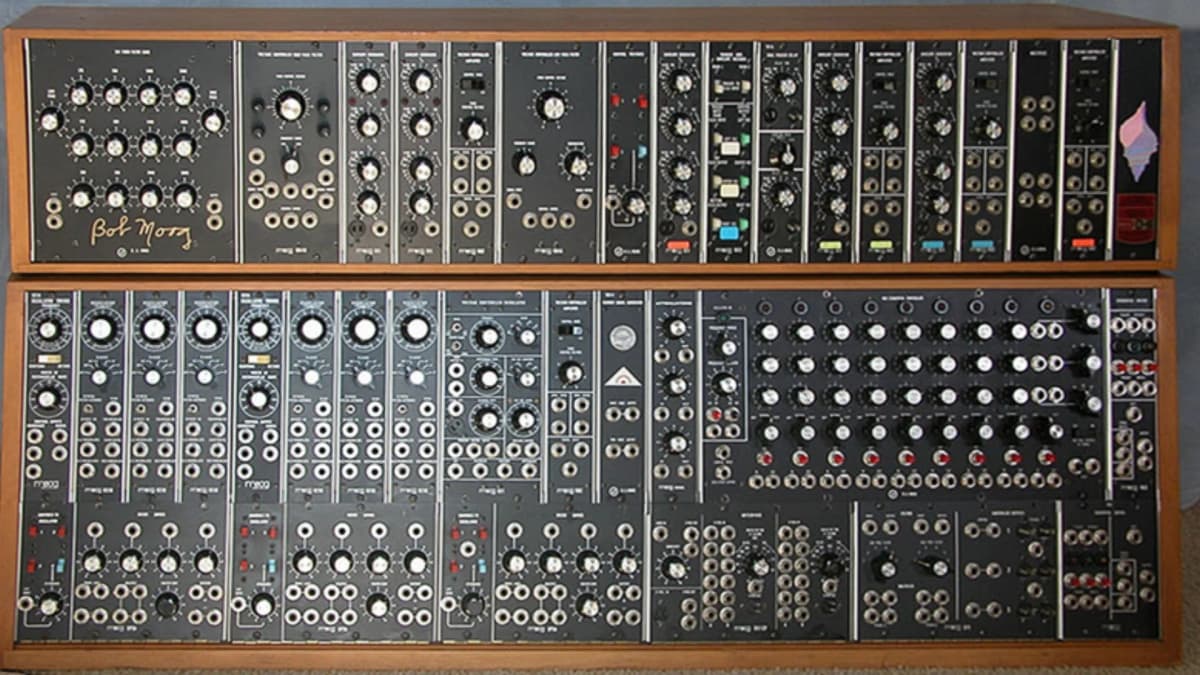
Moog Modular 55, one of the first synth systems heard on records

There is no single first song to use a synthesizer, because the answer depends on what you call a synthesizer and what you call a song. If you mean a piece made on an instrument actually called a synthesizer, the RCA synthesizer records of 1955 and Milton Babbitt’s RCA Mark II works from 1961 come first. If you mean a pop or rock song with a Moog on it, the strongest candidates are 1967 recordings: Mort Garson’s The Zodiac: Cosmic Sounds (May 1967), Perrey and Kingsley’s Kaleidoscopic Vibrations, the Doors’ “Strange Days” and the Monkees’ “Daily Nightly” and “Star Collector”. If you mean the first synthesizer record to become a mass hit, that is Wendy Carlos’s Switched-On Bach (1968).

Below is each candidate, what it is first at, and where the common claims get shaky.

Why there is no single first song to use a synthesizer

“Synthesizer” has meant different things over time. Electric and electronic instruments such as the Telharmonium, the theremin and the ondes Martenot made electronic sounds decades before anyone sold a “synthesizer”, and the theremin, ondes Martenot and trautonium were all commercially produced by the early 1930s. Few historians call them synthesizers, though, because they offer one fixed way of making sound rather than a system for building timbres from oscillators, filters and envelopes.

The word “song” matters too. Some early synthesizer works are avant-garde compositions on tape, not songs you could hum. So it helps to split the question into several firsts.

The first synth song candidates, by definition

If “first” means… Best answer Year
Electronic instrument in popular music Theremin in film scores and Samuel Hoffman’s pop records 1940s
Music released from a machine called a synthesizer RCA’s LP The Sounds and Music of the RCA Electronic Music Synthesizer 1955
Composition written for a synthesizer Milton Babbitt, Composition for Synthesizer (RCA Mark II) 1961
Commercial album featuring the Moog Mort Garson, The Zodiac: Cosmic Sounds (with Paul Beaver) 1967
Rock song with a Moog The Doors, “Strange Days”; the Monkees, “Daily Nightly” 1967
Hit album made on a synthesizer Wendy Carlos, Switched-On Bach 1968
Synthesizer instrumental that became a worldwide pop hit “Popcorn” (Kingsley 1969, Hot Butter’s cover 1972) 1969–1972

Before the first synth: the theremin and friends

Electronic tones reached popular music through the theremin. Miklós Rózsa used it in Hollywood scores such as Spellbound and The Lost Weekend, it famously appeared in The Day the Earth Stood Still (1951), and theremin player Samuel Hoffman carried the sound into pop records at the end of the 1940s. The Beach Boys’ “Good Vibrations” (1966), often cited as the classic theremin hit, actually used Paul Tanner’s Electro-Theremin, a different instrument that he played himself. The single reached number one in the US and the UK. None of these is a synthesizer in the modern sense, but they are the first time many listeners heard electronic tones in a hit. Our theremin story covers this in depth.

The same is true of the 1956 Forbidden Planet score, which Louis and Bebe Barron built from custom circuits and tape recorders, with no synthesizer as we would define it.

The RCA synthesizers and Milton Babbitt: the first synth records

The first machines actually called synthesizers were RCA’s room-sized instruments designed by Harry Olson and Herbert Belar. RCA issued an LP in 1955, The Sounds and Music of the RCA Electronic Music Synthesizer, and the larger Mark II was installed at the Columbia-Princeton Electronic Music Center in 1957. It read punched paper tape and is often described as the first programmable synthesizer.

Milton Babbitt was its main user. His Composition for Synthesizer (1961) and Vision and Prayer (1961), a Dylan Thomas setting for soprano and synthesized tape, are among the first works written specifically for a synthesizer. Philomel (1964) followed, and Charles Wuorinen’s Time’s Encomium, realised on the RCA, won the 1970 Pulitzer Prize for music. If your definition is strict, this is where the first synthesizer music lives. The full story is in our RCA Mark II article.

1967: the first synth songs with a Moog in pop and rock

Robert Moog’s modular synthesizer went on sale in 1964, and by 1967 it began turning up on commercial records. Several releases from that year compete for “first”:

  • Mort Garson, The Zodiac: Cosmic Sounds (May 1967): Paul Beaver played Moog and other electronics, and it is described as the first album recorded on the US West Coast to use the Moog. Critic Richie Unterberger called it some of the first Moog heard on a commercial recording, a carefully hedged claim.
  • Perrey and Kingsley, Kaleidoscopic Vibrations (1967): the duo added the Moog to Jean-Jacques Perrey’s Ondioline and are counted among the first musicians to use it. See our Jean-Jacques Perrey story.
  • The Doors, “Strange Days” (1967): the title track of their second album is widely cited as an early use of the Moog in rock; the band experimented with the instrument during the sessions.
  • The Monkees, Pisces, Aquarius, Capricorn & Jones Ltd. (1967): “Daily Nightly” and “Star Collector” feature early Moog parts, and the album spent five weeks at number one in the US.

Exact release dates within 1967 are where online claims often go wrong, so be wary of any source that crowns one of these as “the” first without explaining its definition. Paul Beaver, who later worked with Bernie Krause as Beaver & Krause, was the key session player because he was one of the few people on the West Coast who knew how to set up and play the instrument.

Rock acts including the Grateful Dead and the Rolling Stones also picked up the Moog in the late 1960s. The Beatles used it on Abbey Road in 1969, on “Because”, “Here Comes the Sun”, “Maxwell’s Silver Hammer” and “I Want You (She’s So Heavy)”, and George Harrison released a whole album of Moog experiments, Electronic Sound, that year. Our Beatles and the Moog story tells that part.

Experimental rock: Silver Apples

Silver Apples, a New York duo, built songs around a rig of oscillators in the late 1960s and are recognised as pioneers in combining psychedelic rock with electronic tones. Their setup was not a commercial synthesizer, which is why they rarely appear in “first synth song” lists, but they deserve a mention. See our Silver Apples story.

1968: Switched-On Bach makes the synthesizer famous

Wendy Carlos’s Switched-On Bach, released in October 1968, was not the first Moog record, but it was the first to become a mass phenomenon. It reached number 10 on the Billboard 200, topped the classical chart from 1969 to 1972, won three Grammys in 1970 and eventually went platinum. It also set off a wave of Moog cover albums. For many listeners this was the first synthesizer record they ever owned. Read more in our Wendy Carlos story.

“Popcorn” and the first synth pop hits

Gershon Kingsley wrote and recorded “Popcorn” for his 1969 Moog album Music to Moog By. The tune became a worldwide success in 1972 through Hot Butter’s cover, which makes it a strong answer to “first synthesizer instrumental hit”. After that the Minimoog (1970), the first synthesizer sold in music stores, put synths on stages and radio. Sun Ra recorded with one on My Brother the Wind in 1970, possibly the first to do so, and Kraftwerk’s Autobahn (1974) reached number 5 on the US album chart, with the edited title track reaching number 11 in the UK. Our Minimoog story picks up from there.

FAQ

What was the first rock song to use a Moog synthesizer?

The Doors’ “Strange Days” and the Monkees’ “Daily Nightly” are the usual answers, both from 1967. Sources disagree on which came out first, so treat both as co-claimants.

Did the Beatles use a synthesizer first?

No. The Beatles used the Moog in 1969 on Abbey Road, two years after the Doors, the Monkees and Mort Garson.

Is “Good Vibrations” a synthesizer song?

Not strictly. Its eerie lead is an Electro-Theremin played by Paul Tanner, an electronic instrument but not a synthesizer.

What was the first album made entirely on a synthesizer to be a hit?

Wendy Carlos’s Switched-On Bach (1968), which went top 10 in the US and later sold over a million copies.

Related articles

Sources

Image credits: Moog Modular 55 photo by Kimi95 (derivative work by Clusternote), Wikimedia Commons, CC BY 3.0. The photo was cropped to fit the featured image.


Bernardo de Azevedo
Written by
Bernardo de AzevedoFounder & Editor

His connection with music began at age 6, in the 1980s, when his father introduced him to Jean-Michel Jarre's Rendez-Vous on vinyl. He works professionally in the legal field, while synthesizers became his space for abstraction and creative exploration. Founder of The Synth Source.