

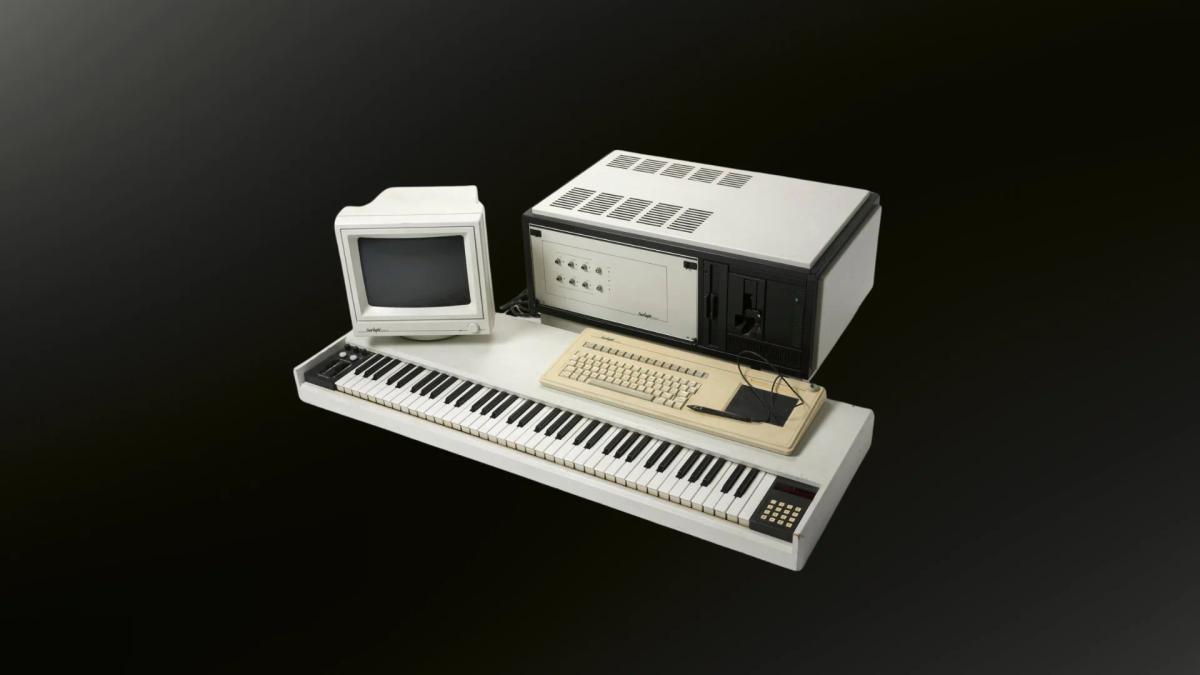
The Fairlight CMI Series III is the last generation of the Computer Musical Instrument, launched by Fairlight Instruments of Sydney in 1985. It replaced the 8-bit sound of the Series II and IIx with 16-bit sampling at 44.1kHz as standard (up to 100kHz in mono), doubled polyphony to 16 voices, pooled 14MB of shared waveform memory, and added a hard disk, a stylus-and-tablet interface, multiple MIDI ports, SMPTE sync and the CAPS sequencer. At roughly £50,000 to £65,000 depending on configuration and source, it was a studio system rather than an instrument. What makes it matter is that it turned the Fairlight from a novelty sound source into a complete production and scoring environment, used heavily on film and television work through the late 1980s.
Table of Contents
Fairlight CMI Series III sound and character
The Fairlight CMI Series III sounds clean, full-range and noticeably more neutral than its predecessors. The Series II’s 8-bit samples, capped at about 30kHz, had a gritty, aliased character that defined early-1980s Fairlight records; the Fairlight CMI Series III’s 16-bit converters, one per voice, and its default 44.1kHz rate gave what Fairlight marketed as compact disc quality. Each voice card also carried a digitally controlled filter and amplifier, so samples could be shaped after playback rather than simply triggered.
Its real strength is depth of memory. Where each Series II voice had 16K of its own waveform RAM, the Fairlight CMI Series III shares a 14MB pool across all voices, later expandable, which Sound On Sound calculated at more than two minutes of sampling at 48kHz. That allowed long, multisampled instruments, stereo samples and full phrases. A voice could map up to 128 subvoices across the keyboard, from a simple split to a different sample on every key, and 8-bit and 16-bit material could be mixed in the same performance, so owners could still use the older library.
It was also a synthesizer. The waveform editor let users draw waves, and the FFT page offered additive analysis and resynthesis with 255 harmonics under amplitude and phase control, against 32 harmonics with fixed phase on the Series II. Few owners explored it: one studio user told Sound On Sound he used the machine as a sampler 90% of the time.
The Fairlight CMI Series III lacks the lo-fi signature that made the earlier CMI instantly recognizable, and it does not sound like an Akai or Emulator either; its character comes from per-voice conversion and the way users built sounds inside its pages. It is precise, polished and slightly sterile compared with the Series II, which is exactly what film and post-production clients wanted.
Features and architecture
- Manufacturer: Fairlight Instruments Pty Ltd, Sydney, Australia
- Year introduced: 1985; magazine previews and reviews followed in 1986
- Production years: about 1985 to 1989 as a music system, with the MFX post-production line built on the same platform into the 1990s; some references extend the CMI range to 1992
- Synthesis type: digital sampling with waveform drawing and FFT-based additive resynthesis
- Category: high-end sampling workstation with integrated sequencing and synchronization
- Polyphony: 16 voices in the basic system; external voice racks and later memory options extended this, with Fairlight quoting up to 64 or 80 voices in different configurations
- Multitimbrality: several instruments could be resident at once and played together within the voice limit, with Nphony settings assigning voices to each
- Sampling: 8-bit or 16-bit, mono or stereo; 44.1kHz default, about 50kHz in stereo and up to 100kHz in mono
- Sample memory: 14MB shared waveform RAM as standard; later 32MB configurations exist, and Kim Ryrie described a 28MB-per-16-voices option in 1987
- Original price: around £60,000 in the UK according to most sources; Electronics & Music Maker quoted both £60,000 and £65,000, and Australia’s NFSA gives about £50,000
- Current market price: no Reverb price guide exists; restored systems have sold for roughly $12,000 to $22,000 in documented listings
- Oscillators: none in the analog sense; each voice is a 16-bit sample playback channel on one of eight dual-channel audio cards
- Filter: digitally controlled filter per voice
- LFOs: per-voice modulation parameters on the FX page
- Envelopes: per-voice and per-subvoice envelope and level parameters on the FX page
- Modulation system: assignable wheels, switches, pedals and sliders mapped to voice parameters
- Sequencer / arpeggiator: Rhythm Sequencer (the renamed Page R, 16-voice, 26 sections per song), CAPS (Composer, Arranger, Performer, Sequencer) with 80 tracks, and MCL text-based composition language
- Effects: none onboard
- Storage: 8-inch floppy drive and internal hard disk (reported as 70MB, 110MB or 140MB depending on source and date), SCSI for further drives, tape backup and slave units
- Computer: two Motorola 68000s and multiple 6809 processors running Fairlight’s modified OS-9 multitasking operating system
- Keyboard: 73-key (six octaves, F to F) unweighted music keyboard; Electronics & Music Maker described it as attack-velocity sensitive only, while some later references credit the Fairlight CMI Series III with aftertouch
- Controllers: alphanumeric keyboard with built-in pressure-sensitive graphics tablet and stylus, replacing the earlier light pen
- Inputs / outputs: per-voice audio outputs from the channel cards, sample input, click and clock outputs, metronome output, Roland DIN sync
- MIDI / USB: 3 MIDI in and 4 MIDI out, fully integrated; SMPTE timecode read, generate and chase
- Display: dedicated video monitor with page-based interface and windowed help and directories
- Dimensions / weight: the Science Museum Group’s mainframe measures 345 x 750 x 480 mm and weighs 45kg, before keyboards and monitor
- Power: mains-powered mainframe with separate digital and analog supplies
Strengths
- Sample quality was a generational leap. Sixteen-bit conversion on every voice and a 44.1kHz default rate moved the Fairlight from characterful 8-bit grit to full-bandwidth sound.
- The shared memory pool changed how instruments could be built. Instead of fixed per-voice RAM, long samples and big multisamples could draw on one large pool, with up to 128 subvoices per voice.
- Synchronization made it a scoring tool. SMPTE read, write and chase, plus four MIDI outputs, let it lock to picture and drive whole rigs, which is why about half its owners used it for film work, according to Kim Ryrie.
- Three sequencing methods could be used together. The pattern-based Rhythm Sequencer, the track-based CAPS and the MCL language covered rhythmic, linear and programmed composition.
- Analysis and resynthesis went far beyond playback. The waveform editor and the 255-harmonic FFT page made it a serious additive synthesizer for those who invested the time.
- Backward compatibility protected investments. Series II sample libraries and Page R sequences could be converted, and 8-bit and 16-bit samples could be combined.
Limitations
- The price restricted it to wealthy studios, successful artists and production houses. Sound On Sound noted that owning one required being reasonably successful.
- The music keyboard was weak for the money. Reviewers criticized its plastic, unweighted keys and limited touch response, especially against the Synclavier.
- CAPS was unfinished at launch. Electronics & Music Maker’s preview described the flagship sequencer as incomplete, and the icon-driven interface was still being developed in late 1986.
- The learning curve was steep. The page-based system rewarded long study that working musicians rarely had, and many sessions relied on a dedicated programmer.
- The synthesis tools went largely unused, with most owners treating it as a very expensive sampler.
- Age is now the main problem. Thirty-year-old hard disks, 8-inch floppies, power supplies and dozens of cards make unrestored systems fragile and costly to revive.
Historical context
Fairlight was founded by Peter Vogel and Kim Ryrie, who built the original CMI on an architecture developed by Tony Furse. The Series I (1979) and Series II (1982) established sampling and the Page R sequencer, and the Series IIx added MIDI in 1983. By the mid-1980s, though, the competition had moved: New England Digital’s Synclavier offered 16-bit sampling at the top of the market, while E-mu and Ensoniq were bringing sampling down in price. Ryrie told Sound On Sound that the Fairlight CMI Series III returned to the shared-memory idea of Fairlight’s earliest prototype, abandoning the Series I and II approach of fixed memory per voice.
The Fairlight CMI Series III appeared in 1985 and reached reviewers in 1986. UK distributor Syco reported a waiting list, and Series II owners were offered trade-ins, with the old machines shipped back to Australia. Software kept evolving after launch: CAPS was completed later, an icon-driven interface followed, and options such as sample-to-disk, SMPTE-based film tools and music printing were announced. Fairlight then employed about 100 people in Sydney. In 1987 it introduced the MFX, essentially a Fairlight CMI Series III with a new control keyboard and a cue-list sequencer aimed at post-production.