

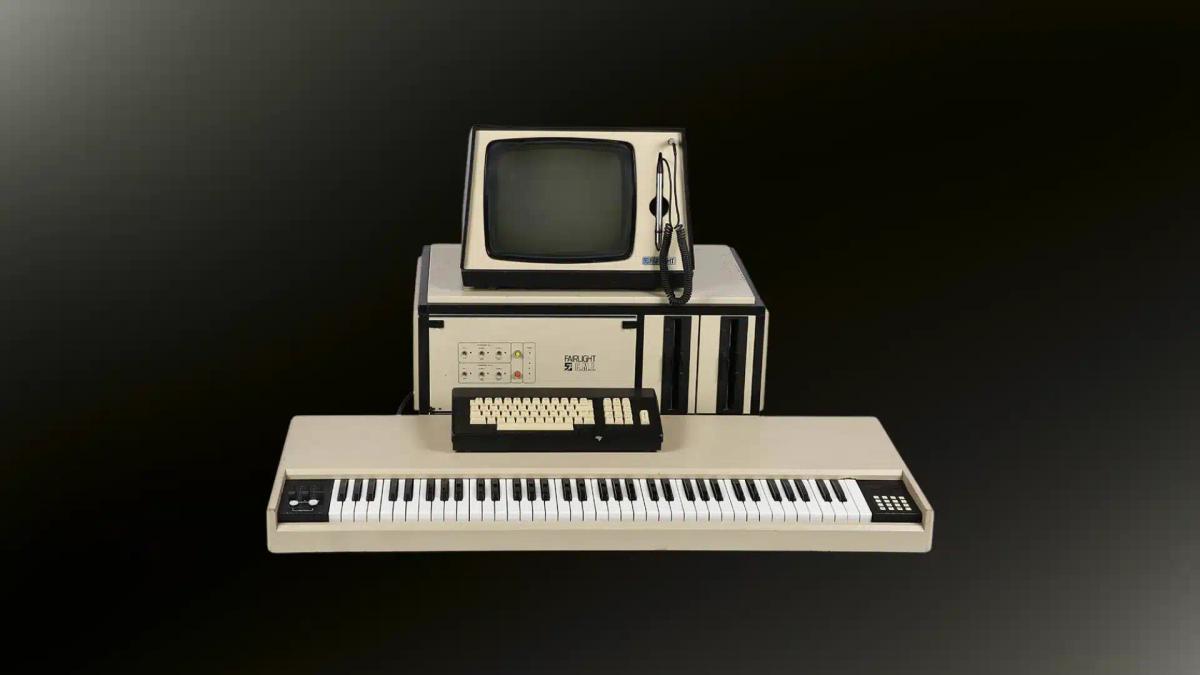
The Fairlight CMI Series II is an eight-voice, 8-bit digital sampling and additive synthesis workstation introduced by the Australian company Fairlight in 1982, followed in 1983 by the Series IIx revision, which brought faster processors, more system memory and an integrated MIDI/SMPTE option. Physically it was a computer before it was a keyboard, built around a mainframe of plug-in cards, a monitor with a light pen and 8-inch floppy drives. What made it matter was less the sampling itself, which the Series I had already offered, than Page R, a graphical pattern sequencer that turned an expensive sound library into a place where records were actually written.
Table of Contents
Sound and character
The Fairlight CMI Series II sounds grainy, punchy and surprisingly heavy. Its samples are 8-bit, stored in only 16 KB per voice, and the top sampling rate rose to 32 kHz from the Series I’s lower ceiling. Those numbers suggest something thin. Sound On Sound’s retrospective writer admitted he thought “it’s only 8-bit, it’ll sound awful” before buying one, then found that the original hardware consistently sounded better than samples taken from it, with a low end that had “an ability to move furniture.”
Much of that character comes from how the machine is built. Each of the eight voices lives on its own channel card with its own sample RAM, digital-to-analog converter and analog low-pass tracking filter, and each voice has its own audio output. The filter is a genuine tone control rather than a hidden fix: a 1984 Electronics & Music Maker tutorial explained that opening it gives a brighter sound at the cost of audible “digital birdies,” while closing it suppresses them but dulls the result.
Short memory also shaped the musical results. With roughly half a second to a second of sound available at practical rates, the Fairlight excelled at stabs, hits, plucks, breaths, percussive fragments and loops rather than long, natural-sounding instruments. Its best-known library sounds, such as the ORCH5 orchestral hit and the ARR1 choir, are short and emphatic. Realism was not its gift: JJ Jeczalik recalled Paul McCartney hearing a sampled brass part and remarking that it did not sound like a horn section. Its strength was making real-world sounds slightly unreal and repeating them with mechanical confidence.
Features and architecture
- Manufacturer: Fairlight (Sydney, Australia)
- Year introduced: Fairlight CMI Series II in 1982; Series IIx in 1983
- Production years: Sound On Sound dates the Fairlight CMI Series II to 1982-1983 and the IIx to 1983-1984, before the Series III took over
- Synthesis type: digital sampling with additive synthesis (harmonic and waveform drawing tools), 8-bit
- Category: sampling workstation and music computer with keyboard
- Polyphony: 8 voices, one per channel card, each functioning as an independent monophonic sampler
- Original price: around £27,000 to £30,000 in the UK depending on source and configuration; U.S. figures of $25,000 or more are commonly cited
- Current market signal: rare; a serviced IIx recently sold for around $20,000
- Oscillators / sample engine: 16 KB of waveform RAM per voice; sampling rate up to 32 kHz; shorter rates trade fidelity for longer sample time
- Processors and memory: two 8-bit Motorola 6800 CPUs and 64 KB system RAM on the Fairlight CMI Series II; two Motorola 6809 CPUs and 256 KB system RAM on the IIx
- Filter: analog low-pass tracking filter on each channel card; IIx software extended the filter range and allowed velocity or controller control of it
- LFOs: vibrato with assignable speed and depth
- Envelopes: per-voice Attack and Damping parameters on Page 7, with Attack assignable to key velocity, plus sustain and slur modes
- Modulation system: 17 real-time parameters patchable to six faders and five switches (three faders and two switches beside the keyboard, the rest via rear sockets), plus key velocity; patching done with the light pen or the alphanumeric keyboard
- Sequencer / arpeggiator: Page R real-time composer, an 8-part graphical pattern sequencer with quantization, up to 255 patterns combined into up to 26 phrases; also Page C and the text-based MCL (Music Composition Language)
- Effects: none onboard
- Memory: two 8-inch floppy drives (around 512 KB per disk), with factory and user voice libraries on disk
- Keyboard: six-octave velocity-sensitive music keyboard with non-weighted plastic keys; optional second (slave) keyboard; separate QWERTY alphanumeric keyboard
- Inputs / outputs: sampling input; individual audio output per voice; optional analog interface card for controlling external analog synthesizers
- MIDI / USB: no MIDI on the Fairlight CMI Series II; MIDI and SMPTE via an optional integrated interface on the IIx, with Page M assigning MIDI in and out; no USB
- Display: monochrome monitor (512 x 256 pixels) with light pen
- Dimensions / weight: multi-unit system; the mainframe alone is described as weighing around 80 lb
- Power: mains-powered mainframe; some units’ original floppy drives were built for 50 Hz supplies, which matters for buyers in 60 Hz countries
Strengths
- Page R changed the Fairlight CMI Series II’s role. A pattern-based, on-screen sequencer with quantization and copy-and-paste logic let musicians build complete arrangements inside the machine. Some buyers wanted the Fairlight for Page R alone.
- The sampled sound has real weight. Eight-bit samples through per-voice filters and dedicated outputs produce a punchy, slightly gritty tone that owners describe as more forceful than the specifications suggest.
- Separate outputs for each voice suited the studio. Each part could be compressed and treated separately, which is how engineers gave Fairlight drums their size.
- The light pen and graphics made sound visible. Drawing waveforms, picking loop points and patching controls on screen made digital audio unusually concrete for its time.
- The IIx added connectivity and headroom. Four times the system RAM, faster 6809 processors and integrated MIDI/SMPTE let the Fairlight drive and sync with other equipment instead of standing alone.
Limitations
- Sample memory is severely limited. With 16 KB per voice, users had to trade sampling rate against length, and long or evolving sounds were out of reach.
- Eight voices, each monophonic, cap the arrangement. Chords, drums and effects all compete for the same channels.
- The 8-bit resolution is noisy by later standards. Aliasing and “birdies” have to be managed with the tracking filter, which costs brightness.
- The price placed it far beyond most musicians. Contemporary accounts compare its cost to a house.
- The original Fairlight CMI Series II has no MIDI, and even on the IIx the interface was an option, so integration with later setups depends on how a given unit was configured.
- The workflow depends on menu pages, a light pen and 8-inch floppies. Media and monitors are now a maintenance concern.
Historical context
The Series I, released in 1979, had proven that a commercial instrument could sample, but its sequencing relied on MCL, a text-based composition language that required something close to programming. The Fairlight CMI Series II, launched in 1982, improved the sampling rate and the software, but its decisive move was Page R, credited to Michael Carlos and described by Red Bull Music Academy as arguably the first proper software sequencer. Wikipedia, citing Audio Media’s history of the company, calls Page R the feature that made the Fairlight CMI Series II “a commercial juggernaut.”
Timing mattered. In 1982 the Fairlight CMI Series II had few direct rivals: New England Digital’s Synclavier was even more expensive and added sampling later. The Fairlight’s public profile in the UK jumped after a South Bank Show feature that year showing Peter Gabriel using it. The IIx followed in 1983 and brought MIDI to the Fairlight.
That same connectivity anticipated the Fairlight’s decline. E-mu’s Emulator II arrived in 1984 at roughly a third of the price and matched many of the Fairlight CMI Series II’s features, and cheaper samplers such as the Ensoniq Mirage followed. A writer in The Register, who had spent £27,000 of a record advance on a IIx, sold it in 1987 for £7,000, arguing that MIDI let cheaper setups match its core functions. Fairlight answered with the 16-bit, 16-voice Series III.