

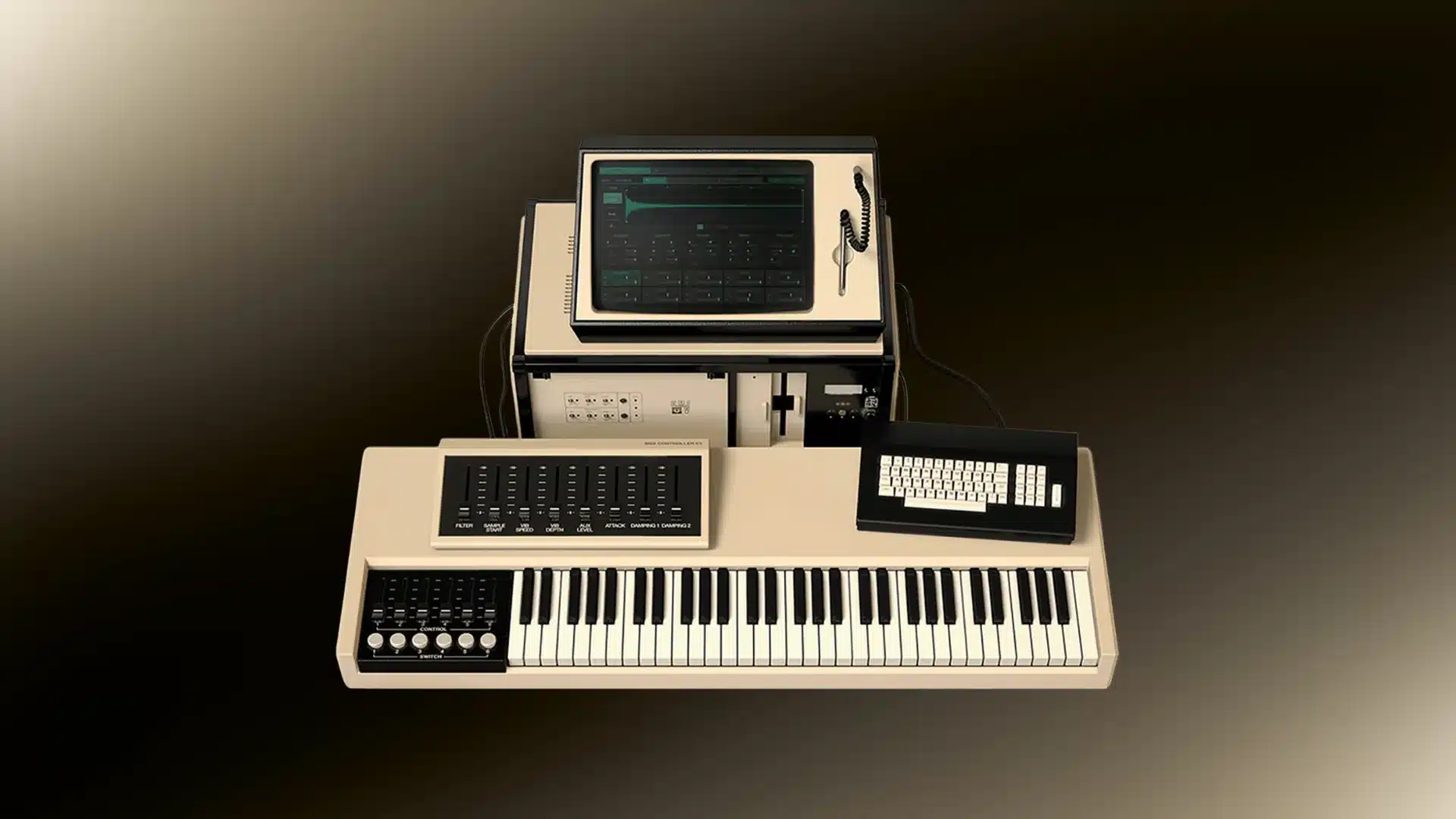
The Fairlight CMI Series I is the first production version of the Computer Musical Instrument, an eight-voice digital system developed in Sydney by Kim Ryrie and Peter Vogel and launched in 1979. Built around two Motorola 6800 processors, eight voice cards with 16K of waveform memory each, a light pen, a green-screen monitor, 8-inch floppy disks and a six-octave keyboard, it combined additive synthesis, hand-drawn waveforms and 8-bit sampling in one computer-based instrument. What makes it meaningful at a glance is simple: it was the machine through which the recording of real sounds, replayed across a keyboard, became a commercial musical tool rather than a laboratory curiosity.
Table of Contents
Sound and character
The Fairlight CMI Series I sounds like an early digital machine and makes no attempt to hide it. Samples are 8-bit, recorded at up to 24 kHz, and the waveform memory on each voice card is small, so a sound at the top rate lasts well under a second. Longer samples meant lowering the rate, down to around 8 kHz, where the result turns cloudy and fuzzy. Aliasing is part of the picture at every rate. Even sympathetic sources describe the original voice cards as “scratchy”, a reputation that the Series II was partly designed to address.
Yet the result is not just a list of defects. A longtime owner writing in Sound On Sound was astonished by the quality for an 8-bit system and singled out its strong bass. Each voice card has its own digital-to-analog converter and tracking filter, and the short, coarse samples gain a crunchy edge from that path. The Fairlight CMI Series I is best heard not as a failed attempt at realism but as a new sound in its own right: a pitched snapshot of the real world, slightly degraded and strangely vivid.
The other half of its voice is synthetic. Sounds could be built from harmonic profiles, computed segment by segment and scaled to the 8-bit range, or drawn on screen with the light pen and interpolated from one shape to another over time. These timbres lean toward glassy, evolving digital tones rather than analog warmth. In practice, the Fairlight CMI Series I is most distinctive with percussive or textural material: breaking glass, clattering objects and short fragments whose brevity becomes a rhythmic asset.
Features and architecture
- Manufacturer: Fairlight Instruments, Sydney, Australia
- Year introduced: 1979
- Production years: 1979 to 1982, when the Series II replaced it; existing units could be upgraded to Series II specification
- Synthesis type: 8-bit digital sampling combined with additive synthesis and hand-drawn waveform synthesis
- Category: computer-based sampling and synthesis workstation
- Polyphony: 8 voices, one per voice card
- Original price: sources differ; UK retrospectives commonly cite around £18,000, other accounts give £12,000 through UK distributor Syco Systems, and US accounts cite around $25,000
- Current market signal: very rare; occasional listings of complete units ask five-figure dollar sums
- Processors: two 8-bit Motorola 6800 CPUs working in tandem
- Sound generation: 8 voice cards, each with 16K of waveform RAM and its own DAC
- Sampling: 8-bit, up to 24 kHz; sample length roughly a quarter of a second to one second, with lower rates down to about 8 kHz for longer sounds
- Filter: per-voice tracking filter on each voice card
- LFOs: no analog-style LFO section; vibrato and other performance parameters assigned through the keyboard’s sliders and switches
- Envelopes: basic per-voice amplitude shaping; sources describe envelope control as limited
- Modulation system: three sliders and two switches on the music keyboard, assignable to parameters such as vibrato, volume and sustain; harmonic-profile interpolation for timbral movement
- Sequencer / arpeggiator: text-based Music Composition Language (MCL) on Page C; no Page R, which arrived with the Series II
- Effects: none onboard
- Memory: 8-inch floppy disks of about 500 KB; the factory library shipped with 22 orchestral instrument samples
- Keyboard: 73-note, six-octave velocity-sensitive music keyboard, plus a separate QWERTY keyboard; an optional second music keyboard was available
- Inputs / outputs: sampling input through the ADC hardware, voice outputs from the voice cards; optional analog interface card for controlling external analog synthesizers
- MIDI / USB: none; MIDI only arrived with the Series IIx
- Display: monochrome green-screen monitor with light pen for waveform drawing and page selection
- Dimensions / weight: mainframe about 750 × 450 × 320 mm and around 40 kg; a full system with keyboards and monitor has been described as weighing around 100 kg
- Power: mains-powered mainframe; detailed ratings not confirmed in the sources consulted
Strengths
- It made sampling practical. Real sounds could be recorded, viewed, edited and played chromatically in one integrated system, years before cheaper samplers made the idea routine.
- Its interface was radically visual for 1979. The light pen and waveform display let musicians see and draw sound rather than infer it from knobs.
- It combined several synthesis methods in one box. Additive harmonic construction, interpolated waveform drawing and sampling all fed the same eight voices.
- The 8-bit sound has a recognizable bite. Short, grainy samples with strong low end gave records a texture that later, cleaner machines did not reproduce.
- Floppy-disk storage made sound libraries portable, so sounds and compositions could be saved, exchanged and reloaded quickly.
Limitations
- Sample memory was tiny. With 16K per voice, sounds lasted around a second at most, and longer samples forced a lower, duller sample rate.
- Fidelity was limited even next to its successors. Eight-bit resolution, a 24 kHz ceiling and aliasing produced the “scratchy” reputation the Series II improved on.
- Sequencing was hard to use. MCL was a text-based language widely described as impenetrable for musicians without an engineering background.
- It had no MIDI, so integration with other instruments relied on the optional analog interface or later upgrades.
- The price put it out of reach of almost all working musicians, and its size and weight made it a studio fixture.
- Holding a light pen up to a vertical screen was tiring, a complaint Fairlight eventually answered with a graphics tablet on the Series III.
Historical context
The Fairlight CMI Series I emerged from a project that originally had nothing to do with sampling. Ryrie and Vogel founded Fairlight in December 1975, naming it after a Sydney Harbour hydrofoil, to build a digital synthesizer. They licensed technology from Tony Furse, a Motorola consultant developing an all-digital additive system, and built the eight-voice Qasar M8: bulky, expensive and, by the founders’ account, sonically sterile.
The breakthrough came from memory. As 16K dynamic RAM chips became available, the design was rebuilt with one channel per card and four times as much waveform RAM, enough to store an entire recorded sound rather than a single synthetic cycle. In 1978 Vogel recorded a short piano passage from a radio broadcast and played it back at different pitches; it sounded, he said, remarkably like a real piano. Ryrie and Vogel coined the term “sampling” and reportedly regarded the technique as something close to cheating at first.
The finished Fairlight CMI Series I was launched in 1979 and shown at the AES convention in New York that year. Its timing mattered. Polyphonic analog synthesizers were reaching maturity, and the Synclavier is usually named as the Fairlight’s first direct competitor. The Fairlight CMI Series I answered a question few manufacturers were asking: what if a synthesizer could start from any sound in the world rather than from an oscillator? It was a flagship statement from a small Australian company, sold to an elite clientele, that defined a new category.
Legacy and significance
The Fairlight CMI Series I matters less as a mature product than as a proof of concept that escaped the lab. Its successors did the same things better: the Series II of 1982 brought faster processing, 32 kHz sampling and the Page R sequencer, the Series IIx added MIDI and the Series III moved to 16-bit sound. Those machines shaped 1980s pop far more directly, but they all rested on decisions made in the Fairlight CMI Series I: per-voice waveform memory, a sampling front end, a screen-based interface and the idea of the Fairlight CMI Series I as a workstation rather than a keyboard.