
Expressive E Osmose: The keyboard synth that makes MPE feel like an instrument
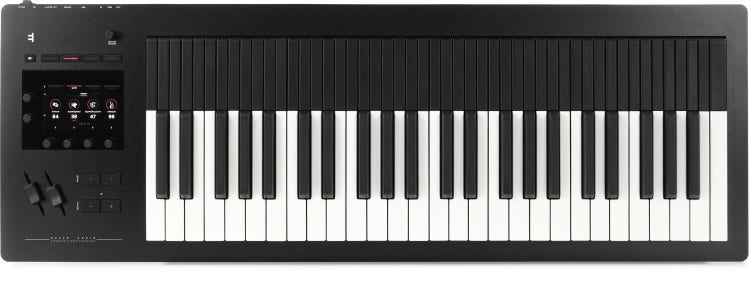
The Expressive E Osmose is a 49-key standalone digital synthesizer and MPE-capable controller that began shipping in 2023 after first being announced in 2019. Built around Expressive E’s gesture-sensitive Augmented Keyboard Action and Haken Audio’s EaganMatrix engine, it is one of the clearest attempts yet to merge the familiarity of a piano-style keyboard with the fluid, per-note expressiveness more often associated with specialist controllers and acoustic instruments.
Sound and character
Osmose does not sound like a conventional virtual-analog keyboard with extra aftertouch layered on top. Its identity is broader and stranger than that. The instrument’s built-in EaganMatrix engine can move from convincing physical-modeling gestures to FM-edged tones, from pliable synthetic leads to unstable hybrid textures that seem to sit halfway between an electronic patch and a living resonant body. In practice, that means it often excels less as a “one sound” machine and more as an articulation machine: an instrument whose real signature emerges when the player bends into notes, leans into pressure, shakes a held tone, or pulls sound sideways in a way that ordinary keyboards simply do not permit.
Continue Reading
That difference matters. Many synthesizers can produce a static imitation of a bowed string, a reed-like lead, or a plucked attack. Osmose is compelling because it can make those sounds behave with more continuous nuance under the fingers. Its best presets are not just timbres but performance systems. The acoustic-leaning voices feel less sample-like than many players will expect, while the more synthetic sounds benefit from a degree of instability and gestural phrasing that keeps them from feeling rigid. Even when it lands on recognizably electronic territory, Osmose tends to reward touch rather than brute programming.
Sonically, then, it leans neither purely vintage nor purely futuristic. It can evoke acoustic response, but it is not pretending to be a workstation. It can move into analog-style territory, but it is not organized like a nostalgia synth. What gives it character is the constant relationship between motion and sound: the feeling that timbre, pitch behavior, and articulation are inseparable.
Features and architecture
- Manufacturer: Expressive E, France; sound engine developed in collaboration with Haken Audio.
- Year: Officially released and began shipping in 2023, after its 2019 announcement.
- Production years: 2023 to present.
- Synthesis type: Digital modular synthesis via the EaganMatrix engine, with virtual analog, FM, physical-modeling, and hybrid possibilities depending on preset and programming.
- Category: Expressive keyboard synthesizer, standalone sound source, MPE controller, and classic MIDI controller.
- Polyphony: Up to 24 voices.
- Original price and current market price: Introduced at €1,799; the 49-key model still sits around that level new in many regions, with street pricing around $1,799 in the US.
- Oscillators: No fixed oscillator count in the traditional subtractive sense; architecture depends on the selected EaganMatrix program.
- Filter: No single fixed flagship filter design; filtering behavior is preset-dependent within the EaganMatrix environment rather than defined by one analog-style signal path.
- LFOs: Not presented as a fixed front-panel subtractive block; modulation structure depends on preset design and deep editing in Haken Editor.
- Envelopes: Likewise preset-dependent rather than exposed as one standard ADSR-per-voice architecture.
- Modulation system: Per-note gestural control including tap, press, pitch bend, vibrato, aftertouch, pressure glide, and note-off expression; six preset macros; assignable modulation slider and pedal control; deeper editing through Haken Editor.
- Sequencer / arpeggiator: No conventional onboard sequencer; built-in expressive/MPE arpeggiator and Pressure Glide performance functions.
- Effects: Global reverb/delay/echo, compressor/drive, shelving EQ; later firmware also added tanh saturation and long reverb.
- Memory: Current system supports 580 factory presets and up to 2048 preset slots; earlier units launched with roughly 500 presets and far fewer onboard slots before later firmware expansion.
- Keyboard: 49 full-size gesture-sensitive keys with Augmented Keyboard Action, polyphonic aftertouch, and per-note lateral pitch control.
- Inputs / outputs: Two 1/4-inch TRS pseudo-balanced line outputs, one 1/4-inch TRS headphone output, two continuous pedal inputs, locking external PSU input.
- MIDI / USB: DIN MIDI In, MIDI Out/Thru, USB Type B; USB carries MIDI, not audio.
- Display: Color LCD screen with dedicated encoders, buttons, and sliders.
- Dimensions / weight: Approximately 895 x 310 x 90 mm; 8.3 kg.
- Power: External locking PSU, 12V, 1.5A, center positive.
Strengths
- A genuinely different playing experience: Osmose is not merely more expressive on paper; its keybed changes phrasing, note shaping, and articulation in a way that feels immediate under the hands.
- A rare bridge between keyboard familiarity and MPE depth: It offers a far more approachable entry point into polyphonic expression than many alternative expressive surfaces.
- Preset design that is built for performance, not just browsing: The stock library is organized around touch interaction, so the best sounds reveal themselves through movement rather than static auditioning.
- A wide and unusual sonic range: Because the EaganMatrix is not tied to one synthesis ideology, Osmose can move credibly between acoustic-like responses, hybrid textures, and overtly synthetic material.
- Strong long-term platform potential: Firmware updates, expanding preset capacity, new effects, and a growing software ecosystem suggest that the instrument is being treated as an evolving platform rather than a frozen product.
- Useful dual identity: It is both a standalone instrument and a serious controller for MPE-compatible software and hardware, which makes it more versatile than many niche expressive devices.
Limitations
- Deep editing is not as immediate as the performance layer: The front panel is intentionally simplified, but serious sound design still leans heavily on the Haken Editor and on understanding a less conventional synthesis environment.
- It is expensive if judged as a normal 49-key digital synth: Much of the price makes sense only if the buyer truly values expressive control and not just onboard sound count.
- The playing feel is unusual and requires adaptation: Its key travel and lateral movement are central to its identity, but players expecting a standard synth or piano action will need time to recalibrate.
- No onboard sequencer: The instrument’s philosophy centers on gesture and articulation rather than step-sequencing workflows.
- USB does not transmit audio: In studio setups, it still behaves like an external instrument rather than an all-in-one USB audio device.
- Its architecture can be conceptually opaque to traditional subtractive-synth users: If you think mainly in terms of oscillator-filter-envelope panels, Osmose asks you to think in a more abstract way.
Historical context
Osmose arrived at an important moment. By the late 2010s and early 2020s, expressive control had become one of the most discussed frontiers in electronic instruments, but much of that conversation centered on controllers that asked keyboard players to abandon the keyboard itself. The Continuum Fingerboard, ROLI-style surfaces, and other MPE-oriented designs offered extraordinary nuance, but they also demanded a new physical language. Osmose answered a different question: what if per-note expressive control could live inside a recognizable black-and-white keyboard format without flattening that expressivity into ordinary aftertouch?
That is why the collaboration mattered. Expressive E already had credibility in gestural control through Touché, while Haken Audio had long been associated with some of the most sophisticated expression-focused synthesis in the field. Osmose brought those lineages together and tried to solve a long-standing market problem: how to make expressive synthesis playable by musicians who already speak keyboard fluently.
Its long gestation also shaped its meaning. Announced in 2019 and shipping in 2023, Osmose lived for years in that uncomfortable space between promise and proof. By the time it finally reached users, it had to be more than a concept. It had to justify the delay, the anticipation, and the skepticism that always accumulates around a highly ambitious instrument.
Legacy and significance
Osmose matters because it reframes expressivity as a keyboard issue rather than a controller niche. Plenty of instruments promise deeper modulation; far fewer ask what happens when touch itself becomes compositionally central again. In that sense, Osmose is significant not because it replaces existing synthesizers, but because it challenges the role many keyboards have settled into over the last few decades: efficient trigger surfaces for predetermined sound events.
What Osmose argues, implicitly, is that a keyboard can once again behave more like an instrument than an interface. That sounds abstract until you play it. A note is no longer just struck and held; it can bloom, tilt, resist, and buckle. This gives the instrument a significance that exceeds its feature list. It is one of the strongest modern cases for the idea that the future of synthesis is not only about bigger engines or more presets, but about more nuanced physical conversation between player and sound.
It also broadens access. The Continuum remains a landmark instrument, but it is specialized. Osmose does not dilute that lineage so much as translate part of it into a form that more musicians can approach. That translational role may end up being its deepest historical contribution.
Artists, users, and curiosities
Expressive E leaned heavily on artists to frame Osmose not as a lab curiosity but as a real musical instrument. Its official release campaign highlighted names such as Jean-Michel Jarre, A.R. Rahman, Flying Lotus, Mike Dean, Cory Henry, André Manoukian, Tarik Azzouz, and T.NAVA, which immediately positioned it across very different musical worlds rather than inside a single synthesizer niche.
One of the most memorable documented connections is Jean-Michel Jarre’s discussion of how Osmose helped shape special effects on Oxymore. That is revealing for two reasons. First, it links the instrument to an artist historically associated with performance-centered electronic sound. Second, it shows that Osmose is not only about showing off bends and slides in demo videos; it can be used as a sound-design tool inside a serious production context.
There is also a more telling curiosity behind the design philosophy. Expressive E’s broader origin story reaches back to university research around the Ondes Martenot, one of the earliest electronic instruments to foreground continuous, nuanced control. Osmose is obviously not a modern Ondes Martenot clone, but the family resemblance is philosophical: both treat expression not as ornament but as the core of the instrument.
Market value
- Current market position: A premium expressive digital synth/controller that occupies a category with very few direct competitors.
- New price signal: The 49-key model remains officially listed around €1,799, with major US retail pricing around $1,799.
- Used market signal: Recent used listings and dealer listings tend to place it roughly in the mid-$1,200s to mid-$1,600s, with some variation by condition, accessories, and region.
- Availability: Considerably easier to buy than during its original reservation phase; official store, dealer channels, and refurbished stock all point to a more stable supply picture.
- Buyer notes: It makes the most sense for players who care deeply about phrasing, touch, and MPE performance. It makes less sense as a value-first alternative to a conventional polysynth.
- Support ecosystem: Stronger than many niche instruments: official firmware development, Haken Editor integration, DAW setup guides, and an expanding ecosystem of MPE-oriented software and preset packs.
- Ease of finding one: No longer rare in the way it seemed during its delayed launch period, but still niche enough that it has not become an everyday mainstream store-floor synth.
- Long-term position: Stable rather than speculative. Its long-term reputation will likely be driven more by its role in expressive keyboard history than by collector scarcity.
Conclusion
The Expressive E Osmose is not important because it has more features than everything else around it. It is important because it asks a harder question: what would happen if electronic keyboards recovered some of the physical nuance that acoustic instruments take for granted? Its answer is not perfect, inexpensive, or conventionally simple, but it is substantial. Osmose stands as one of the most serious recent attempts to make synthesis feel played rather than merely triggered, and that alone gives it a durable place in the modern history of keyboards.

His connection with music began at age 6, in the 1980s, when his father introduced him to Jean-Michel Jarre's Rendez-Vous on vinyl. He works professionally in the legal field, while synthesizers became his space for abstraction and creative exploration. He enjoys composing synthwave and cinematic ambient music. Founder of The Synth Source.