

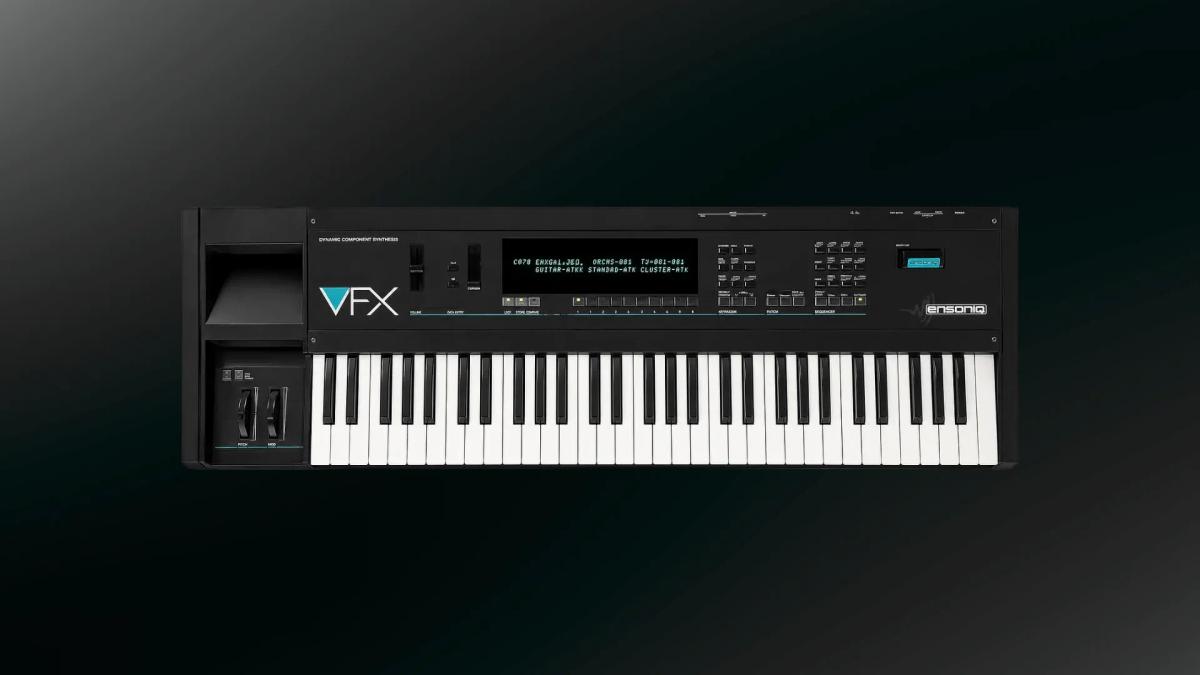
The Ensoniq VFX is a 61-key digital synthesizer that the Pennsylvania company introduced in 1989 as its first fully digital synth. Ensoniq called its engine Dynamic Component Synthesis: each Program stacks up to six Voices, each Voice plays one of 109 ROM waves (sampled instruments, single-cycle waveforms, inharmonic loops, and 17 sweepable Transwaves), and every Voice gets two digital filters, three multi-stage envelopes, an LFO, and a deep modulation matrix. It played 21 notes, was 12-part multitimbral, had polyphonic aftertouch and a 24-bit effects processor, and cost £1,350 in the UK. It matters as Ensoniq’s answer to the Korg M1 and Roland D-50, and as the engine on which the VFX-SD and SD-1 workstations were built.
Table of Contents
Ensoniq VFX sound and character
The Ensoniq VFX sounds big, glassy, and animated, with a slightly dark, grainy edge that reviewers noticed from the start. Simon Trask, reviewing it for Music Technology in July 1989, found it clean but not clinical and strongest on synthesized rather than imitative sounds, while noting that next to the M1 it came across as heavier and grainier. That character is a large part of its appeal today: pads and textures with a recognizably late-1980s digital sheen, but more movement than most ROM synths of the period.
Most of that movement comes from the Transwaves. Each is a table of roughly 100 related waveforms, and the read position through the table is a modulation destination, so an envelope, the mod wheel, aftertouch, or the LFO can sweep the timbre during a note. It is a development of the wavetable idea PPG had introduced, and names such as Spectral-X, Formant-X, Planet-X, and Esqbell-X hint at the range, from vocal formants to bell tones descended from the ESQ-1. Layering up to six of these and the sampled waves, each with its own envelopes and filters, gives the Ensoniq VFX its deep, evolving stacks.
The weak point is resonance. The two filters per Voice are a two- or three-pole low-pass followed by a one- or two-pole low- or high-pass, together giving four poles, but there is no resonance control. Ensoniq compensated with four Resonant Transwaves that imitate a sweeping resonant peak, which work for synth-brass and wah-like effects but do not replace a real resonant filter. Vintage Synth Explorer calls the filter pretty weak and the instrument better at strings and textures than at heavy drums and bass.
It sits between the hybrid Ensoniq synths that preceded it and the ROM workstations that followed: a programmer’s instrument with a sample-based palette, closer in spirit to the Roland D-50 and PPG Wave than to the M1’s preset-led approach.
Features and architecture
- Manufacturer: Ensoniq Corporation, Malvern, Pennsylvania (made in the USA)
- Year introduced: 1989; UK reviews appeared in June and July 1989, though some marketplace listings date units to 1988
- Production years: 1989 to the early 1990s; no firm end date is documented, and the line continued through the VFX-SD and SD-1
- Synthesis type: digital sample-based and wavetable synthesis (Ensoniq’s Dynamic Component Synthesis, with Transwaves)
- Category: performance synthesizer (no onboard sequencer)
- Polyphony: 21 voices with dynamic allocation; a six-Voice Program therefore plays three notes
- Multitimbrality: 3 Tracks in a Preset, 12 parts in Multi mode
- Original price: £1,350 including VAT in the UK; SoundProgramming lists a US MSRP of $1,995, a figure it also gives for the VFX-SD, so the US launch price is not firmly documented
- Current market price: Reverb’s price guide suggests around $363, with clean units from dealers listed at roughly $700 to $1,000
- Oscillators: one digital oscillator per Voice, up to six Voices per Program; 109 waves in 10 classes, including 17 Transwaves of about 100 waveforms each; 16-bit samples at about 39kHz; wave start can be delayed by up to two seconds
- Filter: two digital filters per Voice in series, a two- or three-pole low-pass and a one- or two-pole low- or high-pass; no resonance parameter
- LFOs: one per Voice, seven waveshapes, 0.05Hz to 21Hz, with delay
- Envelopes: three multi-stage envelopes per Voice for pitch, filter, and amplitude, each able to loop while a note is held; sources describe them as five-, six-, or 11-stage depending on how the segments are counted
- Modulation system: 15 sources (velocity, poly and channel pressure, wheels, pedal, envelopes, LFO, keyboard, random, data slider, external MIDI controller, and a Mod Mixer/Shaper with 16 curves) routed to pitch, wave start, Transwave index, both filters, LFO, volume, pan, and effects parameters
- Voice modes: Patch Select buttons switch among four combinations of the six Voices in real time; custom and system Pitch Tables for alternative tunings
- Sequencer / arpeggiator: none
- Effects: ESP (ES5510) 24-bit effects processor with 15 algorithms (reverbs, chorus, flanger, delay, rotary speaker, distortion, and combinations), fed by Dry, FX1, and FX2 busses
- Memory: 60 Programs and 20 Presets each in ROM, internal RAM, and cartridge
- Storage: cartridge port for ROM sound cartridges and RAM cartridges; SysEx dump
- Keyboard: 61 keys, velocity-sensitive, with polyphonic aftertouch
- Inputs / outputs: stereo audio outputs, headphones, pedal and footswitch inputs
- MIDI / USB: MIDI In, Out, and Thru; no USB
- Display: vacuum fluorescent display (Audiofanzine gives 2 x 40 characters) with soft buttons
- Dimensions / weight: Audiofanzine lists 1041 x 381 x 102mm and about 12.2kg, though its own spec pages also give 12.7kg
- Power: internal power supply
Strengths
- Transwaves give it genuine timbral motion. Sweeping through a wavetable with an envelope or aftertouch produces evolving tones that static ROM synths of 1989 could not.
- Six Voices per Program allows dense, carefully balanced layers. Each Voice has its own envelopes, filters, and modulation, so a single patch can contain an attack transient, a body, a sweep, and a noise layer.
- Polyphonic aftertouch is rare and useful. Each held note can respond to its own pressure, which makes swelling chords and individual voice inflections possible from the keyboard itself.
- Patch Select buttons make a single Program perform like four. Switching Voice combinations live is quick, and it remains one of the instrument’s most distinctive performance features.
- The modulation system reaches the effects. Reverb decay, chorus rate, or effect balance can be driven by wheels, pressure, or envelopes, which gives patches a dynamic finish.
- It was competitive on price and depth. Sound On Sound’s Paul Ireson judged it cheaper, better sounding, and more versatile than the M1 and D-50, and called the price an absolute steal.
Limitations
- There is no filter resonance. The Resonant Transwaves are a workaround, not a substitute, and classic squelchy analog-style sounds are hard to make.
- Twenty-one voices go quickly. A full six-Voice Program leaves only three-note polyphony, so complex patches and multitimbral parts compete for a small pool.
- There is no sequencer or disk drive. Ensoniq’s own ESQ-1 had offered a sequencer, and the omission put the VFX at a disadvantage against the M1 as a one-box production tool.
- Outputs are stereo only. Ireson called the lack of separate outputs a sad omission, and unlike the EPS sampler there was no expansion box for more.
- Reliability is a real concern. The three-piece keyboard assembly is known for cracked solder joints and calibration errors, early units had operating system bugs, and some owners report repeated repairs.
- The acoustic samples are limited. Reviewers in 1989 noted the thin drum and acoustic selection compared with the M1’s ROM and its PCM card library.
- Storage depends on aging cartridges. RAM cartridges and their batteries are now scarce and expensive, and the internal backup battery needs replacing.
Historical context
Ensoniq was founded in 1982 by Bruce Crockett, Al Charpentier, and Bob Yannes, former MOS Technology engineers who had left Commodore. The company’s Mirage sampler and its ESQ-1 and SQ-80 synths had all used Ensoniq’s own DOC chip, with digital oscillators feeding analog filters. The Ensoniq VFX broke with that hybrid formula. Built around the OTIS (ES5505) sound chip and the ESP (ES5510) effects processor, it was the company’s first all-digital synthesizer and, in Paul Wiffen’s words for Sound On Sound, the first Ensoniq that could really be compared with the Korg M1.
It arrived in the UK in mid-1989 at £1,350, against an M1 that dominated the market and a D-50 whose layered Partial structure the Ensoniq VFX resembled while doubling its component count from four to six. The British press was enthusiastic. Ireson described himself as a complete convert, and Trask saw it as a serious challenge to the Japanese manufacturers, while both regretted the missing sequencer. Ensoniq issued a series of operating system updates to fix early bugs, including a Multi mode freeze Trask encountered; SoundProgramming lists 2.30 as the final version.