

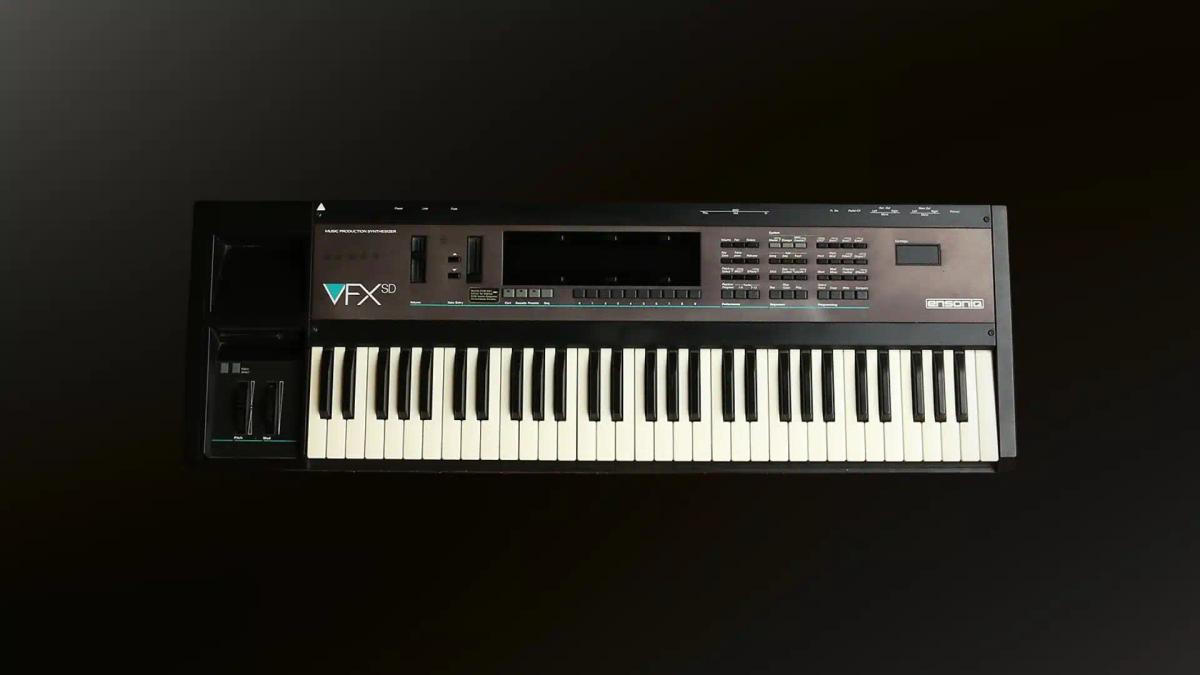
The Ensoniq VFX-SD is a 61-key workstation that Ensoniq previewed at the end of 1989, roughly six months after the VFX synthesizer, and shipped into 1990. The letters stand for Sequencer and Drums. It keeps the VFX’s 21-voice Transwave engine, polyphonic aftertouch, and 24-bit effects, and adds a 24-track sequencer, a built-in 3.5-inch floppy drive, drum waves and programmable drum kits, and a second pair of audio outputs. In the UK it was expected at around £1,900. It matters because it was Ensoniq’s first complete production keyboard in the M1 era, and because its revisions, the VFX-SD II and the SD-1, carried the design well into the 1990s.
Table of Contents
Ensoniq VFX-SD sound and character
At its core the Ensoniq VFX-SD sounds like the VFX: layered, animated digital tones with a slightly dark grain, built from sampled waves and sweeping Transwaves through non-resonant digital filters. The synthesis engine itself is covered in the site’s article on the VFX. What changes on the SD is the palette and the context. The workstation’s job was to make whole arrangements, and its new sounds were chosen for that.
The most important additions were drums. Ensoniq added two wave classes, Drum-Sound and Multi-Drum: the first holds individual kicks, snares, hats, cymbals, toms, congas, timbales, and tambourine spread across the keyboard, and the second holds multisampled kit layouts. David Bradwell, previewing the SD for Music Technology in December 1989, called the drum sounds extremely impressive. To make room, some original VFX samples were dropped, so the SD’s ROM is not a strict superset of the VFX’s; sources give 141 waves for the SD against the VFX’s 109.
The effects section grew too. Bradwell listed new algorithms including gated and room reverbs, a Dirty-Roto with delay, and a Warm Chamber, and the second output pair lets drums or individual parts bypass the main mix for outboard processing. In a full arrangement the SD’s sound is busy, wide, and unmistakably of its moment, polished and spacious rather than dry and punchy like the sampler-based grooves of the same years.
Its weaknesses are the VFX’s, magnified by the workstation role. With 21 voices shared between drums, bass, and layered six-Voice pads, polyphony runs out quickly, and acoustic realism, especially the first SD’s grand piano, was not its strength.
Features and architecture
- Manufacturer: Ensoniq Corporation, Malvern, Pennsylvania
- Year introduced: 1989, previewed in the UK in December 1989; some references, including Polynominal, give 1990, when it was widely available
- Production years: about 1989 to 1990 for the original model, followed by the VFX-SD II (1990) and the SD-1 (1990), which continued into the early 1990s
- Synthesis type: digital sample-based and wavetable synthesis (Dynamic Component Synthesis with Transwaves), as on the VFX
- Category: keyboard workstation (synth, drums, sequencer, and disk storage)
- Polyphony: 21 voices; Wikipedia lists 32, but contemporary reviews and the MAME emulation treat the Ensoniq VFX-SD as a 21-voice machine, with 32 voices arriving on the SD-1/32
- Multitimbrality: 12 parts
- Original price: expected at about £1,900 in the UK in late 1989; the VFX-SD II was £2,025 in 1990; SoundProgramming lists a US MSRP of $1,995, which is not confirmed elsewhere
- Current market price: Reverb’s price guide gives a middle value of about $399, with complete keyboards listed between roughly $550 and $940
- Oscillators: up to six Voices per Program, each with one digital oscillator; 141 waves including 17 Transwaves and the new Drum-Sound and Multi-Drum classes (149 waves in 13 groups on the VFX-SD II)
- Drums: 24 user-programmable drum kits built within the normal Program structure, plus a disk of drum patterns
- Filter: two non-resonant digital filters per Voice in series, as on the VFX
- LFOs: one per Voice with seven waveshapes
- Envelopes: three multi-stage envelopes per Voice
- Modulation system: the VFX’s 15-source matrix, including polyphonic aftertouch, reaching filter, pitch, Transwave index, pan, and effects parameters
- Sequencer / arpeggiator: 24 tracks (12 Sequence tracks plus 12 Song tracks), about 25,000 notes expandable to about 75,000, 60 Sequence and Song locations, 96ppqn resolution, real-time and (from OS 2.0) step entry, auto-punch, event editing, and an Audition mode for comparing takes; no arpeggiator
- Effects: ESP 24-bit processor; each Program, Preset, and Sequence carries its own effects setup; 23 algorithms on the VFX-SD II
- Memory: 60 ROM and 60 user Programs, 20 Presets, plus 60 more Programs on cartridge
- Storage: internal 3.5-inch floppy drive in Ensoniq’s own format (not MS-DOS compatible) for sounds, sequences, operating system, and SysEx data; cartridge slot retained
- Keyboard: 61 keys, velocity, polyphonic and channel aftertouch; poly pressure can be disabled to save sequencer memory
- Inputs / outputs: main stereo pair, auxiliary stereo pair, headphones, pedal/CV input, footswitch input
- MIDI / USB: MIDI In, Out, and Thru; no USB
- Display: fluorescent text display with soft buttons
- Dimensions / weight: not consistently documented in the sources consulted; Audiofanzine’s figures for the VFX (about 104cm wide and roughly 12kg) are a rough guide
- Power: internal power supply
Strengths
- It turned a respected synth into a complete production tool. Sequencer, drums, disk drive, and extra outputs in one box removed the VFX’s most criticized omissions.
- The sequencer was generous for its time. Bradwell called it the only built-in sequencer offering as many as 24 tracks, and its event editing and Audition mode borrowed ideas from software sequencers.
- The Sequence and Song structure suits songwriting. Twelve tracks of patterns plus twelve linear song tracks let users build arrangements from sections and then overdub across them.
- Loading the operating system from disk made updates easy. Ensoniq could ship fixes and new features, as it did with OS 2.0, without replacing chips.
- The extra stereo outputs widened its studio use, letting drums or selected parts be processed separately from the main mix.
- It stays compatible with the VFX library. VFX sounds and cartridges play on the SD, so patches built for either machine remain usable.
Limitations
- Twenty-one voices are tight for a workstation. Drums, bass, and layered pads drain the pool quickly, and 32 voices arrived only with the SD-1/32.
- Early units were unreliable. MusicRadar notes that Ensoniq repaired and upgraded units in the field; the multi-part keyboard assembly suffers from cracked solder joints and calibration errors, and heat-related failures were reported mostly on US units.
- Operating system crashes were common on early software, and some owners report crashes even after the final updates.
- The floppy drive is a liability now. Drives and disks age, and the proprietary Ensoniq format means data cannot simply be copied on a modern computer.
- The first SD’s grand piano was weak, a gap Ensoniq addressed with the 1MB piano waves of the VFX-SD II and SD-1.
- The interface has its limits. Sound On Sound’s Paul Ireson found the sequencer immediate but noted it lacked the visual feedback of computer software and higher-level editing features.
- Sequencer memory is modest by later standards, and polyphonic aftertouch data fills it quickly unless switched off.
Historical context
The Ensoniq VFX-SD was Ensoniq’s response to the one criticism that ran through every VFX review: the absence of a sequencer. Ensoniq had put an eight-track sequencer into its ESQ-1 two years before Korg’s M1 made the workstation the dominant keyboard format, yet the VFX shipped in 1989 without one. Paul Wiffen later wrote in Sound On Sound that the VFX lacked only a sequencer to qualify as a workstation. The SD followed about six months after the VFX, with Ensoniq presenting drums as Programs rather than as a separate drum machine section.
Bradwell’s December 1989 preview described a unit that was, at the time, the only one in the UK, priced provisionally around £1,900. He praised the new keyboard, which Ensoniq planned to standardize across its range and which he found close to the feel of the ESQ-1, as well as the sequencer’s editing. The machine competed with the M1 and, by 1990, with Roland’s D-70, Yamaha’s SY77, and Korg’s T-series, and its strength was the combination of synthesis depth and a sequencer that outclassed most onboard rivals.