

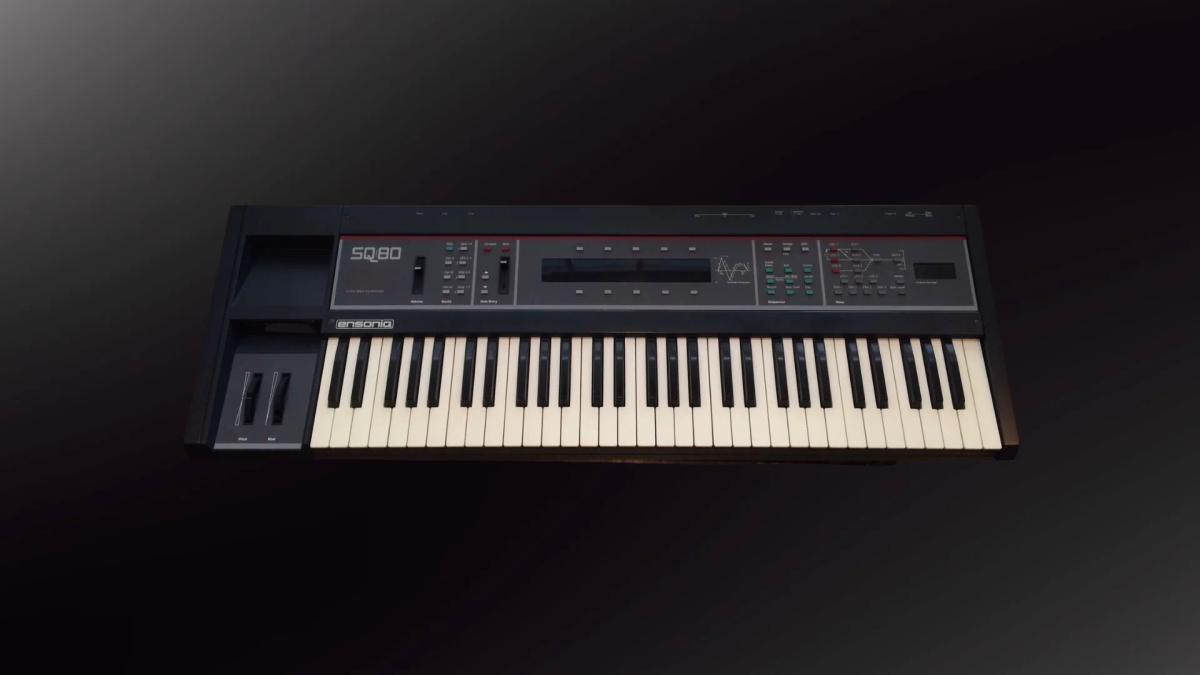
The Ensoniq SQ-80 is an eight-voice hybrid synthesizer and workstation that Ensoniq of Malvern, Pennsylvania, introduced around the turn of 1987 and 1988 as the upmarket successor to its ESQ-1. Ensoniq called its method Cross Wave synthesis: three digital wavetable oscillators per voice, reading from 75 waveforms, feed a resonant analog four-pole filter, with four envelopes and three LFOs available for modulation. On top of that sat an eight-track sequencer, a built-in floppy drive and a 61-key keyboard with polyphonic aftertouch, a rarity at the price. Overshadowed at launch by the Roland D-50 and Korg M1, it sold modestly, but its gritty digital-analog sound and deep modulation have kept it in demand among sound designers and producers ever since.
Table of Contents
Ensoniq SQ-80 sound and character
The Ensoniq SQ-80 sounds grainy, bright and slightly unruly, with an edge that sets it apart from the cleaner digital synths of the late 1980s. Its oscillators are digital, reading short 8-bit waveforms through Ensoniq’s DOC chip, so they stay perfectly in tune but bring noise and aliasing with them, especially low on the keyboard. That raw signal then passes through a resonant 24dB/octave analog low-pass filter based on Curtis CEM3379 chips. Music Technology’s Simon Trask heard grit and warmth in the American synth tradition, while Sound On Sound’s Steve Howell described a PPG-like quality.
The 75 waves are its palette. The first 32 are the ESQ-1 set of analog-style and digital waves; the rest add multisampled single cycles of strings, pianos, organs and reeds, breathy vocal sounds, inharmonic loops, eleven short transient attacks such as clicks, plucks and scrapes, and five drum kits. Layering an attack transient on one oscillator with a sustained wave on the others creates the hybrid tones Ensoniq advertised, and oscillator sync and amplitude modulation between oscillators 1 and 2 push it into harsh, metallic territory.
It is strongest on pads, strings, bells, organs, electric pianos, vocal textures and evolving effects, where the modulation depth and the slightly coarse waves combine well. It is weaker on fat analog-style basses, because the band-limited waves give the filter less to work with, and on realistic instrument imitation, where the D-50 sounded clearer. It sits firmly in the vintage digital camp, with a lo-fi character that later generations of producers have come to value.
Features and architecture
- Manufacturer: Ensoniq Corporation, Malvern, Pennsylvania
- Year introduced: late 1987 to early 1988; Wikipedia and Sonic State give 1987, while Ensoniq’s former engineers, as quoted by Arturia, and several other references give 1988; UK reviews appeared in February 1988
- Production years: about 1987 to 1989
- Synthesis type: hybrid; digital wavetable oscillators with analog filters (Cross Wave synthesis)
- Category: hybrid synthesizer workstation
- Polyphony: 8 voices with dynamic voice allocation; layer and split/layer modes reduce it to 4
- Multitimbrality: 8 parts over MIDI
- Original price: $1,895 list in the United States; £1,395 in the UK
- Current market price: Reverb’s price guide suggests around $600, with dealer listings in the $1,000 to $1,300 range
- Oscillators: 3 digital oscillators per voice, each with its own DCA, reading 75 waveforms from 256KB of ROM; oscillator 2 can sync to oscillator 1, and oscillator 1 can amplitude-modulate oscillator 2
- Filter: one analog resonant 24dB/octave (4-pole) low-pass filter per voice, using CEM3379 chips
- LFOs: 3 per voice, with triangle, sawtooth, square and noise waveforms
- Envelopes: 4 per voice, each with four rates and four levels; a second release stage can simulate reverb tails
- Modulation system: 15 modulation sources (LFOs, envelopes, velocity, aftertouch, keyboard tracking, wheels, pedal and an assignable external MIDI controller), with two modulation inputs per oscillator, DCA and filter
- Sequencer / arpeggiator: 8-track polyphonic sequencer, 60 sequences, 20 songs, about 20,000 notes; no step-time recording; no arpeggiator
- Effects: none
- Memory: 40 internal patches, 80 more on an optional cartridge, and built-in 3.5-inch floppy drive storage for sounds, sequences and SysEx data
- Keyboard: 61 keys with velocity and polyphonic aftertouch, a pressure sensor under each key, selectable channel or polyphonic aftertouch and 16 response curves
- Inputs / outputs: stereo audio outputs, headphone output, sustain and CV pedal inputs, cartridge slot
- MIDI / USB: MIDI In, Out and Thru; no USB
- Display: 2 by 40 character vacuum fluorescent display with soft buttons around it
- Dimensions / weight: about 98 by 34 by 9 cm and 13.2 kg, according to Sound Programming’s specification listing
- Power: internal power supply
Strengths
- The hybrid architecture has a character of its own. Grainy 8-bit wavetables through analog resonant filters produce textures neither pure analog nor clean digital synths could match.
- Modulation is deep for the era. Four multi-stage envelopes, three LFOs and 15 assignable sources made it one of the most flexible synths of its price, rivaled mainly by more expensive instruments such as the Oberheim Xpander.
- Polyphonic aftertouch adds a layer of expression that remains uncommon. Individual notes within a chord can be brightened, panned or modulated by pressure alone.
- The editing interface is quick to learn. Dedicated buttons for each module and soft buttons around the display show a module’s parameters on a single page.
- It is a complete workstation for its time. The eight-track sequencer, floppy drive and eight-part MIDI multitimbrality allowed whole arrangements to be built and stored from one keyboard.
- It is compatible with a large ESQ-1 library. Patches move between the two instruments, and the factory disk alone holds hundreds of sounds.
Limitations
- Eight voices are not many, and layered or split sounds halve that to four.
- There are no built-in effects, which left its dry sounds at a disadvantage against the D-50 and later the M1.
- The 8-bit waves alias and hiss, especially in the low register, and the drum samples are weak by any standard.
- The modulation system has gaps: there is no sample-and-hold, LFO rate cannot be modulated, and there is no cross-modulation between oscillators beyond sync and amplitude modulation.
- The sequencer lacks step-time recording and MIDI file support, and polyphonic aftertouch consumes its memory quickly.
- The keyboard is clattery, and aging keybeds have been reported to trigger random notes; the floppy drive and display are also typical points of wear, which specialist suppliers address with replacement drives and service parts.
Historical context
Ensoniq was founded in 1982 by former MOS Technology and Commodore engineers, among them Bob Yannes, the designer of the Commodore 64’s SID sound chip, who also designed Ensoniq’s Digital Oscillator Chip. The DOC, a 32-oscillator wavetable chip, became the heart of the company’s first instruments: the Mirage sampler (covered separately on this site), the ESQ-1 synthesizer of 1986 and, under a separate agreement, the Apple IIGS computer. Software engineers Bill Mauchly and John Senior joined in 1984; Mauchly later recalled that the team built instruments they personally wanted to own.
The ESQ-1 established the formula of three DOC oscillators feeding an analog filter, with a sequencer onboard. The Ensoniq SQ-80 kept that engine and added 43 new waves, polyphonic aftertouch, a floppy drive and a sequencer memory equal to a fully expanded ESQ-1, for about £300 more in the UK. For its makers, the key additions were the larger display with soft buttons, which made editing faster, and the polyphonic pressure keyboard, which John Senior singled out as an innovation. Its software, eventually at version 1.8, was so close to the ESQ-1’s that Ensoniq later back-ported it to the older instrument as version 3.5.
Timing worked against it. The Roland D-50 arrived in 1987 with sampled attacks and built-in effects, the Yamaha DX7II refined FM, and the Korg M1 soon redefined the workstation with PCM samples and effects. Sound On Sound later noted that the Ensoniq SQ-80 sold poorly despite its abilities. Ensoniq moved its synthesizers to the 16-bit OTIS chip with the VFX of 1989, and the Ensoniq SQ-80 was discontinued around the same time. The company itself was sold to Creative Technology in 1998.