

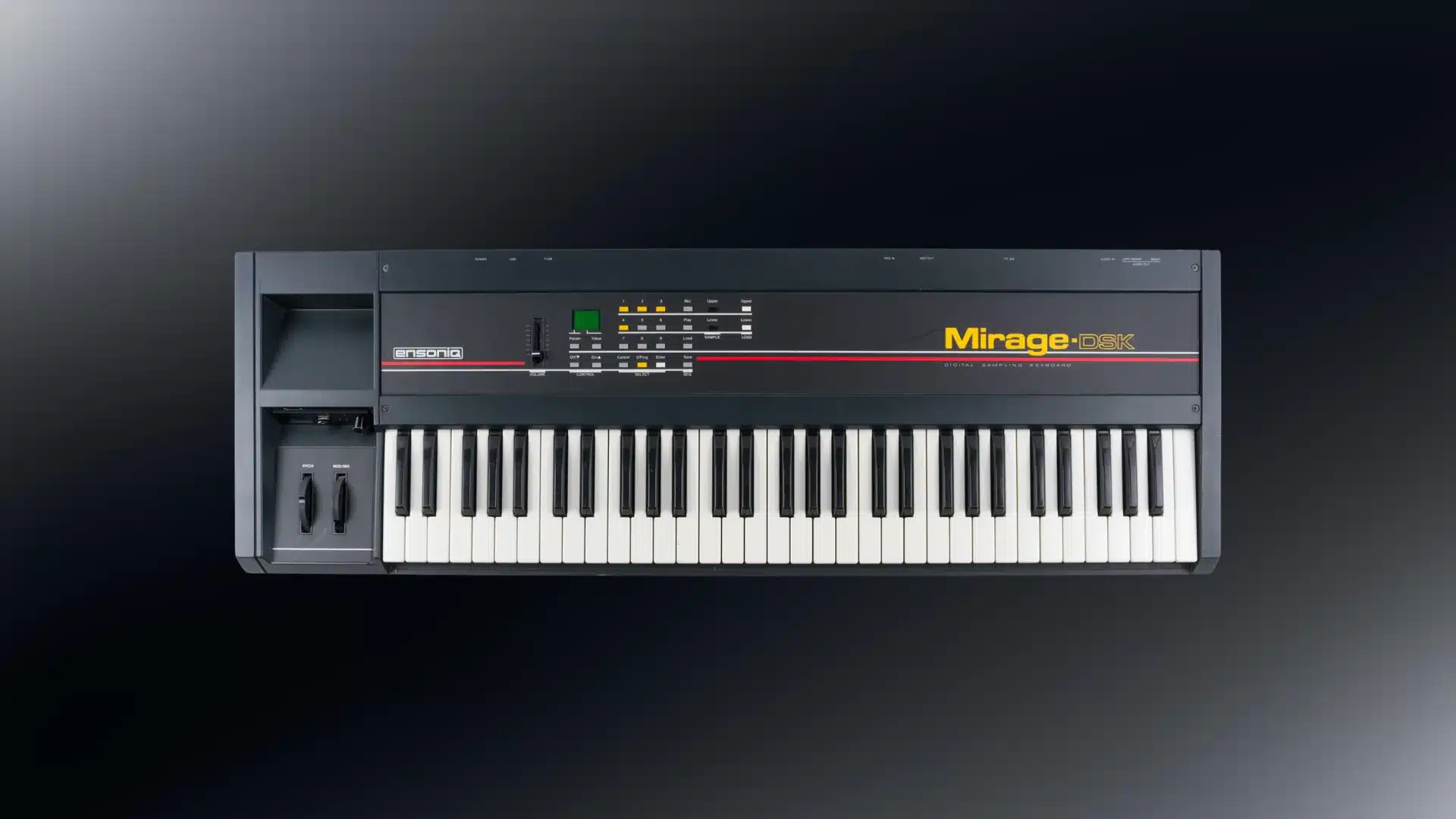
The Ensoniq Mirage is an eight-voice, 8-bit sampling keyboard that began reaching US buyers in late 1984 and was formally introduced at the NAMM show in early 1985. It was the first product of Ensoniq, a Pennsylvania company founded by former Commodore engineers, and it arrived at a list price of $1,695 when sampling was otherwise the territory of instruments costing many thousands more. Built around a custom sound chip, a 61-key velocity-sensitive keyboard, analog Curtis filters and a built-in floppy drive, the Mirage is remembered less for fidelity than for access: it was the machine that turned sampling from a studio luxury into something a working musician could own.
Table of Contents
Sound and character
The Ensoniq Mirage sounds grainy, warm and slightly blurred, and that character comes directly from its numbers. Samples are stored at 8-bit resolution, and the sample rate is tied to sample length: at the maximum of around 33 kHz each half of the keyboard holds only about two seconds of sound, while stretching a sample toward 6.5 seconds means dropping the rate and losing top end. At maximum sample time, one 1985 review put practical bandwidth at only 4 to 5 kHz, so the voice shifts from reasonably clear to distinctly dusty depending on how its owner trades length against brightness.
What keeps the Mirage from sounding merely degraded is the analog stage after the digital playback. Each voice runs through a resonant Curtis four-pole low-pass filter and five-stage envelopes, so samples can be swept, shortened and shaped like a subtractive synth patch. That combination of lo-fi source material and a genuinely musical filter gives the Ensoniq Mirage its signature: soft, slightly gritty strings, choirs and pads, thick sampled basses, and drums with a crunchy, compressed edge.
Reviewers in 1985 placed its sound above the original E-mu Emulator but below the Emulator II and the Kurzweil 250, and early units had audible hiss. Today those limitations are part of the appeal: the Mirage leans vintage, imperfect and textural rather than clean or polished.
Features and architecture
- Manufacturer: Ensoniq
- Year introduced: shipping in the US from late 1984; formally introduced at NAMM in early 1985 and in Europe at the Frankfurt show in February 1985
- Production years: commonly listed as 1984 to 1988, ending as the EPS took over in 1988
- Synthesis type: digital sample playback with analog subtractive filtering
- Category: keyboard sampler with built-in sequencer
- Polyphony: 8 voices
- Original price: $1,695 in the US; UK launch prices were reported between £1,695 and £1,795
- Current market signal: generally low hundreds of dollars on the used market, depending on condition and model
- Sound generation: custom Ensoniq sound chip (the Q-Chip, also known as the Digital Oscillator Chip or DOC), 8-bit samples, variable sample rate up to around 33 kHz, raised to 50 kHz with the optional Input Sampling Filter
- Oscillators: two digital sample oscillators per voice, mixable or switchable by velocity or mod wheel
- Sample memory: 128 KB, divided into two independent 64 KB halves (Upper and Lower), each holding up to eight wavesamples, for 16 in total
- Filter: Curtis CEM3328 four-pole, 24 dB/octave resonant analog low-pass filter per voice, with keyboard tracking
- LFOs: 1 LFO, used mainly for pitch modulation and assignable to mod wheel and other controllers
- Envelopes: five-stage envelopes for filter and amplifier, with velocity response
- Modulation system: velocity or mod wheel crossfading between each voice’s two oscillators; velocity to filter and amplifier; later operating systems added MIDI control from breath controller, pedals and aftertouch
- Sequencer / arpeggiator: real-time sequencer with overdub, 333 notes as standard, expandable by cartridge; no arpeggiator
- Effects: none onboard
- Memory: no permanent internal sound storage; samples, programs and sequences load from disk, with each disk holding six samples (three Upper and Lower pairs), four programs per keyboard half and up to eight sequences
- Storage: built-in 3.5-inch double-density floppy drive, which also boots the operating system at every power-up
- Keyboard: 61 keys, velocity-sensitive
- Inputs / outputs: mono audio out on the original keyboard (stereo outputs added on the DSK-1); audio in switchable between mic and line level; footswitch; sync; expansion cartridge port
- MIDI / USB: MIDI In and MIDI Out (with Out/Thru switching on early units, a dedicated Thru on later ones); no USB
- Display: two-digit LED
- Processors: Motorola 6809-family CPU alongside the custom sound chip
- Dimensions / weight: approximately 103 × 34 × 10 cm, about 10.8 kg
Strengths
- It made sampling affordable. At $1,695, the Ensoniq Mirage cost a fraction of the Emulator and an even smaller fraction of the Fairlight CMI and Synclavier, putting multi-sampling, looping and resampling in front of players who had never been able to try them.
- The analog filter section adds real musical value. Because each voice has a resonant Curtis low-pass filter and multi-stage envelopes, the Mirage behaves like a sample-based synthesizer rather than a simple playback device.
- Its lo-fi character is distinctive and still sought after, as later sample packs and modern operating-system projects show.
- It was surprisingly complete. A disk drive, an onboard sequencer and a keyboard split into two independent halves made it a self-contained writing tool in 1985.
- Its disk library gave it life beyond sampling, keeping it productive for owners who never mastered its sampling procedures.
Limitations
- Editing is famously difficult. Memory allocation, sample start and end points and loop points were entered in hexadecimal through a two-digit display, and reviewers called advanced sampling baffling even after experience.
- Sample time is very short. Each keyboard half holds roughly two seconds at full bandwidth, and longer samples come at a clear cost in brightness.
- Memory is split into two halves that the standard operating system could not join into one long sample.
- The operating system boots from floppy disk, so every power-up depends on a working drive, a concern then and now.
- Connectivity was limited at launch. The original keyboard has a single audio output, and early units could not interpret incoming MIDI velocity until later updates.
- Build quality and reliability were uneven. Reviewers called the early keyboard cheap-feeling, and Ensoniq’s own co-founder Bruce Crockett admitted in 1988 that the company was not proud of the Ensoniq Mirage’s reliability record.
Historical context
The Mirage appeared when sampling was technologically established but economically out of reach. The Fairlight CMI and Synclavier had shown what it could do, and the E-mu Emulator had delivered the first major price break, yet it still cost several times what the Ensoniq Mirage would. At the January 1984 NAMM show, Bob Yannes of Ensoniq, then still operating under the name PVI, predicted a “10-to-1 price reduction in sampler technology” within a year. By late 1984 dealers were fielding calls about a sampler priced around $1,700.
Ensoniq was founded by Bob Yannes, Al Charpentier and Bruce Crockett, all former Commodore staff. Yannes had designed the SID sound chip of the Commodore 64,. Their custom sampling chip, a million-dollar development integrating more than 20,000 components, was the key to the low price. According to Gearnews, Ensoniq released the Mirage partly to fund the development of the digital synthesizer it had originally aimed to build.
Demand outstripped supply in 1985, and European production was licensed to Italy. Later keyboard units, generally referred to as the DSK-8, replaced the original’s large black buttons and Pratt-Reed keybed with smaller grey buttons and a revised keyboard, and sources differ on whether the DSK-8 name applied to the very first units as well. A rack version followed in 1985. The DSK-1, arriving around 1986 or 1987 depending on the source, moved to a lighter plastic case shared with later Ensoniq products, added stereo outputs, used an unweighted keyboard and dropped the expansion port. By 1988 the EPS had replaced the Ensoniq Mirage as Ensoniq’s sampler.