

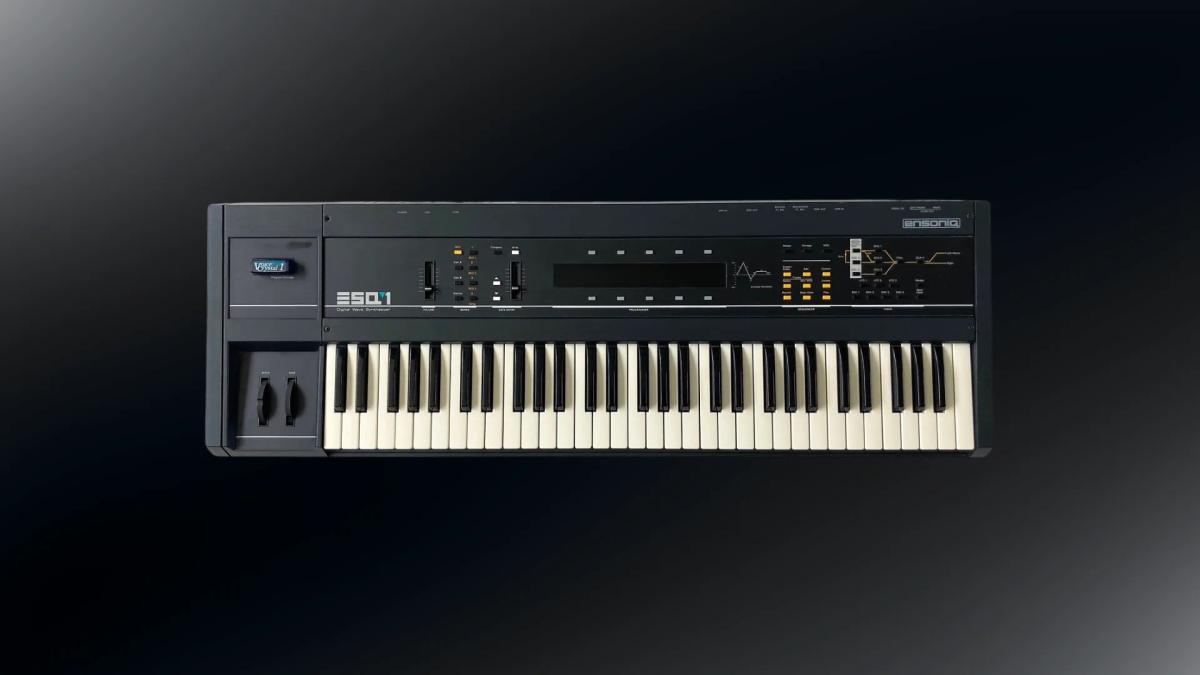
The Ensoniq ESQ-1 is an eight-voice hybrid synthesizer introduced in 1986 that combines three digital wave oscillators per voice with analog Curtis CEM 3379 low-pass filters, a 61-key velocity-sensitive keyboard, and a built-in eight-track MIDI sequencer. It arrived at a time when digital synthesis meant either FM complexity or expensive flagship instruments, and it offered something more approachable: sampled and synthetic single-cycle waveforms shaped by a familiar subtractive signal path. Reviewers at the time called it an outstanding bargain, it outsold Ensoniq’s own breakthrough Mirage sampler, and it is now widely remembered as one of the first affordable instruments to bring the workstation idea into a single keyboard.
Table of Contents
Sound and character
The Ensoniq ESQ-1 sounds like a meeting point between two eras. Its oscillators read from a small ROM of 32 waveforms, stored at 8-bit resolution, that range from classic sawtooth, square, and noise shapes to sampled fragments of piano, electric piano, voice, reed, organ, and bass, plus additive and formant waves. Those raw sources carry a grainy, lo-fi edge. Everything then passes through an analog four-pole resonant filter and a final amplifier, which rounds that grit into something warmer and more physical than a purely digital instrument of the same period.
Sound On Sound’s 1986 review heard that duality immediately, describing sounds that could be big and fat or very digital while keeping their warmth, and comparing the character to a PPG. Later owners describe it as nice and dirty, and argue that the analog filters and amplifiers are what keep the raw waveforms from sounding harsh.
It excels at bell-like and vocal pads, hard-edged digital basses, and layered timbres where one oscillator supplies an attack and another the sustain. Oscillator sync and amplitude modulation add metallic colors that sit between analog sync sweeps and DX-style sidebands. The filter does not self-oscillate and its resonance is quantized, so the Ensoniq ESQ-1 rarely delivers the liquid squelch of a fully analog polysynth. What it offers instead is texture: a gritty hybrid voice that cuts through a mix rather than receding into it.
Features and architecture
- Manufacturer: Ensoniq (Malvern, Pennsylvania, USA)
- Year introduced: 1986
- Production years: commonly listed as 1986 to 1988
- Synthesis type: hybrid subtractive synthesis, digital wave oscillators with analog filtering
- Category: polyphonic keyboard synthesizer with built-in sequencer, often described as an early workstation
- Polyphony: 8 voices with dynamic voice allocation
- Multitimbrality: Multi mode across up to nine MIDI channels (eight sequencer tracks plus the keyboard), sharing the eight voices dynamically
- Original price: commonly cited as $1,395 in the United States, with some sources listing $1,295; around £1,080 to £1,115 in the UK at launch
- Oscillators: 3 digital oscillators per voice (24 in total), each with its own digitally controlled amplifier; 32 waveforms in ROM, including standard synth waves, sampled sounds, additive, formant, and band-limited waveforms; oscillator sync and amplitude modulation
- Filter: one analog four-pole (24 dB/octave) resonant low-pass filter per voice based on the Curtis CEM 3379, digitally controlled, with keyboard tracking; not self-oscillating
- LFOs: 3 per voice, with triangle, sawtooth, square, and noise shapes, plus delay, reset, and a randomized “human” mode
- Envelopes: 4 per voice, each with four time and four level parameters; three freely assignable and one dedicated to the final output amplifier, with no fixed filter envelope
- Modulation system: each destination accepts two modulators chosen from 15 sources, including envelopes, LFOs, velocity, keyboard tracking, mod wheel, pedal, and MIDI controllers such as breath control
- Sequencer / arpeggiator: 8-track MIDI sequencer with 30 sequences and 10 songs, real-time and step recording, quantization, punch-in, copy, merge, and transpose; 2,400 notes internally, expandable to around 10,000 with the SQX-10 cartridge; no arpeggiator
- Effects: none onboard
- Memory: 40 internal programs, plus 80 on a RAM cartridge or ROM voice cartridges
- Keyboard: 61 keys, velocity-sensitive, no aftertouch; split and layer modes, plus a mono mode with portamento
- Inputs / outputs: stereo and mono audio outputs with per-voice panning, tape in/out for data storage and sync, sustain pedal input, sequencer footswitch input, CV/pedal input; no headphone output
- MIDI / USB: MIDI In and MIDI Out, no MIDI Thru; no USB
- Display: 80-character (two lines of 40) vacuum fluorescent display with ten soft buttons, a data slider, and increment buttons
- Dimensions / weight: not consistently documented in the sources consulted; units were built in an earlier metal housing and a later plastic housing that share no interchangeable parts
Strengths
- The hybrid voice has real identity. Digital waveforms supply a gritty source palette and the analog filters give it weight, so it sounds neither like a pure analog polysynth nor like an FM instrument.
- Three oscillators per voice was generous: Electronics & Music Maker noted it was more than any other synth under £2,000, allowing layered timbres and detuned stacks within one patch.
- The modulation system is deeper than the price suggested. Two modulators per destination from a pool of 15 sources led one 1986 reviewer to compare its routing to the complexity of Oberheim’s matrix synths.
- The sequencer was a serious tool. Sound On Sound wrote that it beat many stand-alone sequencers, and eight tracks driving internal and external MIDI voices made the Ensoniq ESQ-1 a compact production center.
- The interface is readable for a 1980s digital synth. The large fluorescent display, soft buttons, and page-based editing make programming less opaque than many contemporaries, and owners still praise the display’s visibility on dark stages.
Limitations
- Eight voices are shared across everything. The sequencer and Multi mode draw on the same pool, so busy arrangements quickly run into voice stealing unless external MIDI instruments carry part of the load.
- The filter is low-pass only and does not self-oscillate, with resonance quantized into digital steps. Sweeps can sound slightly stepped, and players looking for screaming analog resonance will find it restrained.
- There is no dedicated filter envelope or knob-per-function control. Everything is reached through pages, soft buttons, and a data slider, which suits careful programming more than live tweaking.
- The keyboard has velocity but no aftertouch. Ensoniq added polyphonic aftertouch on the later SQ-80.
- Sequencer memory is modest at 2,400 notes without an expansion cartridge, and the sequencer’s contents depend on battery-backed RAM.
- Practical omissions drew comment from the start: no MIDI Thru, no headphone output, and no onboard effects, so the dry voice usually needs external chorus or reverb.
- Early operating system versions had documented bugs, including crashes and MIDI lockups, later addressed in firmware updates.
Historical context
Ensoniq was founded in Pennsylvania by Bruce Crockett, Al Charpentier, and Bob Yannes, engineers who came from Commodore. Yannes had been the lead designer of the SID, the sound chip of the Commodore 64. The company’s first major success was the Mirage, a sampling keyboard shown at the 1985 NAMM show for around $1,700, and its success made the company’s name. Ensoniq’s strategy was to design custom chips in-house and use them to undercut rivals on price.
The Ensoniq ESQ-1 applied that strategy to the synthesizer. Its oscillators came from the Ensoniq 5503 Digital Oscillator Chip, a Yannes design also used in the Mirage and later found in the Apple IIGS computer. Here the chip played short wavetable cycles that then passed through a conventional analog filter and amplifier path. That mattered in 1986: the Yamaha DX7 had made digital synthesis mainstream, but FM programming was notoriously opaque, and the Ensoniq ESQ-1 offered digital waveforms with subtractive logic most players already understood.
Price was the other half of the story. Sound On Sound identified the Sequential Prophet VS and the Roland JX-10 as the Ensoniq ESQ-1’s two serious rivals, each costing almost £1,000 more, and concluded that nothing at a similar price could compete. Adding a capable eight-track sequencer to that package pushed the instrument into territory that would soon be called the workstation, a category the Korg M1 would later make famous.
The rackmount ESQ-M followed around 1987 with the same voice architecture but without the sequencer. In 1988 Ensoniq released the SQ-80, an expanded successor that added more waveforms, polyphonic aftertouch, and twice as many sequences. By early 1988, Sound On Sound reported that Ensoniq ESQ-1 sales had already surpassed those of the Mirage, which itself had passed 25,000 units, and Cherry Audio now puts the Ensoniq ESQ-1’s total at over 50,000.