

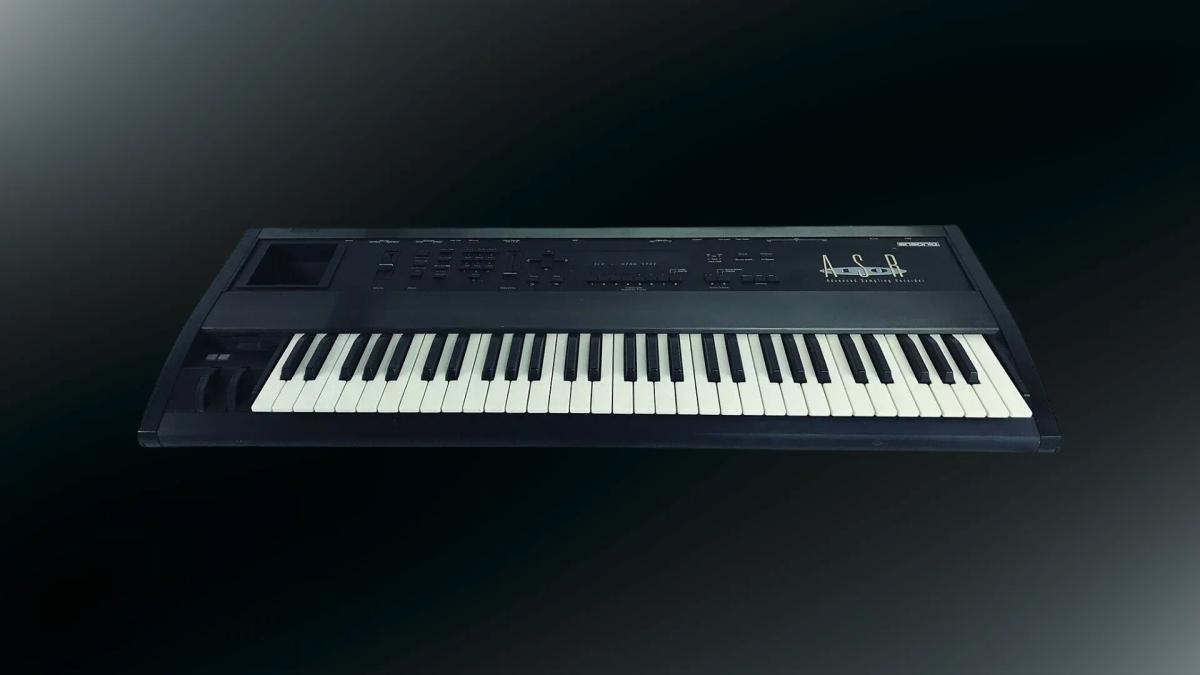
The Ensoniq ASR-10 is a 61-key, 16-bit stereo sampling workstation introduced in 1992 and produced until 1998. Its name stands for Advanced Sampling Recorder, and it combined sampling, two digital filters per voice, a DP/4-derived effects processor, and a 16-track sequencer in one keyboard. On paper it was a well-specified upgrade of Ensoniq’s EPS line. In practice it became one of the defining beat-making instruments of the 1990s and early 2000s, used by RZA for many of his Wu-Tang Clan productions and by Kanye West during Jay-Z’s Roc-A-Fella sessions.
Table of Contents
Sound and character
The Ensoniq ASR-10 does not sound transparent, and that is a large part of its appeal. Owners describe it as warm, punchy, and dark; one Gearspace reviewer called it “powerful and gritty, dark and just downright NASTY sounding.” Samples tend to come back out of it thicker and more forward than they went in.
Much of that character comes from what happens after recording. Each voice runs through two digital filters and three envelopes for pitch, filter, and amplitude, which is closer to a synthesizer voice than to a playback engine. That is why the Ensoniq ASR-10 is good at turning a short slice of a record into a bass line, a filtered loop, or a pad that no longer resembles its source. Sound On Sound’s 1993 review called it “much more an instrument than a sample recorder/player” and said it was “better at generating than organising.”
The sample rate options also shape the sound. At the lower rate of roughly 29.76 kHz, frequency response is limited to around 14.8 kHz. The trade-off was about memory and polyphony, but the softened top end suits music that values weight over sparkle. Add DP/4-derived effects, which reviewers at launch praised for building large layered sounds quickly, and the result is a sampler that leans vintage and musical rather than clinical: strong for loops, chopped soul and jazz, and heavy low end, less suited to anyone who wants a neutral recorder.
Features and architecture
- Manufacturer: Ensoniq (made in the U.S.A.)
- Year introduced: 1992
- Production years: 1992 to 1998
- Synthesis type: 16-bit sampling with digital filtering
- Category: keyboard sampling workstation (rack ASR-10R and 88-key weighted ASR-88 versions also existed)
- Polyphony: 31 voices at the 29.76 kHz playback rate, 23 voices at 44.1 kHz
- Original price: £1,999 including VAT in the UK at launch; a U.S. user review on Sonic State recalls a price of about $2,000
- Sampling: stereo, 64-times oversampling delta-sigma conversion, 44.1 kHz or 29.76 kHz sample rates, resampling of internal mixes and effects, time compression and expansion
- Sound structure: up to eight Instruments in memory, up to eight layers per Instrument, up to 127 WaveSamples per Instrument; two Patch Select buttons recall four layer combinations
- Filter: two digital filters per voice, in low-pass, high-pass, and band-pass configurations, with slopes up to 24 dB per octave
- LFOs: one multi-waveform LFO with delay
- Envelopes: three multi-stage envelopes, for pitch, filter, and amplitude
- Modulation system: modulation matrix with 15 assignable sources, with velocity and polyphonic aftertouch available as performance controls
- Sequencer / arpeggiator: 16-track sequencer (eight internal tracks plus eight MIDI-only tracks in song mode), up to 80 sequences, 96 PPQ resolution; OS 2.0 added two digital audio tracks recorded to RAM or SCSI disk; no arpeggiator
- Effects: one 24-bit effects processor derived from the DP/4, with 50 algorithms in ROM routed via three internal stereo buses; later OS disks raised the total to 62 algorithms
- Memory: 2 MB RAM standard, expandable to 16 MB with SIMMs; storage on a 3.5-inch high-density floppy drive; SCSI optional on the keyboard version
- Keyboard: 61 keys with velocity and polyphonic aftertouch
- Inputs / outputs: stereo main outputs, headphone output, stereo inputs switchable between mic and line with input trim, pedal/CV and footswitch inputs; optional output expander adding three stereo output pairs; optional S/PDIF digital I/O
- MIDI / USB: MIDI In, Out, and Thru; no USB
- Display: two-line blue alphanumeric display, with no waveform display
- Dimensions / weight: not reliably documented for the keyboard; the rack ASR-10R is listed at 432 × 133 × 381 mm and 10.4 kg
- Library compatibility: reads EPS and EPS-16 Plus sounds, and Akai S1000/S1100 and Roland CD-ROM libraries via SCSI
Strengths
- Its sound has weight and colour. Filters and effects give samples a warm, dense quality that many producers prefer to a more transparent sampler.
- It is an instrument first. Two filters per voice, three envelopes, a 15-source modulation matrix, and polyphonic aftertouch let a short sample become a playable, expressive sound.
- Everything lives in one box. Sampling, editing, effects, and a 16-track sequencer sit inside the keyboard, so a complete beat can be built without a computer, a mixer, or an external sequencer.
- Resampling is built into the workflow. Internal mixes, including effects, can be recorded back as new stereo samples, which saves memory and encourages layering, bouncing, and degrading sounds in creative ways.
- The effects section is strong enough, being derived from a dedicated Ensoniq processor, that the Ensoniq ASR-10 can also serve as an outboard effects unit.
- It suits performance. Sound On Sound’s launch review praised it for live musicians and singled out the Patch Select buttons for switching layer combinations while playing.
Limitations
- Editing without a waveform display is slow. Truncating and looping are done by numbers and by ear, a weakness flagged at launch.
- The menu system requires many button presses, and owners describe a steep learning curve even for simple tasks.
- Memory is small. The 2 MB base configuration holds about 30 seconds of mono audio at the lower rate, and even 16 MB is modest once stereo samples and sequences share it.
- Polyphony drops from 31 to 23 voices at 44.1 kHz, so the highest-quality setting costs voices.
- SCSI, extra outputs, and digital I/O were all optional on the keyboard model. Without SCSI, every session depends on slow floppy disks, which the Music Technology reviewer said serious users could “forget.”
- Age is now a factor. Owners report worn Edit, Record, and Play buttons and occasional lockups with large stereo sample sets.
Historical context
Ensoniq was founded in the early 1980s by engineers from MOS Technology, the chip maker behind the Commodore 64’s processor. Its Mirage brought sampling to a much wider market in the mid-1980s, and the EPS series followed as a more serious performance sampler. The Ensoniq ASR-10 replaced the EPS-16 Plus directly, keeping much of its architecture and panel layout while adding stereo sampling, a digital input option, resampling, and time stretching. Sound On Sound opened its review with “The EPS is dead, long live the ASR!”
The timing mattered. Akai was the reference point in professional sampling, and Ensoniq competed by joining sampling, synthesis, effects, and sequencing in one keyboard. Music Technology called it “a musician’s sampler,” and Gearnews later wrote that it “gave Akai a real run for its money.” That design fitted a type of musician becoming central to popular music: the producer working alone, building tracks from records, with limited money and no engineer. A version 2.0 operating system pushed further in that direction by adding two tracks of digital audio recording alongside the sequencer.
The Ensoniq ASR-10 ran until 1998, the year Ensoniq was acquired by Creative Technology and merged with E-mu. The later, more compact ASR-X carried the name forward, but the Ensoniq ASR-10 remains the model most closely identified with Ensoniq’s sampling legacy.
Legacy and significance
The Ensoniq ASR-10 matters less for any single specification than for how it treated the sample: not as a realistic instrument to drop into a recording, but as raw material to be reshaped with a full set of synthesis tools. That assumption matched how hip-hop production developed in the 1990s.