

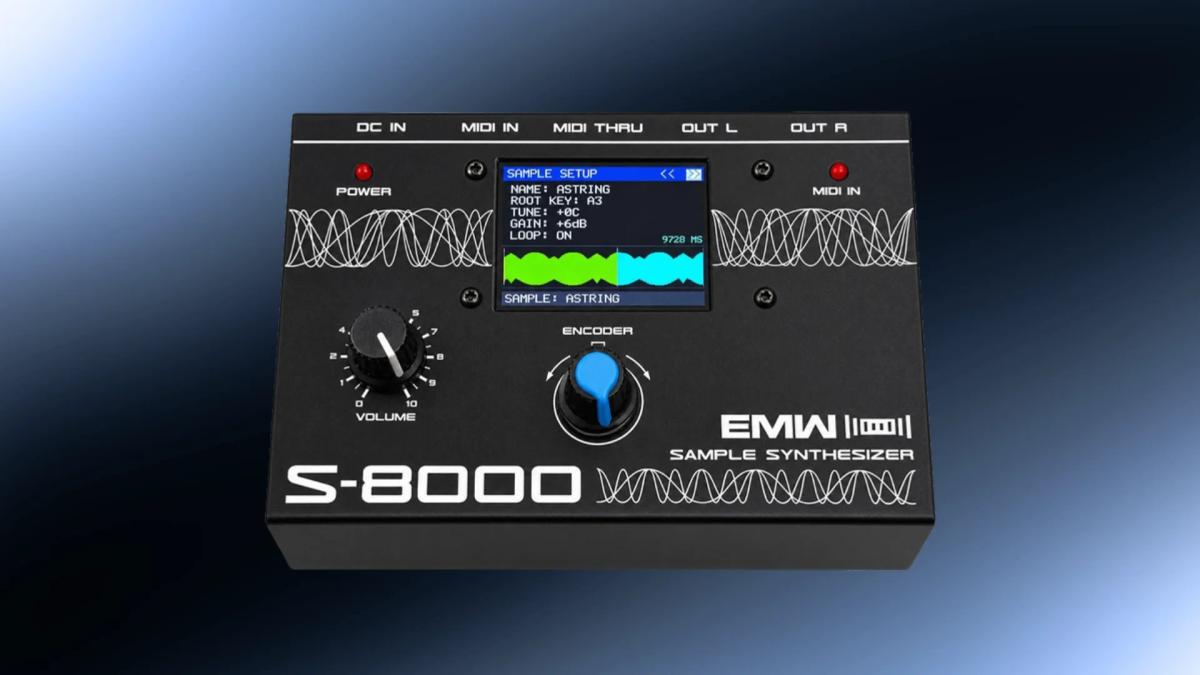
The EMW S-8000 is a compact hardware sample synthesizer made by Electronic Music Works (EMW), a Brazilian company best known for Eurorack modules, small desktop synths and the EMW-200, its revival of the EML Electrocomp 200. The instrument appeared on MATRIXSYNTH on September 27, 2026, and Synth Anatomy reported two days later that it was available now. Its engine plays single samples and multisamples built from WAV files stored on a microSD card, then runs them through a resonant filter with its own ADSR envelope, an amplifier envelope, a multi-waveform LFO and a built-in effects section. EMW describes it as an 8-voice polyphonic instrument with stereo output, and Synth Anatomy gives a price of US$429 from the company’s own store. The S-8000 is not a new idea in itself. Its interest lies in offering a low-cost, menu-driven way to play multisampled instruments over MIDI, from a maker that has spent 2026 releasing a run of compact digital sound modules.
Table of Contents
EMW S-8000 sound and character
Because the EMW S-8000 is a sample player, its character starts with the recordings it is given. EMW ships it with a sample library organized by instrument and by the equipment the sounds were taken from, and the company says it will keep adding to that library. Users can also build their own instruments from WAV files, either as a single sample spread across the keyboard or as a multisample in which several recordings each cover part of the range. Every sample can be adjusted for tuning, gain, root key, start point and loop point, which is the basic toolkit needed to turn raw recordings into a playable instrument.
Synth Anatomy reports several playback modes, running from clean and transparent reproduction to rawer textures that it describes as inspired by classic digital samplers. Neither that report nor the manufacturer text published by MATRIXSYNTH explains which machines served as models or how the rawer modes work, so the exact nature of that coloration is not documented. Synth Anatomy is equally clear about what the engine leaves out. There is no granular or spectral processing, and the site frames the S-8000 as a sample synth that plays samples back rather than a sampler in the recording sense.
After the sample stage comes a conventional subtractive voice. The resonant filter has its own ADSR envelope plus cutoff and resonance controls, and the manufacturer text quoted by MATRIXSYNTH refers to multimode filtering, although the available modes are not listed and EMW does not say whether the filter is analog or digital. A second ADSR envelope shapes the amplifier, and an LFO with several waveforms provides cyclic movement. Velocity, the mod wheel and aftertouch are the documented modulation sources, which suits a player driving the EMW S-8000 from an expressive MIDI keyboard.
Effects are a substantial part of the package. The EMW S-8000 offers chorus, phaser, delay and reverb, each with adjustable parameters, along with two processes EMW calls Bloom and Stereo Spread. Neither of the published reports explains what Bloom does, and Stereo Spread is described only by its name. The signal leaves the unit in stereo through two 6.3 mm jacks, so the effects and any stereo samples reach a mixer or audio interface intact.
The physical interface is minimal. Synth Anatomy lists a volume knob, an endless encoder for the menu and a good-sized display, which MATRIXSYNTH identifies as a color graphic screen. That layout follows the two-control approach Synth Anatomy described earlier in 2026 for EMW’s DX7000 and VPOLY-6X. Editing therefore happens mostly through menus, or remotely: many synthesis, performance and effects parameters respond to MIDI CC, so a DAW or a controller with knobs can stand in for a front panel. A few readers under Synth Anatomy’s article asked for more physical controls.
The video above is a test-sounds demonstration by Tiago Mallen whose Portuguese title calls the S-8000 the most complete synthesizer he has played and tags EMW’s account. It is best treated as a launch demo rather than an independent review. No hands-on review from a major outlet had been published by October 20, 2026. Synth Anatomy’s own verdict was modest and sympathetic: it called the instrument “a small, likable synth” that falls short of powerful samplers but fits players who want to perform multisampled sounds live from a keyboard.
Features and architecture
- Manufacturer: EMW (Electronic Music Works), Brazil
- Year introduced: 2026 (reported by MATRIXSYNTH on September 27, 2026; listed as available by Synth Anatomy on September 29, 2026)
- Production years: 2026 to present
- Synthesis type: Sample-based; single samples and multisamples followed by a subtractive filter and amplifier stage
- Category: Compact hardware sample synthesizer (sound module without a built-in keyboard)
- Polyphony: 8 voices, according to EMW’s description as published by MATRIXSYNTH
- Multitimbrality: Not specified by the manufacturer
- Original price: US$429 from the EMW store, per Synth Anatomy; no UK or EU price found
- Current market price: US$429 direct from EMW as of October 2026; no third-party street prices documented
- Oscillators: Sample playback from WAV files, single or multisample; per-sample tuning, gain, root key, start point and loop point; several playback modes from clean to rawer, vintage-inspired textures
- Filter: Resonant filter with cutoff and resonance; described as multimode by the manufacturer, modes not listed; analog or digital implementation not specified
- LFO: One LFO with multiple waveforms (waveform list not specified)
- Envelopes: Two ADSR envelopes, one for the filter and one for the amplifier
- Modulation system: Velocity, mod wheel and aftertouch as modulation sources; destinations not specified by the manufacturer
- Sequencer / arpeggiator: None documented
- Effects: Chorus, phaser, delay, reverb, Bloom and Stereo Spread
- Memory: Samples stored on microSD card; bundled sample library organized by instrument and source equipment; card capacity and preset count not specified by the manufacturer
- Keyboard: None; played from an external MIDI controller
- Inputs / outputs: Stereo audio output on two 6.3 mm mono jacks (left and right); DC power input
- MIDI / USB: 5-pin MIDI In and Thru; many parameters controllable by MIDI CC; USB not specified by the manufacturer
- Display: Color graphic display with an endless encoder for menu navigation; separate volume knob
- Dimensions / weight: Not specified by the manufacturer
- Power: External DC supply; voltage and current not specified by the manufacturer
Strengths
- It plays real multisamples. Users can assemble instruments from their own WAV files with per-sample root key, tuning, gain, start and loop settings, rather than relying only on a fixed ROM.
- The price is accessible. At US$429, the EMW S-8000 is a far simpler and smaller commitment than the flagship sample players Synth Anatomy cited for comparison, such as the Elektron Tonverk and Torso S4.
- The synth layer is complete enough for shaping sounds. A resonant filter with its own envelope, an amplifier envelope and an LFO cover the basic subtractive moves a multisample usually needs.
- Effects are built in. Chorus, phaser, delay and reverb, plus Bloom and Stereo Spread, let the unit produce finished stereo sounds without external processing.
- It is expressive from a keyboard. Velocity, mod wheel and aftertouch are documented modulation sources, which suits the live, keyboard-driven use Synth Anatomy identified as its natural role.
- Storage is open and easy to expand. Samples live on a microSD card, and EMW says it will add to the bundled library regularly.
- Remote control is broad. Many synthesis, performance and effects parameters respond to MIDI CC, so a DAW or hardware controller can make up for the small front panel.
Limitations
- It is not a sampler. The EMW S-8000 plays back files prepared elsewhere, and Synth Anatomy notes that it loses out to more powerful machines such as the Blackbox 2.
- Sample manipulation is traditional. There is no granular or spectral processing, so the unit does not compete with the textural engines found in many current samplers.
- Hands-on control is minimal. A volume knob and one encoder handle the front panel, and some readers of Synth Anatomy’s coverage asked for more physical controls.
- Key specifications are missing. Sample format limits, microSD capacity, multitimbrality, dimensions, weight and power requirements were not published in the coverage available at launch.
- Polyphony is modest. Eight voices can run short when sustained notes, layered pads or long release tails overlap.
- Independent evaluation is lacking. As of October 2026 no major outlet had published a hands-on review, and the main video demo credits EMW’s own account.
- Distribution is narrow. The documented purchase route is EMW’s own store, with no international dealer pricing found for the UK or Europe.
Historical context
Electronic Music Works began with an attempt to rebuild a vintage American synthesizer. According to Perfect Circuit, the project started in 2008 as an effort to recreate the EML Electrocomp 200, was set aside and later revived as the EMW-200, which kept the original’s unusual 1.2 V per octave scaling. Equipboard dates the company to 2009 and names electronic engineer Paulo Sergio dos Santos as its founder, so the sources differ by a year on the starting point. Synthtopia covered the EMW-200 Electronic Sound Lab in March 2012, and the company went on to build what Perfect Circuit counts as more than 100 Eurorack modules, along with integrated instruments such as the SYSTEM-15, which Gearnews and Synth Anatomy reported in June 2022.