Home›Synths›EMS Synthi AKS: The briefcase modular behind Pink Floyd…
Synths

EMS Synthi AKS: The briefcase modular behind Pink Floyd’s On the Run and Bowie’s Heroes

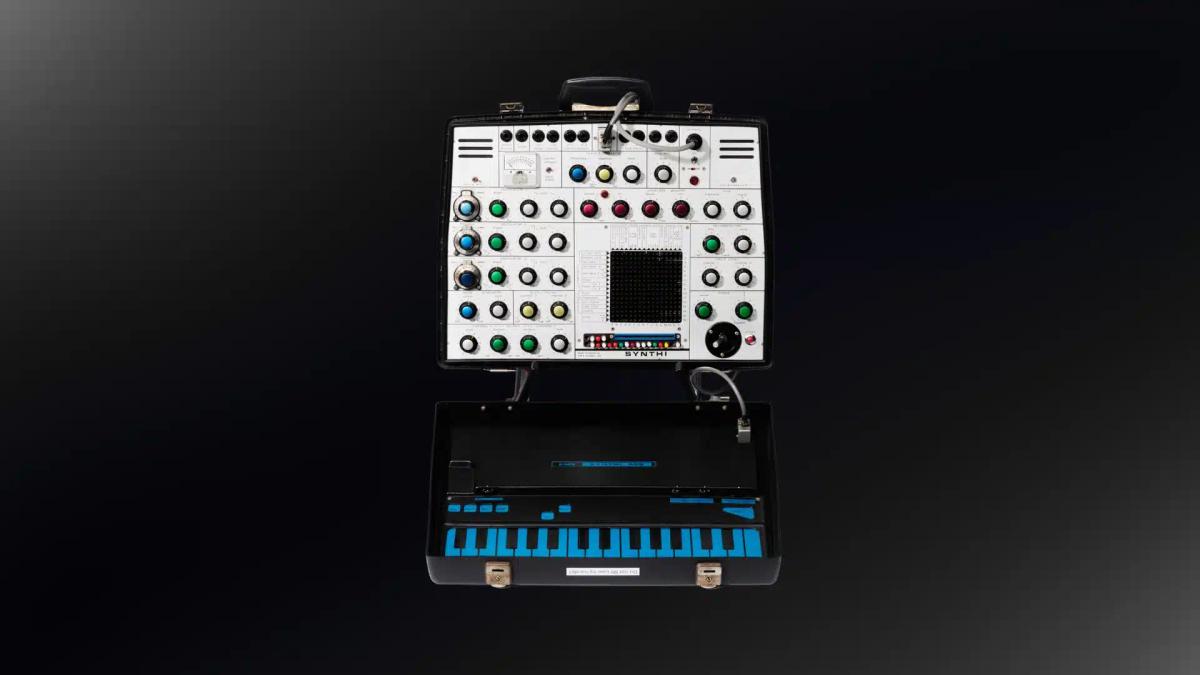
The EMS Synthi AKS is a portable analog synthesizer released by Electronic Music Studios of London in March 1972. It takes the voice architecture of the VCS3, three oscillators, a noise source, a ring modulator, a low-pass filter, a trapezoid envelope and a spring reverb, all…

Bernardo de Azevedo
Bernardo de Azevedo
· Updated
EMS Synthi AKS: The briefcase modular behind Pink Floyd’s On the Run and Bowie’s Heroes

The EMS Synthi AKS is a portable analog synthesizer released by Electronic Music Studios of London in March 1972. It takes the voice architecture of the VCS3, three oscillators, a noise source, a ring modulator, a low-pass filter, a trapezoid envelope and a spring reverb, all routed through a 16 x 16 pin matrix, and packs it into a plastic attaché case whose lid hides a touch keyboard and a 256-event digital sequencer.

The “K” stands for keyboard and the “S” for sequencer. It was never an easy instrument, yet it became the EMS model professional musicians most wanted, and it left its mark on records by Pink Floyd, Brian Eno and David Bowie.

Sound and character

The EMS Synthi AKS does not sound like a polished keyboard synthesizer, and it was never designed to. Its voice is thin and glassy at one extreme and violently noisy at the other, with a strong tendency toward the unstable, the metallic and the atmospheric. Goldfrapp’s Will Gregory is reported to have said that anything played through an EMS acquires a 1950s sepia-tone quality, and that description captures something real: the instrument colours sound as much as it generates it.

Much of that character comes from how the voice is wired. Oscillator 1 offers sine and ramp outputs, while the other two provide square or triangle and ramp, and the third can drop to subsonic rates to act as a modulation source. The filter is a low-pass design with a cutoff slope of up to 18 dB per octave and a response control that can push it into self-oscillation, so it doubles as an extra sine source.

GForce Software, which owns an EMS Synthi AKS, simply calls the filter “savage.” The ring modulator adds clangorous, bell-like and robotic tones, and the spring reverb, unusual for a synthesizer of this size, gives the whole instrument a slightly haunted acoustic halo.

The pin matrix adds its own subtleties. Each pin contains a resistor, and pin colours mark different values, so the choice of pin changes the strength of a connection. Because the matrix is unbuffered, adding pins can pull oscillator tuning, a nuisance for melodic playing but part of why AKS patches feel organic and slightly unpredictable. The instrument shines in effects, drones, sequenced pulses, treated instruments and evolving textures. It can play melodies, but it rarely sounds tame doing so.

Features and architecture

  • Manufacturer: EMS (Electronic Music Studios), London; later EMS of Cornwall under Robin Wood
  • Year introduced: 1972 (the V&A dates the release to March 1972)
  • Production years: from 1972 through EMS’s original London and Oxfordshire era, which ended with the company’s liquidation in 1979; occasional EMS Synthi AKS units were then built by Datanomics between 1980 and 1984
  • Designer: David Cockerell
  • Synthesis type: analog subtractive, semi-modular via pin matrix
  • Category: portable briefcase synthesizer with integrated touch keyboard and digital sequencer
  • Polyphony: monophonic
  • Original price: £420 according to Sound On Sound and the National Music Centre, more than twice the £198 Synthi A; some sources cite around £450
  • Current market price: vintage units commonly trade in five figures; see Market value below
  • Oscillators: 3; oscillator 1 with sine and ramp outputs, oscillators 2 and 3 with square or triangle and ramp; oscillator 3 extends to subsonic rates for modulation; noise generator
  • Filter: voltage-controlled low-pass filter, up to 18 dB per octave, able to self-oscillate
  • LFOs: no dedicated LFO; oscillator 3 or the self-oscillating filter serve the role
  • Envelopes: 1 trapezoid envelope shaper with attack, on time, decay and off time, plus a manual trigger button
  • Modulation system: 16 x 16 pin matrix with resistor pins of different values, joystick controller, ring modulator, two input amplifiers for processing external audio
  • Sequencer / arpeggiator: digital sequencer in the lid storing up to 256 events, with variable clock rate, transposition and re-recording; no arpeggiator
  • Effects: voltage-controlled spring reverb
  • Memory: no patch memory; patches exist only as pin layouts
  • Keyboard: 30-contact capacitive touch keyboard, about two and a half octaves, with dynamic control; the EMS handbook describes pitch generated from a 5-bit value converted to one of 30 voltages
  • Inputs / outputs: two external inputs, stereo signal outputs, high-level outputs, stereo headphone jack, built-in monitor loudspeakers with mute switch
  • MIDI / USB: none; no native gate input, oscillator sync or sample and hold
  • Display: none; a meter is used for levels and to show the sequencer clock rate
  • Dimensions / weight: about 48.5 x 43.2 x 13.7 cm with the case closed, per the V&A’s measurement of Eno’s unit
  • Power: internal mains supply, switchable between 200 to 250 V and 100 to 130 V depending on region

Strengths

  • Portability was genuinely radical in 1972. A complete patchable synthesizer, keyboard and sequencer that closed into a briefcase could travel to studios and stages in a way large modular systems could not.
  • The pin matrix allows almost any module to modulate almost any other without a tangle of cables, and it makes the signal flow of a patch visible at a glance.
  • The two input amplifiers turn the EMS Synthi AKS into a processor as much as a sound source. Guitars, voices and other instruments can be routed through the filter, ring modulator and reverb, which is exactly how Eno used it.
  • The built-in sequencer was early and practical. Storing 256 events in a portable instrument gave players looping, machine-driven patterns years before compact stage sequencers were common.
  • Its sonic identity is unmistakable. The combination of ring modulation, spring reverb, self-oscillating filter and slightly unstable oscillators produces textures that are hard to reproduce with more conventional instruments.

Limitations

  • The touch keyboard is notoriously hard to play. Sound On Sound’s Gordon Reid called it “an unplayable membrane keyboard” and recalled struggling with it as a student, an experience he found many other owners shared.
  • Tuning stability is limited. Sellers and references note that the oscillators need around ten minutes of warm-up, and the unbuffered matrix can shift pitch as pins are added.
  • It is monophonic, has a single envelope and lacks oscillator sync, sample and hold, a gate input and MIDI, so integrating it into modern rigs usually requires modifications or careful workarounds.
  • There is no patch memory. Jean-Michel Jarre’s team, recreating Oxygène live in 2007, used several VCS3 and EMS Synthi AKS units and dedicated each one to a family of sounds because re-patching between pieces took too long.
  • The thin plastic case and lid are fragile with age; dealers regularly mention cracked KS covers and references warn that case mountings can fail.
  • Programming is demanding. Even experienced synth programmers have admitted the AKS can defeat them, because without understanding the routing it is possible to get no sound at all.

Historical context

The EMS Synthi AKS grew out of a rapid sequence of EMS products. The VCS3 of 1969 had already made a compact, pin-patched synthesizer viable in Britain. In 1971 David Cockerell repackaged that design in a Spartanite attaché case as the Synthi A, sold for £198 and popular with colleges and studios. The EMS Synthi AKS arrived a year later as a direct descendant, adding the touch keyboard and sequencer in the lid. Sound On Sound described it as the machine “everybody wanted,” and the National Music Centre calls it the EMS product most desired by professional musicians. EMS also sold the keyboard and sequencer section separately as the KS.

Timing explains much of its appeal. In 1972, EMS’s own flagship, the Synthi 100, cost £6,500 and only around 30 were made. The EMS Synthi AKS offered much of the same experimental modular approach in luggage form, with a sequencer at a time when, as Sound On Sound notes, there were effectively no stage sequencers. Alan Parsons remembered it as the “hot synth of the year” during the Dark Side of the Moon sessions.

EMS’s commercial fortunes did not match that reputation. Cockerell left in 1972, Peter Zinovieff’s interest in conventional synthesis had faded by 1974, and after a move to Oxfordshire the company was liquidated in 1979. Datanomics built occasional VCS3s, AKSs and vocoders between 1980 and 1984. Robin Wood, an EMS employee since 1970, acquired the rights in 1995 and has continued building and servicing EMS instruments in Cornwall. EMS’s own website currently lists new Synthi A and VCS3 units at £5,950, without listing the EMS Synthi AKS, and Sound On Sound described output in 2021 as “glacially slow,” with a waiting list.

Legacy and significance

The EMS Synthi AKS matters because it made experimental synthesis portable before it made it convenient. Its keyboard was difficult and its tuning temperamental, yet it put modular thinking, signal processing and sequencing into a single object a musician could carry. That combination shaped how rock and ambient musicians approached electronics in the 1970s: less as a substitute for the organ and more as a way to transform sound and build machine-driven motion.

Its influence also lies in what it encouraged. The AKS rewarded players who treated it as a laboratory: feeding guitars through it, using the sequencer for patterns no hand could play, and exploiting the instability of the circuits. Eno’s approach, using the instrument to colour other musicians’ playing and to generate systems rather than tunes, is inseparable from this kind of design.

It also remains a template. Erica Synths’ Syntrx, reviewed by Sound On Sound in 2021, is a new design rather than a clone, but its matrix-based architecture is measured directly against the Synthi.

Artists, users, and curiosities

The best-documented EMS Synthi AKS moment is Pink Floyd’s “On the Run” from The Dark Side of the Moon (1973). According to Alan Parsons, as reported by Sound On Sound, the track was made with a EMS Synthi AKS rather than a VCS3: the sequence was programmed on the touch keyboard and played back at high speed, and because there were no stage sequencers to speak of, it had to be reprogrammed before each concert. Guitar Player credits David Gilmour and Roger Waters with working on the effect together, and notes that the EMS Synthi AKS was also used for the solo on “Any Colour You Like.”

The most remarkable single unit belongs to the David Bowie Archive and is now held by the V&A. Brian Eno bought this EMS Synthi AKS in 1974 and used it on his own records, including Discreet Music (1975), and on the Bowie albums he worked on with Tony Visconti. On the title track of “Heroes,” Eno manipulated the filters and joystick to create what Visconti described as a “shuddering, chattering effect” that builds toward the end of the song. In 1999 Eno gave the synthesizer to Bowie with a letter asking him to look after it and to patch it in unusual ways.

Jean-Michel Jarre is also closely associated with EMS instruments. GForce links the EMS Synthi AKS to Oxygène, and Sound On Sound reported that VCS3 and Synthi AKS units were central to the 2007 live recreation of that album. GForce also points to Ultravox’s “Slow Motion,” played by Chris Cross, as evidence that the instrument could handle melodic lines and not only effects.

A final curiosity comes from Depeche Mode. In a 1987 Making Music interview, Alan Wilder described an EMS Synthi AKS among the older gear the band still used: “That’s really old, and it comes in a briefcase, like a businessman’s case. It looks amazing, really James Bond. It’s a noise machine really.” Fifteen years after launch, it was already a vintage oddity, and still in use.

EMS Synthi AKS market value

  • Current market position: a blue-chip vintage instrument, valued for historical importance, rarity and a sound that newer designs approach but do not duplicate
  • New price signal: EMS’s website lists new Synthi A and VCS3 units at £5,950 but does not list the EMS Synthi AKS; no standard new-retail EMS Synthi AKS market is visible
  • Used market signal: prices have risen steeply; GForce cited up to £10,000 in 2016, Sound On Sound put well-kept vintage Synthis at £9,000 to £12,000 in 2021, and recent dealer listings for serviced EMS Synthi AKS units have gone close to or beyond £19,000 or $20,000
  • Availability: hard to find; units surface occasionally through specialist dealers and auction-style listings
  • Buyer notes: favour units recently serviced by an EMS specialist; check the KS cover and case for cracks, the keyboard’s responsiveness, oscillator warm-up stability, pots, monitor speakers, the full pin set and the condition of the sequencer
  • Support ecosystem: EMS in Cornwall still offers spares and service for most original products, and independent specialists overhaul and calibrate vintage units
  • Market character: collectible and rising rather than stable, driven by provenance-rich recordings and a small surviving population
  • Long-term position: likely to remain one of the defining collector synthesizers of the 1970s, with modern matrix-based alternatives serving players who want the workflow without the cost or upkeep

Conclusion

The EMS Synthi AKS was never the most playable or reliable synthesizer of its era, and its keyboard frustrated many who tried it. What it offered instead was a portable, patchable sound laboratory with a sequencer in its lid, arriving at the moment rock and ambient music were ready to use electronics as texture, motion and transformation. “On the Run,” Discreet Music and “Heroes” are not incidental credits; they show what the instrument made possible. That is why the EMS Synthi AKS still matters: it turned experimental synthesis into something a musician could carry, and the records made with it changed what electronic sound could mean in popular music.

Sources

  1. All About EMS, Part 2 (Retrozone), Sound On Sound
  2. “Heroes” synthesizer, EMS Synthi AKS, Victoria and Albert Museum collections
  3. Electronic Music Studios official website
  4. Synthi educational handbook (EMS), Vasulka archive
  5. Erica Synths Syntrx review, Sound On Sound
  6. Object Of Desire: EMS Synthi AKS, Sonic State
  7. EMS Synthi AKS, GForce Software blog
  8. Synthi AKS, MESS (Melbourne Electronic Sound Studio)
  9. Electronic Music Studios (EMS) Synthi A, Vintage Synth Explorer
  10. Alan Parsons on Pink Floyd’s The Dark Side of the Moon, Guitar Player
  11. Gear Rundown: Brian Eno, Mixdown
  12. Jean-Michel Jarre: Live In Your Living Room, Sound On Sound
  13. Mode-al (Making Music, June 1987), Muzines
  14. EMS Synthi AKS listing, Soundgas
  15. EMS objects, National Music Centre collection

Bernardo de Azevedo
Written by
Bernardo de AzevedoFounder & Editor

His connection with music began at age 6, in the 1980s, when his father introduced him to Jean-Michel Jarre's Rendez-Vous on vinyl. He works professionally in the legal field, while synthesizers became his space for abstraction and creative exploration. Founder of The Synth Source.