

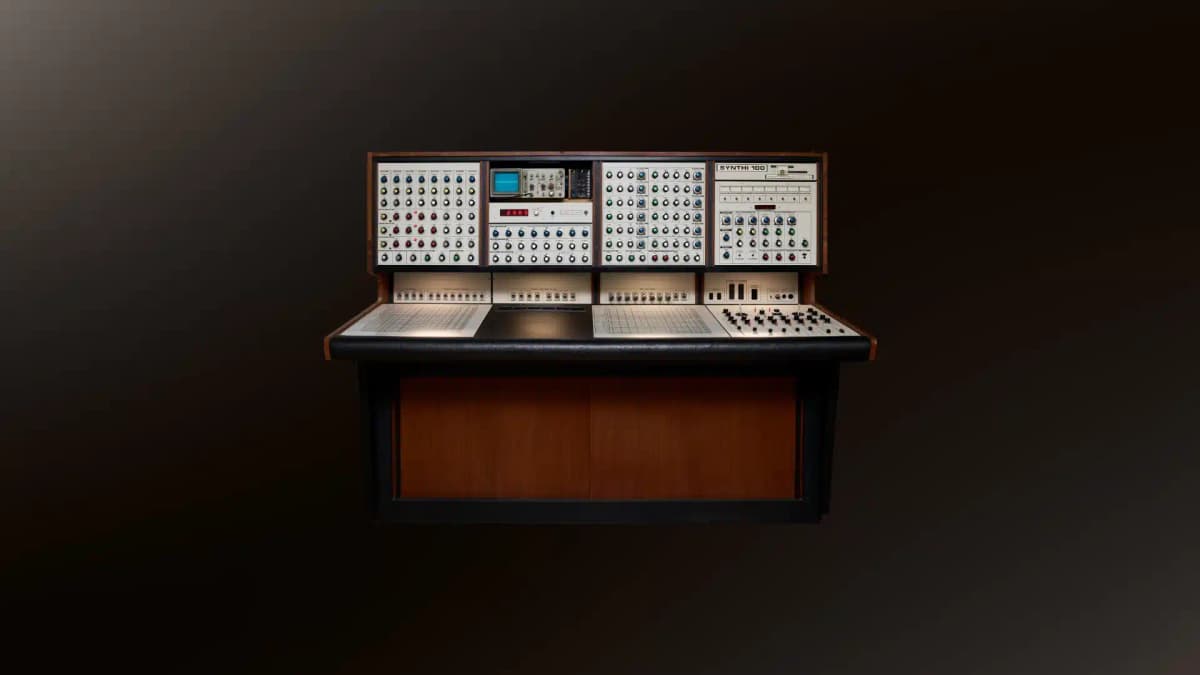
The EMS Synthi 100 is a large semi-modular analog synthesizer that Electronic Music Studios (London) Ltd introduced in 1971, at a price of around £6,500. Developed after a commission from Radio Belgrade and designed by David Cockerell in the circle around Peter Zinovieff, it scaled the VCS3 concept up to cabinet size: twelve oscillators, eight filters, three ring modulators, two pin matrices instead of one, two five-octave keyboards and a 256-step digital sequencer. Only about 30 were built, nearly all for broadcasters and universities. It matters because it was one of the first commercial synthesizers to put digital sequencing at the heart of an analog instrument, and because a handful of those institutional machines shaped radio, television and film sound across Europe.
Table of Contents
EMS Synthi 100 sound and character
The EMS Synthi 100 sounds like a large VCS3, which is what it was meant to be. Its oscillators, filters and envelope shapers come from the same family of EMS circuits, so the character is lean, glassy and often slightly unstable, with resonant filters that whistle and sing rather than thump. Restorers and owners describe the oscillators and filters as more stable than those of the portable VCS3, but nobody buys into EMS for the solid low end of a Moog. The sound lives in the middle and upper registers, in ring-modulated metallic tones, sweeping noise and filter-pinged percussion.
What changes is scale. With twelve oscillators, four high-pass and four low-pass filters, three ring modulators, two noise generators, an eight-octave fixed filter bank and two voltage-controlled spring reverbs, a single patch can build layered textures that would need several VCS3s chained together. Two 60 by 60 pin matrices, one for audio and one for control voltages, mean that routing a slow random voltage into a filter bank while a sequence drives three oscillators and a reverb is a matter of placing pins rather than rewiring.
The EMS Synthi 100 is at its best for evolving electronic textures, radiophonic effects and sequenced patterns. It is weaker as a conventional keyboard instrument: the keyboards were limited to one or two voices each, and the panel encourages experiments rather than quick, repeatable sounds. Its musical identity is clearly vintage and institutional, closer to the electronic music studio of the early 1970s than to anything a gigging keyboardist would recognize.
Features and architecture
- Manufacturer: Electronic Music Studios (London) Ltd (EMS); a later Curtis-based version was developed under Datanomics after EMS collapsed
- Year introduced: 1971; Sound On Sound dates the release to January 1971, the BBC unit was installed by April 1971, and some collections and listings give 1972 for specific units
- Production years: 1971 to 1979, when EMS ceased trading; sources put the total at about 30 units, with estimates ranging from 26 to 31
- Synthesis type: analog subtractive with digital sequencing
- Category: floor-standing semi-modular studio synthesizer with two keyboards
- Polyphony: each manual is usually described as duophonic, and some collection records describe the keyboard as monophonic; the EMS Synthi 100 is not polyphonic in the modern sense
- Original price: around £6,500 in 1971; the BBC’s Delaware reportedly cost £5,400, and later configurations ran higher
- Current market price: no public price guide; Electronic Sound put values at £50,000 to £100,000 in 2019
- Oscillators: 12 VCOs in three groups: six audio-range with sine and ramp, three audio-range with pulse/square and triangle, three low-frequency with pulse/square and triangle
- Filter: four resonant low-pass and four resonant high-pass filters, plus an eight-octave fixed filter bank
- LFOs: the three low-frequency oscillators, plus a random voltage generator
- Envelopes: three trapezoidal envelope shapers, two envelope followers and three voltage-controlled slew limiters
- Modulation system: two 60 by 60 pin matrices (one for audio signals, one for control voltages), three ring modulators, two X-Y joysticks, sample-and-hold and a pitch-to-voltage converter
- Sequencer / arpeggiator: digital sequencer with 256 events across three layers, providing six control voltage tracks; later sold separately as the EMS Sequencer 256
- Effects: two voltage-controlled spring reverbs and four send/return treatment lines
- Memory: no patch memory; patches were recorded by noting pin positions and knob settings
- Keyboard: two five-octave manuals, described by Sound On Sound as velocity-sensitive
- Inputs / outputs: eight input amplifiers, eight output channels with voltage-controlled amplifiers, faders, filters, mutes and panners, and two stereo outputs
- MIDI / USB: none originally; some restorations have added MIDI
- Display: oscilloscope, digital frequency meter and eight level meters
- Computer control: the Computer Synthi, designed around a DEC PDP-8/M minicomputer, could control its modules; Sound On Sound says three were built
- Dimensions / weight: about 2,000 by 950 by 837 mm; the restored Melbourne unit is recorded at 190 kg
- Power: internal mains power supply
Strengths
- The module count is enormous for its time. Twelve oscillators, eight filters, a filter bank and three ring modulators allowed complex patches that would otherwise need several synthesizers.
- The split pin matrices keep audio and control routing separate and visible. Patches can be built, read and changed quickly once the grid logic is understood, without a single cable.
- The digital sequencer was far ahead of most rivals. Storing 256 events from the keyboards in memory gave studios repeatable sequenced material in an era of analog step sequencers with eight or sixteen steps.
- It is a complete studio in one cabinet. Input amplifiers, output mixing, panning, reverbs, meters and an oscilloscope let it process external sound and deliver a finished stereo mix.
- The EMS sound is distinctive. Its light, metallic and unpredictable character remains well suited to experimental electronic music, sound design and textures that differ from American designs.
Limitations
- It was never a musician’s instrument. The price limited buyers to institutions, and the size sometimes required walls to be removed before installation.
- It is difficult to play and patch. Sound On Sound’s Gordon Reid described it as almost unusable, and David Cockerell himself reportedly failed to coax a usable sound from one in the 1990s.
- Build quality was uneven. Restorers report original parts that did not hold up to age or heavy use, and researcher Sean Williams has argued that design and manufacturing flaws held it back.
- There is no patch memory, so returning to a sound depends on careful documentation of pins and settings.
- The keyboards offer only one or two voices each, which rules out conventional chordal playing.
- The control voltage standard of 0.5V per octave complicates integration with 1V-per-octave equipment, although an input gain setting can compensate.
- Restoration is expensive and slow. Parts are scarce, missing sequencer boards have had to be replaced with modern replicas, and substitute components can behave differently.
Historical context
EMS grew out of Peter Zinovieff’s private studio in Putney, London, where he, David Cockerell and Tristram Cary experimented with computer-controlled music in the late 1960s. The company’s first commercial successes were the VCS3 of 1969 and its portable relative, the Synthi A. The EMS Synthi 100 came from a different direction: Paul Pignon and Vladan Radovanović of Radio Belgrade’s Third Program commissioned a large custom system in 1970, and Desmond Briscoe of the BBC Radiophonic Workshop ordered an identical machine. Cockerell, credited as designer, effectively scaled up the VCS3 architecture and added the digital sequencer that grew out of the studio’s computer work.
The BBC unit, nicknamed the Delaware after the street where the Radiophonic Workshop’s Maida Vale studios stood, was installed in April 1971. Radio Belgrade’s machine, serial number 4, followed in 1971 or 1972 depending on the source. Subsequent units went to the universities of Cardiff, Glasgow, East Anglia and Melbourne, to WDR in Cologne, to state studios in Moscow, Bucharest, Warsaw and Athens, to Ghent University’s IPEM, and to a few American institutions and private owners. Stockhausen’s WDR system was reportedly a custom version built around a large vocoder, and EMS also sold the sequencer separately as the Sequencer 256. A more ambitious Computer Synthi, controlled by a PDP-8/M minicomputer at a projected £25,000, found few buyers because only EMS Synthi 100 owners needed it.
The market for such machines was always small, and analog studio systems were quickly overtaken by cheaper synthesizers and, later, digital technology. EMS ran into insurmountable financial trouble in 1979, after a European distributor failed to pay its debts, and the company’s assets passed to Datanomics. A revised EMS Synthi 100 using Curtis oscillator, filter and envelope chips was developed there, but only one was sold, to a music college in Spain. By the early 1980s several owners regarded the EMS Synthi 100 as obsolete; the BBC dismantled the Delaware, and the University of East Anglia’s director noted in 1983 that it had no significant resale value.