Home›Synths›Elka Synthex: The Italian polysynth behind Jarre’s lase…
Synths

Elka Synthex: The Italian polysynth behind Jarre’s laser harp and a cult reputation built after its failure

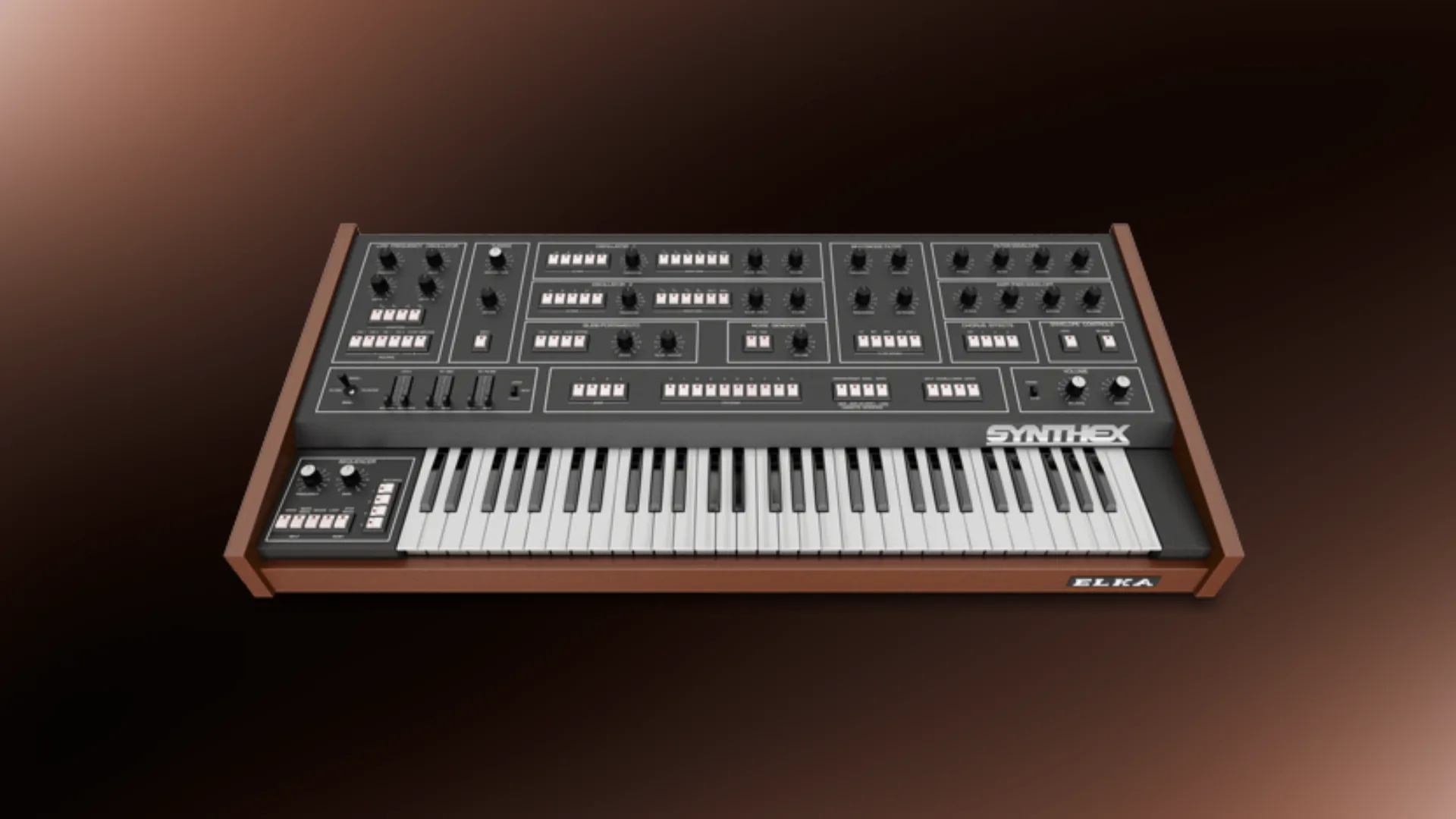
The Elka Synthex is an eight-voice polyphonic synthesizer designed by the independent Italian engineer Mario Maggi and released by Elka, a company better known for home organs, in the early 1980s.

Bernardo de Azevedo
Bernardo de Azevedo
· Updated
Elka Synthex: The Italian polysynth behind Jarre’s laser harp and a cult reputation built after its failure

The Elka Synthex is an eight-voice polyphonic synthesizer designed by the independent Italian engineer Mario Maggi and released by Elka, a company better known for home organs, in the early 1980s. Maggi finished his prototype in 1981, and the instrument reached the market in 1982.

It combined two digitally controlled oscillators per voice with an analog four-pole multimode filter, a built-in chorus, split and layer modes, and a four-track sequencer, at a time when most of its rivals offered no sequencer at all. It sold poorly, was discontinued by the middle of the decade, and then spent the following decades turning into one of the most sought-after polysynths of its era, largely thanks to Jean-Michel Jarre’s album Rendez-Vous.

Sound and character

The Elka Synthex is usually described as lush, but that word only covers part of its character. Its pads and ensemble sounds are wide and glossy, partly because the built-in chorus sits at the end of the signal path and partly because the instrument can play two patches at once and route them to separate stereo outputs. Keith Emerson, speaking in 1985, singled it out as good for string and brass sounds, which is a fair summary of where it sits most comfortably.

The other side of the instrument is sharper. Each voice offers oscillator sync, ring modulation, and cross-modulation of pulse width, and the multimode filter includes high-pass and two band-pass modes alongside the 24 dB low-pass. Paul Wiffen, who programmed the factory presets, wrote that the Elka Synthex’s sync sounds could “cut tempered steel,” and GreatSynthesizers singles out the band-pass and high-pass modes at high resonance as especially strong. That gives it a glassy, metallic edge.

Its oscillators also shape its identity. Because they are digitally controlled rather than free-running VCOs, they hold pitch very well, and Wiffen recalled that a Elka Synthex was “in perfect tune, ready to be played” on power-up while analog rivals still needed attention. The envelopes are a known weak point: GreatSynthesizers finds them slower than those of the Prophet-5, Jupiter-6/8, and OB-X, so the Elka Synthex leans toward pads, sweeps, bells, and sustained leads more than toward snappy plucks.

Features and architecture

  • Manufacturer: Elka (Italy), from a design by Mario Maggi
  • Year introduced: 1982 for the commercial release (Cherry Audio and MusicTech date it to summer 1982); Maggi’s prototype was completed in 1981, and several references list 1981 as the launch year
  • Production years: sources differ, with 1981 to 1984 and 1981 to 1985 commonly listed, while GreatSynthesizers dates production from 1982 to around 1987 based on serial numbers
  • Production run: disputed; Wikipedia gives 1,850 units, GreatSynthesizers estimates roughly 900 to 1,000
  • Synthesis type: subtractive, with digitally controlled oscillators feeding an analog filter and VCA
  • Category: polyphonic keyboard synthesizer with built-in sequencer
  • Polyphony: 8 voices, or 4 + 4 in split and double modes
  • Original price: reported at around £2,500 in some references, with Paul Wiffen recalling a UK retail price of “over three grand”; leftover stock was later sold off for a few hundred pounds
  • Current market price: commonly in five figures, from around €9,000 to €16,000 at auction according to GreatSynthesizers’ 2026 update
  • Oscillators: 2 DCOs per voice with selectable waveforms, octave-range transposition, oscillator sync, cross-modulation of pulse width, and ring modulation; white and pink noise
  • Filter: analog four-pole multimode filter built around Curtis chips (identified as the CEM3320), with 24 dB low-pass, 12 dB high-pass, and 12 dB and 6 dB band-pass modes
  • LFOs: 2, with LFO 1 offering several waveforms and multiple destinations, and LFO 2 working under joystick control
  • Envelopes: 2 ADSR envelopes, one for the filter and one for the amplifier, plus hold and switchable release
  • Modulation system: joystick in place of pitch and mod wheels, with six sliders assigning its effect to LFOs, oscillators, and filter; oscillator sync, ring modulation, and cross-modulation
  • Sequencer / arpeggiator: 4-track monophonic sequencer with 128 steps per track, real-time and step entry, independent track lengths, and real-time transposition; no arpeggiator
  • Effects: built-in chorus with 3 fixed modes; a stereo mode that spreads the two layers across the outputs
  • Memory: 40 factory presets and 40 user memories, plus cassette interface for patches and sequences
  • Keyboard: 61 keys, no velocity sensitivity
  • Inputs / outputs: stereo outputs, cassette interface, sequencer sync input, expression pedal input for filter cutoff, and footswitch inputs for functions including advance, glide, hold, and release; no headphone socket
  • MIDI / USB: no MIDI on the earliest units; later units used a computer-interface break-out box or factory-fitted MIDI sockets, and retrofits exist; MIDI handles little more than note on and note off; no USB
  • Dimensions / weight: a large full-size instrument; one collector reference lists about 30 kg, while exact dimensions could not be verified
  • Power: internal mains supply, with early US-market units built for 117 V and European units for 220 V

Strengths

  • The voice is genuinely distinctive. Chorus, stereo layering, and a filter with usable band-pass and high-pass modes give it a sheen and an edge that set it apart from the Prophet-5 and Oberheim sound of the same period.
  • Stable oscillators made it a practical instrument. Its DCOs held pitch from power-up, which mattered on stage at a time when many analog polysynths needed regular retuning.
  • It was unusually complete for 1982. Split and layer modes, two independently programmed sounds, stereo outputs, and an onboard four-track sequencer turned it into something close to a self-contained performance workstation.
  • The sequencer encouraged creative use. Independent track lengths let short loops drift against each other, a feature Wiffen highlighted for building evolving patterns from very little material.
  • Build quality is high. GreatSynthesizers describes solid casework and quality controls, and notes that almost all parts inside are standard components.

Limitations

  • Eight voices shrink to four per sound when splitting or layering, and there is no unison mode.
  • The keyboard has no velocity sensitivity, which limits expressive playing compared with later instruments.
  • MIDI is rudimentary even on later units: note on and note off, with no program change or system exclusive support, so integration into a modern rig is limited.
  • The envelopes are slower than those of its main rivals, which makes very percussive sounds harder to achieve.
  • The joystick sits on the programming panel rather than beside the keys, and Wiffen found it a little tricky to control while playing.
  • Practical drawbacks include a loud cooling fan, no headphone output, considerable weight, and the general maintenance demands of a dense early-1980s instrument with around a thousand chips inside.

Historical context

The Elka Synthex arrived just as the professional polysynth market was consolidating around the Prophet-5, the Oberheim OB series, the Roland Jupiter-8, and the Memorymoog. Elka was a credible keyboard maker, and its Rhapsody string machine had sold well, but it was still known mainly for organs and accordions. That reputation became the instrument’s central problem. Wiffen later concluded that “the Elka name was the problem,” noting that the Elka Synthex was sold largely through organ shops rather than the specialist stores where serious synth buyers shopped.

The design itself came from outside the company. Maggi developed the Elka Synthex independently and brought it to Elka for financial backing and manufacturing. He had already built the MCS70, a programmable monosynth used for every sound on the 1978 album Automat, and only one MCS70 was ever built. Polyphonic instruments made that project look obsolete, and the Elka Synthex was his answer.

Timing then turned against it. The Yamaha DX7 arrived in 1983 and quickly drew attention away from expensive analog polysynths, and MIDI was arriving at the same moment. The Synthex’s earliest units had no MIDI at all, and later implementations remained basic. Elka lost faith in the instrument and sold remaining stock cheaply through Electronics & Music Maker, while its later EK-22 and EK-44 synthesizers followed the market’s shift toward chip-based and FM designs.

Legacy and significance

The Elka Synthex is an instructive case of an instrument whose reputation was made after its commercial life ended. Later, it became attractive precisely because it was rare, it sounded unlike the American polysynths that dominated the canon, and its most famous recording made its sound easy to identify.

It also deserves attention for what it anticipated. A polysynth with stable digitally controlled oscillators, two-part multitimbrality, stereo layering, and a multitrack sequencer looks less like a 1982 analog synth and more like an early sketch of the workstation concept. Wiffen even suggested that, after a software update allowed sequencer tracks to address either the upper or lower sound, it may have had the first multitimbral sequencer. That claim is his, not a settled fact.

The revival activity around it confirms the point. Cherry Audio released the Elka-X in 2022, Arturia followed with Synthx V, Xils Lab had already offered Syn’X, and Black Corporation built the Xerxes, an eight-voice hardware homage, followed by the Xerxes MK2. Maggi himself announced a Synthex 2 in 2015, and a separate crowdfunded revival of the original failed to reach its target. Few commercial failures of the early 1980s have attracted that much reinterpretation.

Artists, users, and curiosities

The Elka Synthex is inseparable from Jean-Michel Jarre’s Rendez-Vous, where it supplied the sound triggered by his laser harp. Sound On Sound lists the Elka Synthex on every track of the album, and the laser harp association more than any spec sheet is what kept the instrument’s name alive.

Its other users span progressive rock, pop, and soul. Geoff Downes used it with Asia, and Sound On Sound points to “Suspicion” and “Voice of America” on Astra. Keith Emerson acquired one by 1985 and played it live on “Fanfare for the Common Man.” Stevie Wonder used it on “Skeletons” from Characters (1987), where Wiffen linked an OSCar and a Elka Synthex via MIDI for the bass sound. Magnum’s Mark Stanway, Tangerine Dream, and Nick Rhodes of Duran Duran are also cited as users.

The curiosities are as memorable as the credits. According to Vintage Synth Explorer and Cherry Audio’s account reported by MusicTech, the last Elka Synthex was built for Stevie Wonder after regular production had ended. Wiffen recalled that Elka briefly considered selling the instrument under the anagram “Lake” to distance it from the organ brand, and was told Italian pride would not allow it. He also described a Elka Synthex that was water-damaged after the Docklands concert and worked perfectly once it had dried out.

Elka Synthex market value

  • Current market position: a rare, collectible early-1980s polysynth valued above most of its contemporaries relative to its original reputation
  • New price signal: no new hardware; the sound is available new through software such as Cherry Audio’s Elka-X and Arturia’s Synthx V, and through the Black Corporation Xerxes MK2 as a hardware homage
  • Used market signal: GreatSynthesizers reports roughly 8,000 to 12,000 EUR/USD in 2019 to 2021 and auctions of about 9,000 to 16,000 EUR in 2026; Sound On Sound cited a value of about £10,000 in 2025, and individual asking prices have gone considerably higher
  • Availability: hard to find, with units appearing occasionally through specialist dealers and auctions
  • Buyer notes: check which version is on offer (no MIDI, break-out box, retrofitted, or factory-fitted MIDI), the voltage configuration, the condition of the keyboard and joystick, sequencer and memory function, the cassette interface, and the cooling fan
  • Support ecosystem: most parts are standard components, but servicing calls for an experienced vintage technician
  • Market character: collectible and largely driven by rarity, the Jarre association, and the instrument’s reputation for lush, wide polyphonic sounds
  • Long-term position: established as a high-value classic, with prices fluctuating at auction rather than following a steady curve

Conclusion

The Elka Synthex represents a design that was more ambitious than its market moment allowed. Mario Maggi built a stable, multitimbral, sequencer-equipped polysynth with a voice of its own, and Elka launched it into a market that doubted the brand and was about to turn toward digital synthesis. What rescued it was sound: the chorus-washed pads, the cutting sync and band-pass tones, and above all the laser harp of Rendez-Vous. Today it stands as evidence that one of the most forward-looking polysynths of the early 1980s came from outside the usual American and Japanese centers of the industry.

Sources

  1. Elka Synthex (Retrozone), Sound On Sound
  2. Arturia Synthx V review, Sound On Sound
  3. ELKA Synthex: analog classic and vintage workstation, GreatSynthesizers
  4. Elka Synthex, Vintage Synth Explorer
  5. Elka Synthex, Polynominal
  6. Elka Synthex, Wikipedia
  7. Cherry Audio’s Elka-X is a plugin emulation of ELKA Synthex, a rare 1982 Italian analogue polysynth, MusicTech
  8. Cherry Audio Elka-X review, MusicTech
  9. Cherry Audio Releases Elka-X Synthesizer, Cherry Audio
  10. Another Chapter in the Story (Keith Emerson interview), Electronics & Music Maker, via Muzines
  11. Elka Synthex, Hollow Sun Nostalgia
  12. Italian synthesizers, Gearnews
  13. Automat (Romano Musumarra and Claudio Gizzi album), Wikipedia)
  14. Synthex 2 announced, RouteNote
  15. Meet XERXES MK2, the new updated Elka Synthex replicant by Black Corporation, MusicTech

Bernardo de Azevedo
Written by
Bernardo de AzevedoFounder & Editor

His connection with music began at age 6, in the 1980s, when his father introduced him to Jean-Michel Jarre's Rendez-Vous on vinyl. He works professionally in the legal field, while synthesizers became his space for abstraction and creative exploration. Founder of The Synth Source.