

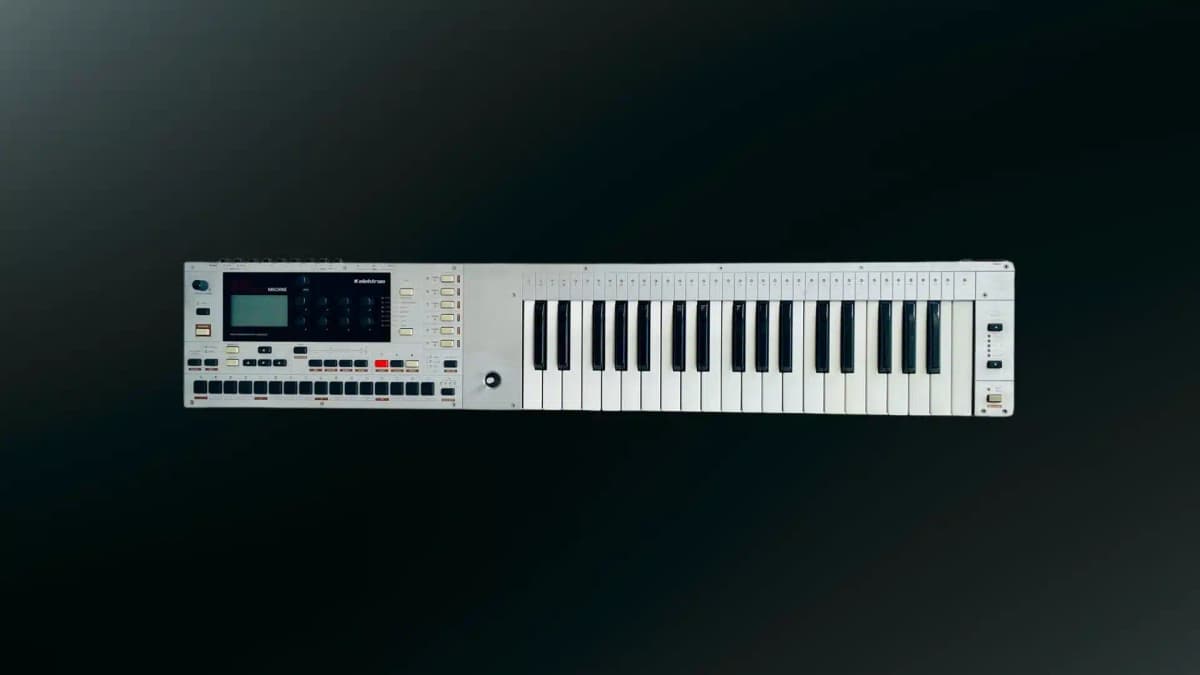
The Elektron Monomachine SFX-6 is the keyboard version of Elektron’s Monomachine, a six-track digital synthesizer and sequencer that the Swedish company introduced at the turn of 2003 and 2004. Built in a run of just 500 units, it placed the Monomachine engine in a long brushed-aluminum case with a 37-key keyboard, LEDs above the keys, a joystick and an internal power supply. Each of its six tracks could load a different synthesis machine, from analog-style SuperWave and Commodore 64-inspired SID emulation to 12-bit DigiPro waveforms, simplified FM and a formant voice engine, all driven by the parameter-lock sequencer Elektron had pioneered on the Machinedrum. Elektron itself describes the Elektron Monomachine SFX-6 as its first keyboard synthesizer.
Table of Contents
Elektron Monomachine SFX-6 sound and character
The Monomachine sounds digital and makes no attempt to hide it. Paul Nagle, reviewing the Elektron Monomachine SFX-6 for Sound On Sound in April 2004, described results that were dirty, digital and industrial, with the DigiPro waveforms, SID machine and sample-rate reduction producing some of the most characterful sounds. MusicTech’s later retrospective was blunter: it will never sound analog and it is not warm. What it offers instead is range, from brittle chiptune leads and metallic FM percussion to robotic vocal syllables and buzzing, Kraftwerk-style sequences.
The architecture explains that range. Each of the six tracks is a monophonic voice built from a chosen machine, followed by a resonant multimode filter, an amplitude envelope with attack, hold, decay and release, three tempo-synced LFOs, a one-band EQ, distortion, sample-rate reduction and a tempo-synced delay. SuperWave covers saw, pulse and an Ensemble mode that can stack up to four notes on a single track; SID models the 6581 chip’s oscillator with ring modulation and sync; FM+ offers three simplified DX-style algorithms; VO mimics speech; and dedicated FX machines add reverb, chorus and compression, or process the two external inputs.
The real character, though, comes from the sequencer. With parameter locks, any step can carry its own filter, waveform, envelope or effect settings, and a slide track glides between locked values. A single SuperWave saw can be turned into an acid line or a constantly shifting texture without touching an encoder in real time. The flip side is that the Monomachine is less convincing as a conventional polysynth: its six-voice poly mode uses every track, and lush, warm pads are not its strength. It sits at the cold, modern, experimental end of the 2000s digital spectrum.
Features and architecture
- Manufacturer: Elektron, Gothenburg, Sweden
- Year introduced: 2003 according to Elektron’s own product history; launch prices were published in February 2004 and most reviews and databases date the Elektron Monomachine SFX-6 to 2004
- Production years: a single limited run of 500 units; Elektron has not published an end date for the keyboard model, and the Monomachine module line continued until June 2016
- Synthesis type: digital, multiple engines (virtual analog, SID emulation, 12-bit wavetable and percussion, simplified FM, formant voice synthesis)
- Category: keyboard synthesizer with integrated step sequencer
- Polyphony: six monophonic tracks, or one six-voice polyphonic track that uses all six
- Multitimbrality: 6 parts, plus 6 external MIDI tracks
- Original price: €1,950 in the EU and $1,900 in the US and rest of world at launch, according to Elektron’s published pricing; some references give $1,950
- Current market price: very limited supply; an Elektron Monomachine SFX-6 was listed on Reverb at about $4,400 in October 2026, while Equipboard’s tracked Reverb listings for Monomachine units averaged around $2,600
- Oscillators: one machine per track; SuperWave (saw, pulse, Ensemble), SID, DigiPro (32 waveforms or 24-sample BeatBox), FM+ (Static, Parallel, Dynamic), VO and GND (sine or noise)
- Filter: one resonant multimode filter per track, specified as 24dB
- LFOs: 18 tempo-synced LFOs, three per track
- Envelopes: one amplitude envelope per track (attack, hold, decay, release), plus machine-specific envelope parameters
- Modulation system: parameter locks on up to 62 parameters per step, slide track, LFOs that can target most parameters, joystick
- Sequencer / arpeggiator: six-track internal step sequencer (2 to 64 steps), six external MIDI tracks, swing, song mode and chaining; arpeggiator on all 12 tracks
- Effects: per-track EQ, distortion, sample-rate reduction and delay; FX machines for reverb, chorus and compression; external audio processing
- Memory: 128 patterns, 128 kits and 32 songs per Elektron’s specifications (Sound On Sound’s review of OS 1.02 counted 24 songs); no separate patch library at launch
- Keyboard: 37 keys with LEDs above them showing played and sequenced notes, specified as velocity-sensitive; no aftertouch; MULTI-TRIG key and four-way steel joystick
- Inputs / outputs: six 1/4-inch audio outputs, two 1/4-inch audio inputs, headphone output
- MIDI / USB: MIDI In, Out and Thru; no USB
- Display: 128 x 64 backlit LCD
- Dimensions / weight: 975 x 176 x 55 mm, about 7 kg
- Power: internal power supply (the SFX-60 module used an external one)
Strengths
- Parameter locks make it unusually expressive as a sequenced instrument. Every step can have its own sound, so movement and variation are built into patterns rather than added later.
- The engine variety is wide. Analog-style, SID, wavetable, FM, voice and percussion machines in one unit let a single Elektron Monomachine SFX-6 cover leads, bass, drums and noise.
- It works as a self-contained studio. Six tracks of synthesis, internal effects, two audio inputs and six separate outputs made laptop-free performance practical in the mid-2000s.
- It is a capable MIDI sequencer. Six external tracks with arpeggiators and parameter-locked MIDI data let it run other gear alongside its own voices.
- The keyboard adds something the module lacks. Playable keys and the LED display above them make it easier to enter and visualize melodic parts, which owners on the Elektronauts forum single out.
- Build quality is solid, with a brushed-aluminum case and bolted rear-panel jacks noted at launch by Sonic State.
Limitations
- Polyphony is minimal. True six-voice playing consumes every track, so the Elektron Monomachine SFX-6 is not a substitute for a conventional polysynth.
- The sound is cold by design. Players looking for analog warmth or plush pads will find it brittle, as MusicTech and Audiofanzine reviewers note.
- The keyboard is basic: there is no aftertouch, and Sound On Sound’s review unit had intermittently sticking keys. The sequencer did not record velocity at launch.
- The internal power supply can develop audible hum, reported both in the 2004 review and by later owners, some of whom swapped in an external supply.
- It is a first-generation (MKI) design, so it lacks the MKII’s improved converters and user waveforms; whether a +Drive upgrade is available for the Elektron Monomachine SFX-6 is reported inconsistently.
- Repairs are harder than on the module. Owners report that Elektron no longer stocks many SFX-6-specific parts, and the case is long and heavy for a three-octave instrument.
- The workflow is idiosyncratic. Global pattern lengths, no triplets at launch and the drum-machine logic suit some players and frustrate others.
Historical context
Elektron began in 1997 as a project by three Chalmers University of Technology students in Gothenburg: Daniel Hansson, Anders Gärder and Mikael Räim. Its first product, the SidStation, was built around the Commodore 64’s SID chip and, according to Elektron, was the reason the company formed. The Machinedrum followed in 2001 and introduced the parameter-lock sequencer and kit system that defined Elektron’s instruments. The Monomachine extended that concept from drums to melodic synthesis.
The Monomachine appeared in two forms. The SFX-60 was a compact module in the Machinedrum’s format, while the Elektron Monomachine SFX-6 added the keyboard, joystick and internal power supply in a 975 mm case. Elektron announced pricing in February 2004, Sound On Sound reviewed the Elektron Monomachine SFX-6 in its April 2004 issue (a cover story, according to Sonic State), and Elektron limited the keyboard version to 500 units. Owners who wanted the module’s portability and the keyboard’s playability could combine an SFX-60 with an external controller, which made the Elektron Monomachine SFX-6 something of a one-off.
The platform kept developing after the keyboard run. The SFX-60 MKII arrived in 2007 with better converters and a slimmer case, OS 1.20 in July 2008 added user waveforms to MKII hardware, and the SFX-60+ MKII with +Drive storage followed in 2010. Elektron announced the end of both the Monomachine and the Machinedrum in June 2016, selling remaining stock through its web shop until June 21. By then, the analog Analog Four and Analog Rytm had taken their place in the range.