

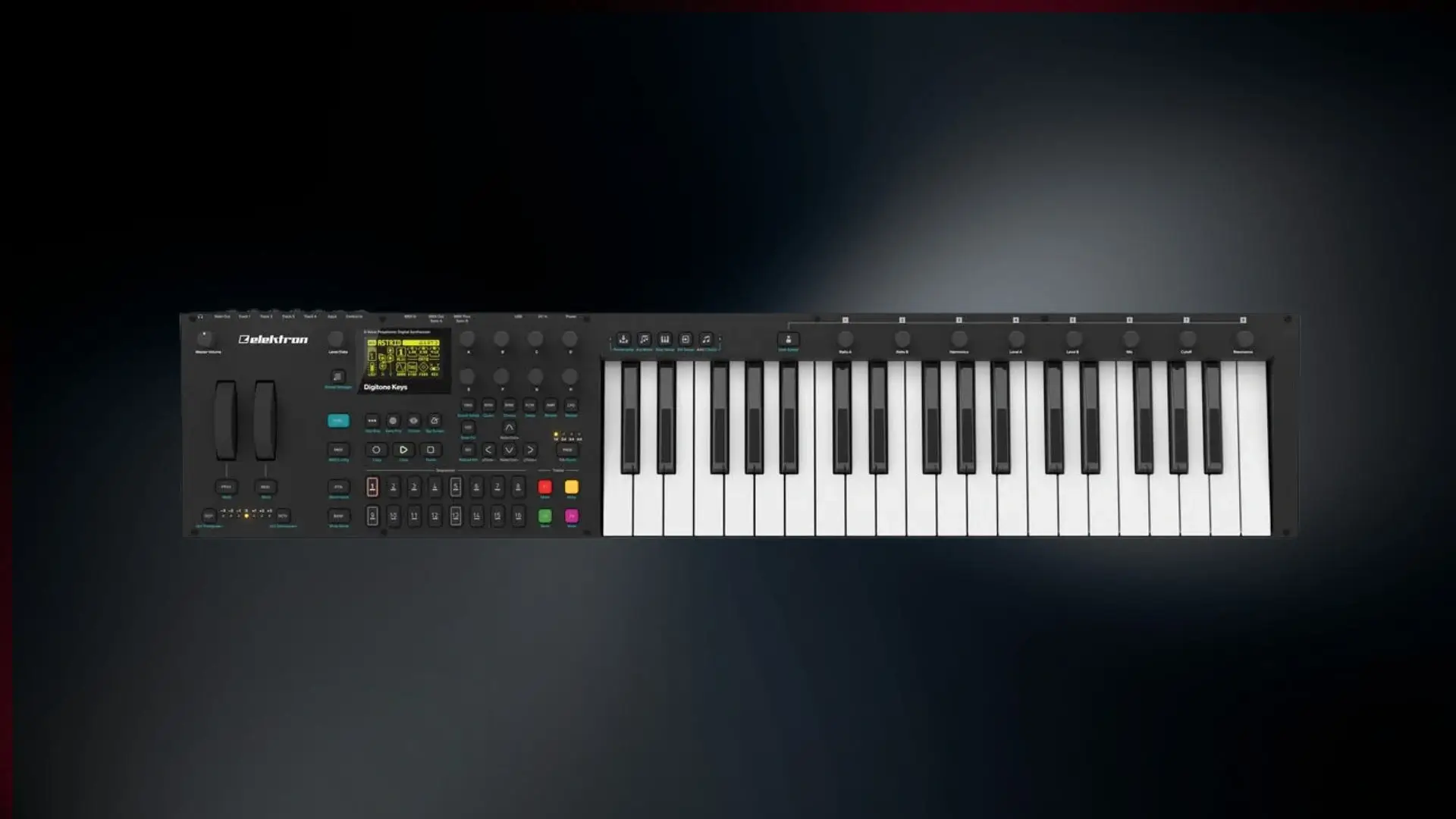
The Elektron Digitone Keys is a 37-key digital FM synthesizer introduced in 2019 that placed the sound engine of the Digitone into a wider, performance-oriented keyboard format. It kept the core idea of the original machine: a modernized four-operator FM engine shaped through filters, effects, parameter locks, and Elektron sequencing. What made the Elektron Digitone Keys version meaningful was not that it radically changed Digitone synthesis, but that it reframed it. It turned an already powerful desktop FM groovebox into a tactile instrument with keys, aftertouch, wheels, assignable controls, expanded outputs, and a stronger claim as the center of a live electronic setup.
Table of Contents
Elektron Digitone Keys sound and character
The Elektron Digitone Keys does not sound like a nostalgic attempt to recreate the Yamaha DX7 era in a literal way. Its identity is cleaner, tighter, and more deliberately hybrid. The raw material comes from digital FM, but the Elektron Digitone Keys’s practical character comes from the way Elektron places that FM engine inside a subtractive-style signal path. Instead of leaving the user alone with abstract ratios and operator routing, the Digitone Keys lets metallic, glassy, bell-like, percussive, rubbery, and synthetic tones pass through filters, overdrive, envelopes, modulation, and effects.
That design matters because it changes the emotional behavior of FM. Classic FM can be brilliant but brittle, mathematically flexible but musically intimidating. The Elektron Digitone Keys makes FM feel less like programming a telecom system and more like shaping a synthesizer voice. Bright tones can be softened by filtering. Thin sounds can be widened with chorus and reverb. Percussive attacks can become sequence-driven rhythmic material. Digital sharpness can be made more physical through overdrive and performance modulation.
In practice, it excels at crystalline chords, synthetic mallets, cold pads, precise basses, plucked sequences, evolving arpeggios, and sharply animated techno patterns. It is not a lush analog polysynth, and it should not be judged by that standard. Its best sounds often sit between precision and instability: clean enough to cut through a mix, complex enough to remain animated, and structured enough to be sequenced with intent.
The keyboard format also changes the way the sound is perceived. On the desktop Digitone, the engine naturally invites pattern construction. On the Elektron Digitone Keys, the same engine becomes more immediate as a playable harmonic instrument. Aftertouch, velocity, pitch bend, modulation wheel control, and assignable encoders encourage the player to treat FM timbre as something performed, not merely edited.
Features and architecture
- Manufacturer: Elektron.
- Year introduced: 2019.
- Production status: introduced in 2019 and later moved into Elektron’s legacy-product category; a precise official end-of-production date is not consistently published in accessible official material.
- Synthesis type: digital FM synthesis using a four-operator architecture, combined with a subtractive-style voice path.
- Category: digital FM keyboard synthesizer, performance groovebox, and MIDI sequencing hub.
- Polyphony: 8 voices.
- Multitimbrality: 4 internal synth tracks.
- Original price signal: launched at approximately $1299 / £1180 / €1320.
- Later new-price signal: European retail pricing was reported around €999 in 2020 after a notable price drop.
- Current market signal: used-market examples appear sporadically, with asking prices varying widely depending on region, condition, and availability.
- Oscillators / tone generation: four-operator FM engine with multiple algorithms and harmonic controls.
- FM structure: eight algorithms, with carrier/modulator relationships designed to make FM programming more approachable than traditional open-ended operator editing.
- Filter: multimode filter per voice, plus a base-width filter.
- Drive: overdrive is part of the voice architecture, with a master overdrive effect also available.
- LFOs: two assignable LFOs.
- Envelopes: operator-related envelopes, filter shaping, and amplifier shaping are part of the sound-design system.
- Modulation system: velocity, aftertouch, pitch wheel, modulation wheel, assignable controllers, LFOs, parameter locks, trig conditions, and per-step automation.
- Sequencer: Elektron sequencer with four synth tracks and four MIDI tracks.
- Sequencing functions: parameter locks, micro timing, trig conditions, individual track lengths, sound-per-step changes, real-time recording, grid recording, and step recording.
- Arpeggiator: arpeggiator available for synth tracks.
- Effects: chorus, delay, reverb, and master overdrive.
- Memory: +Drive storage for up to 128 projects and 2048 sounds.
- Pattern structure: projects contain patterns, sound pools, kits of track sounds, sequencer data, parameter locks, and routing information.
- Keyboard: 37-key semi-weighted keyboard with velocity sensitivity and aftertouch.
- Performance controls: assignable pitch wheel, modulation wheel, and eight assignable rotary encoders.
- Audio outputs: main stereo outputs, headphone output, and individual track outputs.
- Audio inputs: stereo audio inputs for routing external sources through the Elektron Digitone Keys.
- Control inputs: inputs for control voltage, expression, or sustain-type control assignments.
- MIDI: MIDI In, Out, and Thru on DIN connectors, with sync-related functions.
- USB: Hi-Speed USB 2.0 for MIDI, data transfer, and Overbridge-related integration.
- Display: 128 × 64 OLED display.
- Dimensions: approximately 868 mm wide, 185 mm deep, and 90 mm high including knobs, feet, and jacks.
- Weight: approximately 6 kg.
- Power: 12 V DC center-positive external power supply; typical power consumption is listed at 9 W.
Strengths
- The core sound engine makes FM unusually direct. The Elektron Digitone Keys does not remove FM complexity, but it reduces the distance between idea and sound by combining algorithms, harmonic controls, filters, envelopes, and effects in a musically coherent system.
- The keyboard changes the Elektron Digitone Keys’s psychology. With full-size keys, aftertouch, pitch bend, and modulation control, it feels less like a box that happens to make pitched sounds and more like a synthesizer that can be played, performed, and shaped in real time.
- The Elektron sequencer remains one of its defining strengths. Parameter locks, trig conditions, micro timing, and sound-per-step changes make it possible to turn relatively small sonic materials into evolving, asymmetric, and highly detailed patterns.
- The four MIDI tracks make the Elektron Digitone Keys useful beyond its own sound engine. It can function as a compact command center for external synthesizers, drum machines, or modules, which is important for live electronic setups.
- The individual track outputs are a serious practical advantage. They allow the four internal synth tracks to be recorded or processed separately, making the Elektron Digitone Keys version more studio-friendly than the basic idea of “Digitone with a keyboard” suggests.
- The sound sits well in electronic music. Its tones can be precise, glassy, percussive, and harmonically complex without occupying the same space as analog polysynths, which makes it useful in arrangements that need definition rather than mass.
- The design rewards performance preparation. Assignable encoders, controller modes, keyboard mapping, and modulation assignments encourage the user to build playable systems rather than simply browse presets.
Limitations
- Eight voices can feel restrictive when using sustained chords, long releases, layered tracks, unison, or dense four-part arrangements. The limitation is not fatal, but it is real.
- The fixed structure of four internal synth tracks and four MIDI tracks is powerful, but less open-ended than later Elektron developments. In a post-Digitone II context, the original voice and track count feels more obviously constrained.
- The form factor is polarizing. At approximately 868 mm wide, it is much wider than most 37-key instruments, because the control surface sits beside the keyboard rather than above it.
- The interface is still an Elektron interface. It is more approachable than many historical FM instruments, but it is not a knob-per-function keyboard, and deeper work requires comfort with pages, modes, shortcuts, and sequencing logic.
- The small OLED display is efficient but not luxurious. It supports the workflow well, but users expecting a large visual sound-design environment will not find one here.
- The individual track outputs are useful, but they are not the same as a fully expanded effects-routing environment. Users planning multitrack recording should understand how effects and outputs are routed before building a studio workflow around it.
- As a legacy product, it is not as straightforward to buy new as current Elektron instruments. Availability depends heavily on used-market timing and region.
Historical context
The Digitone Keys appeared in 2019, roughly one year after the original Digitone brought Elektron’s modern FM concept into a compact desktop format. That timing matters. By the late 2010s, hardware synthesizers had returned strongly, but the dominant romance of the market was still heavily analog: VCO polysynths, mono bass machines, and reissues of older circuits. Elektron’s move was different. It treated FM not as a relic of 1980s digital keyboards, but as a living engine for sequencing, modulation, and performance.
The original Digitone already reframed FM by combining it with the Elektron sequencer. The Elektron Digitone Keys version went further by asking whether that system could also be a keyboard instrument. Elektron had precedent for this kind of idea: the company had previously explored side-by-side keyboard/control layouts in earlier instruments such as the Monomachine keyboard version and later with the Analog Keys. The Elektron Digitone Keys therefore sits within a small but distinctive Elektron lineage: machines that refuse to separate synthesis, sequencing, and performance into conventional categories.
Its odd shape was part of the story. Most keyboard synthesizers place controls above the keys. The Elektron Digitone Keys placed the Digitone-style panel to the side, producing an instrument that looked almost like a desktop Elektron box permanently attached to a compact keyboard. That made it visually divisive, but it also made practical sense. The player could keep one hand on the keys and the other on sequencing, sound design, and performance controls.
Historically, the Elektron Digitone Keys responded to a specific opportunity: FM was powerful, but still carried the reputation of being abstract and unfriendly. Elektron’s answer was not to make FM nostalgic or simplified into presets. It made FM programmable through the grammar of contemporary electronic performance: locks, trigs, patterns, modulation, routing, and hands-on control.