
Elektron Analog Keys: The four-voice analog flagship that turned Elektron into a keyboard instrument
The Elektron Analog Keys is a four-voice analog performance synthesizer introduced in late 2013 as the keyboard flagship of Elektron’s original Analog line. Built on the same core synthesis platform as the Analog Four but expanded into a 37-key format with aftertouch, joystick control, individual outs, CV/Gate sequencing, and Elektron’s famously deep sequencer architecture, it was never just a desktop synth with keys bolted on. It was an attempt to turn Elektron’s machine-centric way of thinking into a playable, expressive keyboard instrument.
Sound and character
The most striking thing about the Analog Keys is that it does not behave like a classic vintage polysynth, even though its voice path is fully analog. Its sound is firm, focused, and modern in the way it presents itself. Notes tend to arrive with a kind of forward clarity rather than with the loose bloom of older Roland or Oberheim-style polysynths. That gives it a different center of gravity: less immediately nostalgic, more sculptural and performance-driven.
Continue Reading
In practice, it excels at muscular basses, dry and articulate sequences, sharply defined stabs, unstable drones, and evolving patches that become more interesting once the sequencer and macros start moving the parameters. Pads are absolutely possible, but they do not come from the instrument in a lush, instant-gratification way. The Analog Keys often sounds best when you lean into what Elektron gave it: motion, contrast, pressure, and modulation.
Part of that character comes from the architecture itself. Each voice combines two analog oscillators, sub-oscillators, noise, dual filters, analog overdrive, and feedback, which means the instrument can move from tight and controlled to saturated and growling without leaving its own internal structure. Reviews from the launch period repeatedly noted that it could sound surprisingly weighty in the low end, and that low-frequency authority matters because it changes the role the instrument can play. The Analog Keys is not merely a poly for chords; it can also behave like a serious mono lead and bass machine, then flip back into polyphonic sequencing with almost no loss of identity.
What makes it memorable, though, is not any single raw tone. It is the way the sound responds to Elektron-style intervention. Parameter locks, per-step sound changes, performance macros, arpeggiation, and the joystick all make the instrument feel less like a static keyboard and more like a living control surface for analog timbre. That is why the Analog Keys often leaves a stronger impression in motion than in isolated preset browsing.
Features and architecture
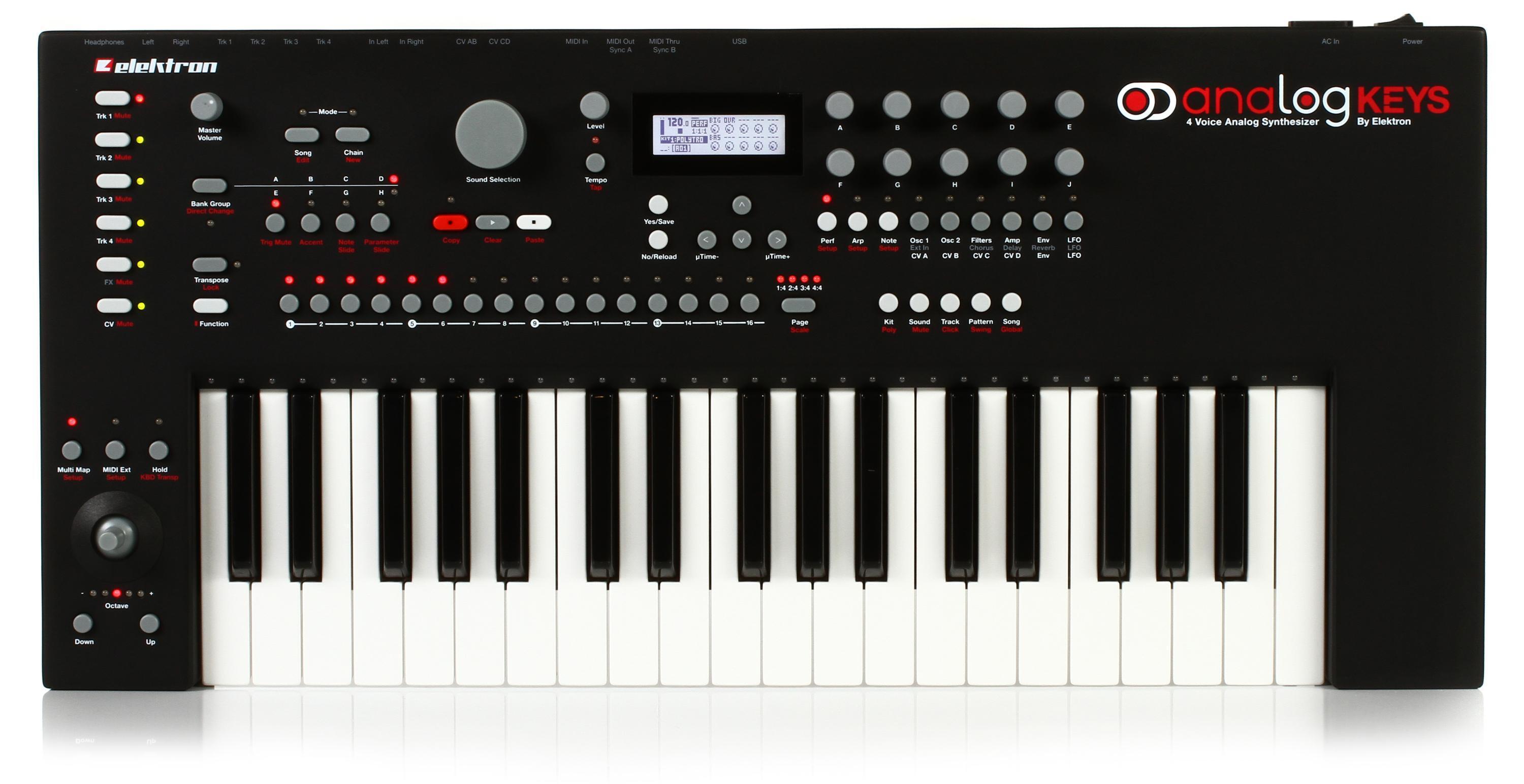
- Manufacturer: Elektron
- Year introduced: 2013
- Production years: Introduced in late 2013; now discontinued
- Synthesis type: Analog subtractive synthesis with digital control
- Category: Four-voice analog performance keyboard / sequencer synthesizer
- Polyphony: Up to 4-note polyphony, multitimbral operation, or unison
- Original price: Announced at US$1,849 / €1,749 / £1,449, with launch-era street pricing commonly cited around US$1,799
- Current market signal: Discontinued; used values vary widely by condition, region, display health, accessories, and dealer status
- Oscillators: 2 analog oscillators per voice, variable waveshape on all waveforms, AM and sync modes, 2 sub-oscillators, and a noise generator
- Filter: 1 four-pole analog low-pass ladder filter and 1 two-pole analog multi-mode filter per voice, plus analog overdrive and filter feedback
- LFOs: Per voice, 2 assignable LFOs, 1 dedicated vibrato LFO, and 2 dedicated waveshape LFOs
- Envelopes: 1 amp envelope, 2 assignable envelopes, plus dedicated fade, noise, vibrato, and autobend envelopes
- Modulation system: Performance macros, velocity routing, aftertouch assignment, mod-wheel assignment, pitch-bend assignment, joystick control of up to 15 parameters, parameter locks, and per-step sound changes
- Sequencer / arpeggiator: 4 synth tracks, 1 FX track, 1 CV/Gate track, up to 64 steps per pattern, individual track lengths, micro-timing, swing, slide, accent, track transpose, sound-per-step change, and 6 arpeggiators
- Effects: Wideshift Chorus, Saturator Delay, Supervoid Reverb
- Memory: +Drive with 128 projects and 4096 sounds; per project: 128 patterns, 128 kits, 128 sounds, and 16 songs
- Keyboard: 37 semi-weighted keys with velocity and aftertouch
- Inputs / outputs: Stereo main outs, stereo headphone out, 2 audio inputs, 4 stereo TRS individual track outs, and 2 dual CV/Gate outputs
- MIDI / USB: MIDI In, Out, Thru, DIN Sync out, and electrically isolated USB 2.0
- Display: 122 × 32 pixel backlit LCD
- Dimensions / weight: 660 × 309 × 93 mm; approximately 5.4 kg
- Power: 100–250 VAC, 50–60 Hz; typical consumption 14 W, maximum 25 W
Strengths
- A rare combination of keyboard and Elektron sequencing: The Analog Keys is one of the few instruments that genuinely merges a playable keyboard with a deep per-step sequencing environment, rather than treating the sequencer as an afterthought.
- A strong modern analog voice: Its tone is not a vintage clone cliché. It has punch, low-end authority, and a modern edge that works especially well for sequences, basses, dark leads, and hybrid performance roles.
- Multitimbral depth in a compact footprint: Four synth tracks, an FX track, and a CV track allow the instrument to act less like a single keyboard and more like a self-contained analog composition system.
- Excellent performance potential: The joystick, macros, arpeggiators, aftertouch, and track-based structure make it unusually good for live reshaping rather than static preset recall.
- CV/Gate integration: For musicians working with modular or semi-modular rigs, the Analog Keys can function as both synth and control center.
- Individual outputs: Compared with the tabletop Analog Four of the period, the keyboard version offered a more studio-friendly routing concept.
- Deep memory and project structure: The +Drive system makes it much more practical as a serious long-term instrument than many analog synths that sound great but store very little.
Limitations
- Only four voices: However deep the architecture is, four voices remain four voices. Dense chord work and long-release pads quickly expose the limit.
- Steep learning curve: The instrument rewards commitment, but it absolutely expects commitment. It is not an immediate, one-evening synth for most users.
- Small display by keyboard-synth standards: The screen is serviceable, not luxurious, and some of the depth lives behind menus rather than on a one-knob-per-function surface.
- Less naturally “sweet” than some classic polysynths: If a player wants instant lushness, vintage softness, or traditional polyphonic charm, other instruments get there faster.
- Workflow identity can be polarizing: Much of its power depends on embracing the Elektron way of building patterns, kits, sounds, and performance states.
- Discontinued status changes the buying calculus: It is no longer a current-production instrument with fresh retail availability, so condition and support history matter more than they would on a new model.
Historical context
The Analog Keys arrived at an interesting moment. By late 2013 and early 2014, analog synthesis was already back in force, but much of the market energy centered on either straightforward monosynths, retro-minded polysynths, or desktop modules. Elektron came from a different lineage. Its reputation had been built not on keyboard instruments, but on machines: boxes with sequencing depth, pattern logic, and a performance philosophy that treated composition as something programmable and mutable.
That is what made the Analog Keys important inside Elektron’s own history. It translated the Analog Four’s architecture into a flagship keyboard format and, in doing so, answered a practical question: what happens when Elektron stops expecting players to bring an external controller and instead builds the performance surface into the instrument itself?
The answer was not simply “Analog Four with keys.” The keyboard format added a more immediate relationship to pitch, aftertouch, joystick movement, and live gesture. It also made the instrument legible to a broader group of musicians who might never have approached a compact Elektron box first. In that sense, the Analog Keys was both an expansion and a test: an expansion of the Analog line upward, and a test of whether Elektron’s sequencing culture could live convincingly inside a keyboard instrument.
Legacy and significance
The Analog Keys matters because it occupies a space that few instruments ever tried to claim. Most synth keyboards ask you to think like a keyboard player first and a programmer second. Most Elektron boxes historically asked the reverse. The Analog Keys is significant because it tries to hold both identities at once.
Its legacy is not that it became the dominant analog keyboard of its era. It did not. Instruments from Sequential, Moog, Dave Smith Instruments, Korg, and others were often easier to grasp, more traditionally voiced, or more instantly flattering. The Analog Keys did something else: it demonstrated that an analog keyboard could be built around sequencing logic, parameter-lock culture, kit-based thinking, and modular-style control responsibilities without losing musical seriousness.
That makes it more influential in concept than its market footprint might suggest. It broadened the idea of what a performance synth could be. It also remains one of the clearest statements of Elektron’s design philosophy during the company’s first analog period: not nostalgia, not simplicity, but depth, control, and transformation over time.
Seen from today, the Analog Keys feels almost like a parallel branch in keyboard design history. It was not chasing the past. It was asking whether a keyboard could become an Elektron machine without ceasing to be expressive under the hands.
Artists, users, and curiosities
The Analog Keys never became a universal mainstream stage keyboard, but it developed a reputation among artists who valued character, sequencing, and controlled instability more than immediate polish. That profile helps explain why it appears in circles where live electronics and hybrid production matter.
Thom Yorke is one of the clearest notable users associated with the instrument. Documentation collected by The King of Gear links the Analog Keys to his 2015–2016 Tomorrow’s Modern Boxes DJ performances and also cites his later remarks about using it on ANIMA. That association fits the instrument well: the Analog Keys is at its strongest when used as a quick, mutable sound source inside a larger performance and production ecosystem rather than as a grand centerpiece polysynth.
Elektron’s own retrospective language also suggests that the instrument left an impression on artists including Zola Jesus and Tennyson, which is revealing in itself. Those names point to a synth whose reach was less about universal session ubiquity and more about finding musicians who valued atmosphere, control, and unusual workflow.
One of the more memorable curiosities from the launch period is that serial number 1 was auctioned for charity, a small but telling detail that captured how intentionally Elektron framed the release. Another is the official launch-era demo “Analog Keys Experience,” published in November 2013, which emphasized polyphonic playing and joystick-based parameter manipulation. Even the preset and sound-design credits are revealing: contributors included Richard Devine and Daren Ager, which makes sense for an instrument whose identity is bound up with movement and sonic architecture rather than with simple bread-and-butter patch categories.
Market value
- Current market position: A discontinued, somewhat cultish Elektron flagship that sits between “underrated used bargain” and “specialist performance instrument.”
- New price signal: There is no meaningful regular new-stock market now; the relevant baseline is its original launch pricing rather than current retail.
- Used market signal: Prices are uneven. Reverb’s price-guide snippets place it in a broad mid-tier used range, while dealer and marketplace listings can climb notably higher for clean examples with box, service history, or regional scarcity.
- Availability: It is not impossible to find, but it is no longer commonplace. Reverb, eBay, and specialist used dealers remain the main channels.
- Buyer notes: Screen condition, encoder feel, joystick condition, included PSU, firmware state, and whether the original box is present all meaningfully affect value.
- Support ecosystem: Elektron still hosts manuals, Transfer support, and knowledge-base material, which helps the instrument age better than many discontinued niche synths.
- Ease of finding one: Moderate. Easier than truly rare boutique instruments, harder than mainstream current-production synths.
- Long-term value outlook: It appears stable and somewhat underappreciated rather than fully collectible. Its distinctiveness comes more from workflow and feature combination than from sheer scarcity alone.
Conclusion
The Elektron Analog Keys is not important because it is the warmest, biggest, or most immediately lovable analog keyboard of its generation. It is important because it attempted something more difficult. It translated Elektron’s sequencer-first, machine-minded philosophy into a genuinely playable keyboard instrument without flattening that philosophy into something generic. The result is a synth that can feel demanding, even stubborn, but also unusually alive. For players who want an analog keyboard that thinks in patterns, gestures, and transformations instead of just patches, the Analog Keys still stands apart.

His connection with music began at age 6, in the 1980s, when his father introduced him to Jean-Michel Jarre's Rendez-Vous on vinyl. He works professionally in the legal field, while synthesizers became his space for abstraction and creative exploration. He enjoys composing synthwave and cinematic ambient music. Founder of The Synth Source.