

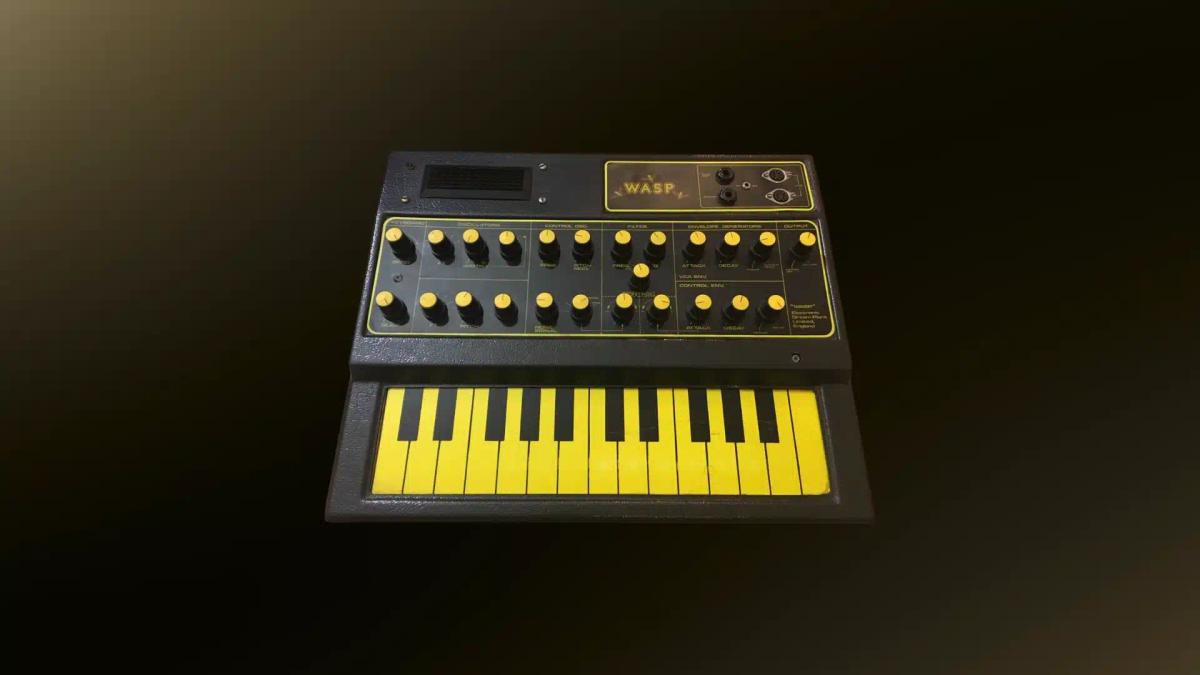
The EDP Wasp is a small monophonic synthesizer that the British company Electronic Dream Plant launched in 1978 at £199. Designed by Chris Huggett and championed by musician Adrian Wagner, it combined two digitally generated oscillators with an analog multimode filter built from CMOS logic chips, two envelopes, an LFO, a built-in speaker and battery power, all inside a black and yellow plastic case with a flat, two-octave touch keyboard. At a time when a Minimoog or an ARP Odyssey cost well over £1,000 in the UK, the EDP Wasp put a genuinely capable synth within reach of bedroom musicians and the post-punk scene, and its link sockets anticipated networked instruments years before MIDI.
Table of Contents
EDP Wasp sound and character
The EDP Wasp sounds bigger and nastier than its size suggests. Chris Carter, reviewing it for Sound On Sound’s retro series in 1995 after more than a decade of use, described a strong bass end and a very bright top, and reported that in blind listening it held its own against Korg, Roland and Moog monosynths of the period. The catch is the internal speaker, which makes everything sound thin and buzzy, true to the name. Through an amplifier or a desk, and especially with effects, the character changes completely.
Much of that character comes from the filter. It is a 12dB/octave state variable design with low-pass, band-pass and high-pass outputs, but instead of operational amplifiers it uses CMOS inverters (CD4069 chips) running from a single 5V supply. A 2022 DAFx paper modeling the circuit attributes its dirty, asymmetric behavior at high resonance to exactly that choice, and Doepfer, whose A-124 module is based on it, describes the inverters being abused as op-amps to produce distortion. A built-in limiter stops the filter from self-oscillating, so the EDP Wasp growls rather than whistles.
The oscillators are the other half of the story. They are derived digitally, which gives them a stability unusual for a cheap 1970s synth, and offer sawtooth or square waves across five footages, with pulse width on oscillator 1 and an octave-wide pitch offset on oscillator 2 for intervals. Combined with an LFO that includes noise and random steps, and envelopes that can repeat, the EDP Wasp is strongest at hard basslines, buzzing leads, noise percussion and random-stepped patterns. It is far less suited to smooth, expressive solo playing, and it sits firmly on the raw, lo-fi side of vintage.
Features and architecture
- Manufacturer: Electronic Dream Plant (EDP), Oxfordshire, England; distributed in the UK by Rod Argent’s Keyboards
- Year introduced: 1978
- Production years: 1978 to around 1981, with the Deluxe following in 1979 and the Special made in a very limited run around 1981
- Synthesis type: hybrid subtractive (digitally generated oscillators, analog filter and amplifier)
- Category: portable, battery-powered monophonic synthesizer
- Polyphony: monophonic with highest-note priority; up to four units could be played polyphonically from the Caterpillar keyboard
- Original price: £199
- Current market price: recent serviced originals have sold for around £1,400 to £1,600, with one example sold by The Music Locker at £1,595 and Equipboard’s tracked Reverb listing near $1,800; the Deluxe sells higher
- Oscillators: 2 digital oscillators with five footages (32′ to 2′), each switchable between off, sawtooth and square; pulse width on oscillator 1 and a one-octave pitch offset on oscillator 2
- Filter: 12dB/octave CMOS state variable filter with low-pass, band-pass and high-pass modes, envelope and LFO amounts with normal or inverted polarity, and a limiter that prevents self-oscillation
- LFOs: 1 LFO, roughly 1Hz to 100Hz, with sine, ramp, sawtooth, square, noise and random waves; separate noise level control
- Envelopes: 2; the amplifier envelope has attack, decay and switchable sustain, the filter envelope has attack/decay plus delay, and both have a repeat mode
- Modulation system: LFO and envelope to filter, LFO to oscillator pitch, glide up to about 3 seconds, pitch bend knob
- Sequencer / arpeggiator: none built in; EDP’s separate Spider sequencer stored 252 steps
- Effects: none
- Memory: no patch memory
- Keyboard: flat 25-note, two-octave capacitive touch keyboard printed on a vinyl overlay, with no moving parts and no velocity
- Inputs / outputs: line output, headphone output (both mute the speaker), two 7-pin DIN Link sockets carrying 5V CMOS logic; no CV/gate and no external audio input on the standard model
- MIDI / USB: none; the proprietary Link system predates MIDI, and Kenton later made a MIDI-to-Link converter
- Display: none
- Speaker: built-in 4 x 2-inch speaker
- Dimensions / weight: compact and very light plastic case; published dimensions and weight are not consistently documented
- Power: six C-type 1.5V batteries or an external 9V supply; the Deluxe and Special were mains-powered
Strengths
- The filter has real character. The CMOS state variable design adds grit and asymmetry that more refined filters lack, which is why Doepfer and others still reproduce it.
- The oscillators are stable. Digital generation keeps the two oscillators in tune and in step, a practical advantage over many analog monosynths of the same price and age.
- Modulation goes further than the price suggests. Six LFO waves including random, a delay stage on the filter envelope and repeat modes on both envelopes make rhythmic and sample-and-hold patterns easy.
- It is genuinely portable. Battery power and a built-in speaker meant it could be played anywhere, and buskers in Covent Garden reportedly did exactly that in the early 1980s.
- The Link system was ahead of its time. Two digital DIN sockets let Wasps talk to each other and to the Spider and Caterpillar, a networked approach that predated MIDI by several years.
- It is simple to repair. There are no custom chips or microcontrollers, so a competent technician can usually bring a unit back to life.
Limitations
- The touch keyboard is hard to play. It responds to skin capacitance, so gloves do not work, humidity and sweat can make it trigger on its own, and envelopes only retrigger when a finger is lifted.
- There is no velocity or real touch sensitivity, despite EDP’s advertising, and only a single knob for pitch bend.
- The internal speaker is poor and prone to hum, which made the Wasp sound like a toy to many listeners at first hearing.
- Reliability is weak. The plastic case and screws crack, pots get noisy, the keyboard print wears through and units can develop a constant drone.
- The standard model has no CV/gate or MIDI, so integrating it requires a Kenton converter or similar interface.
- The filter cannot self-oscillate, which rules out some classic sine-whistle and percussive filter tricks.
- Batteries drain quickly, and the external power supply is effectively mandatory for stable use.
Historical context
The EDP Wasp came out of a chance meeting in Oxford. Chris Huggett, a service engineer for Ferrograph and 3M tape machines, was working in a studio used by Adrian Wagner, a synthesist who wanted a low-cost synth for everyone. Huggett designed the EDP Wasp in his spare time in 1977, and the two set up Electronic Dream Plant to build it, with Oxford engineer Steve Evans also credited among the founders. Rod Argent’s Keyboards in London helped finance production and became its main retailer.
Launched in 1978 at £199, the EDP Wasp undercut established instruments by a large margin and was promoted as an ultra low-cost synth that could match machines several times its price. EDP built a small ecosystem around it: the Deluxe (1979) with a moving keyboard, wooden end cheeks, mains power and an external input; the 252-step Spider sequencer; the Caterpillar master keyboard, which played up to four Wasps or Gnats as a polysynth; and the single-oscillator Gnat. A launch press release even listed Millipedes, Eagles, Cockroaches, Beetles, Grubs, Moths and a Playing Mantis, most of which never appeared.
The low price left little profit per unit, and the company lost money in 1979. Huggett left in early 1980 to found the Oxford Synthesiser Company with Paul Wiffen, who had joined EDP in its last period. Accounts of the end differ: Sound On Sound’s obituary of Huggett says EDP was wound up in 1980, while other sources date its closure to 1982 after an Oxford successor took over the Gnat. Wagner, ousted in 1981, set up Wasp Synthesizers, which made a very limited run of wooden Wasp Specials before folding within a year.