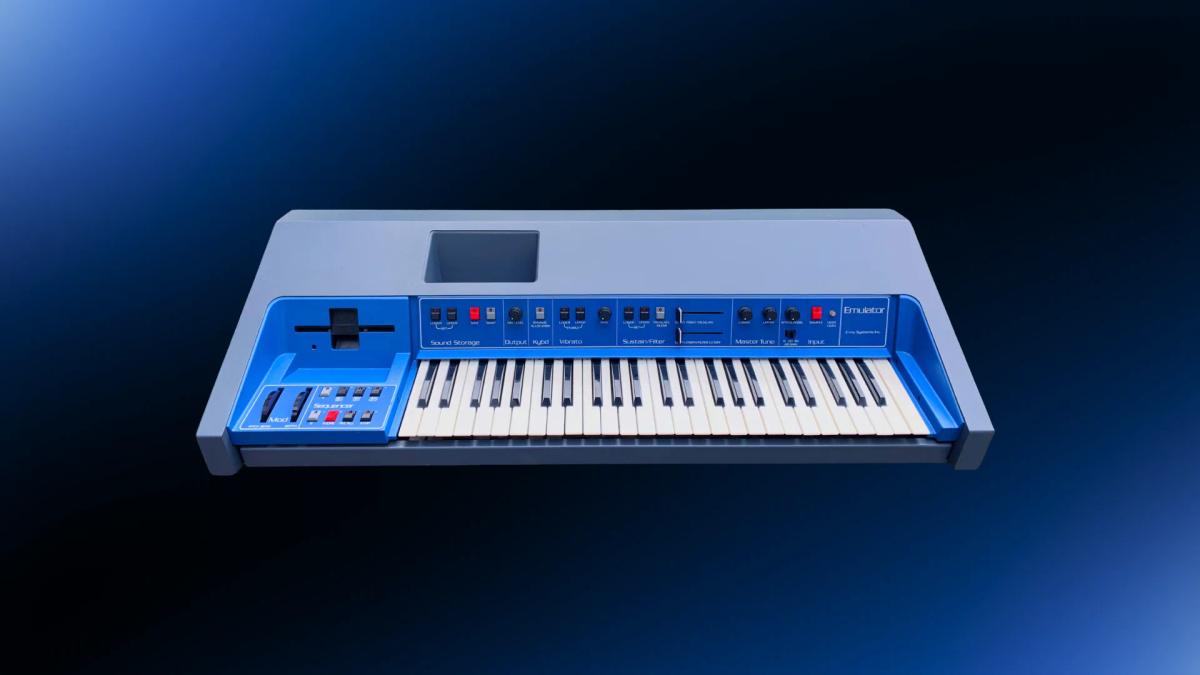
E-mu Emulator: The 1981 keyboard sampler that turned digital sampling into a working instrument
The E-mu Emulator, later known as the Emulator I once its successor appeared, is an eight-bit digital sampling keyboard unveiled by E-mu Systems at the Winter NAMM show in January 1981.
The E-mu Emulator, later known as the Emulator I once its successor appeared, is an eight-bit digital sampling keyboard unveiled by E-mu Systems at the Winter NAMM show in January 1981. Built around a Z80 processor, 128 KB of RAM, a four-octave keyboard split into two independent sections, and a built-in 5.25-inch floppy drive, it offered sampling in a single self-contained instrument at a fraction of the price of the Fairlight CMI.
Roughly 500 were sold before it was replaced in 1984, and its importance lies less in its specifications than in the template it set: a keyboard that records the world, stores sounds on disk, and plays them back as notes.
The E-mu Emulator sounds grainy, warm, and slightly ghostly. Samples are stored at about 30 kHz with companded eight-bit resolution, and usable bandwidth is limited to around 10 kHz. The result is a soft top end, audible grit, and a dusty density that later, cleaner samplers do not reproduce. A 1991 retrospective in Music Technology described sustained sounds such as strings and voices as having a “haunting quality not at all unlike a Mellotron”, and that comparison is useful. Like the Mellotron, the E-mu Emulator turns recordings of real instruments into something recognisably mechanical, and much of its charm lives in that gap between the source and the result.
The same retrospective noted that percussive samples lacked the bite of later machines. In a 1983 One Two Testing feature, keyboardist Dave Stewart added that pure synth tones tended to click at loop points, while harmonically rich material such as voices worked better, and that the filtering made bright bass sounds hard to obtain.
Several design choices shape this character directly. Pitch comes from changing the playback rate of the stored sample, so transposing a sound far from its source also shifts its formants and attack, which gives stretched samples their uncanny quality. A tracking low-pass filter on the output closes as the played pitch falls, masking noise in lower registers, and is part of why the E-mu Emulator sounds rounded rather than harsh. Doubling and detuning the two keyboard sections could produce what Music Technology called “enormous sounds”, which explains its long afterlife as a source of choirs, pads, and textures rather than realistic instrument emulation.
Features and architecture
Manufacturer: E-mu Systems
Year introduced: 1981 (unveiled at Winter NAMM in January; first customer shipment to Stevie Wonder in June)
Production years: 1981 to early 1984, when the Emulator II replaced it; a revised “Mark 2” version followed in 1982
Synthesis type: digital sample playback with companded eight-bit sampling
Category: polyphonic sampling keyboard
Polyphony: 8 voices on the standard model; a 4-voice model was also offered, and a 2-voice version was built but sold only once
Original price: about $10,000 in the U.S. at launch, cut by roughly 20 percent to about $8,000 with the 1982 revision; £4,750 for the 8-voice model in the UK in 1982 (£3,650 for 4 voices, £2,450 for 2 voices)
Current market signal: rare collector’s instrument with very few listings; no stable price guide
Sample rate and resolution: about 30 kHz, companded eight-bit conversion with a quoted signal-to-noise ratio of about 72 dB; bandwidth limited to about 10 kHz
Sample memory: 128 KB of RAM, roughly 120 KB available for sound data, giving about two seconds per keyboard section and about four seconds in total
Oscillators: none; sounds come from recorded samples, one per keyboard section as standard, with optional multi-sampling software
Filter: tracking low-pass output filter with a cutoff slider; fuller filtering and envelopes came from add-ons such as J.L. Cooper’s processing board
LFOs: vibrato via mod wheel or foot pedal, assignable per section
Envelopes: no conventional ADSR; short and natural release modes selectable by foot switch
Modulation system: pitch bend and mod wheels, vibrato pedal, release and doubling foot switches, dynamic voice allocation
Sequencer / arpeggiator: real-time polyphonic sequencer of about 900 notes, added in the 1982 revision; no arpeggiator
Effects: none onboard
Memory: no patch memory; software and sounds load from 5.25-inch floppy disks holding two sounds each
Keyboard: four octaves (49 keys), not velocity-sensitive, split into fixed two-octave upper and lower sections
Inputs / outputs: upper, lower, and mix outputs and a mic/line sampling input, all on jack and XLR; pedal and switch inputs; RS-232 port
MIDI / USB: none as built; CV/gate and MIDI interfaces and retrofits came later
Display: none; loop and truncation points were set by ear with sliders
Dimensions / weight: approximately 953 × 381 × 203 mm; roughly 30 to 34 kg depending on the source
Power: internal mains supply with a 110V/240V selector
Strengths
It put sampling into a single, portable keyboard. The Fairlight required several separate units and cost far more, while the E-mu Emulator combined sampling, storage, and playback in one steel-cased instrument that could go on stage.
Disk storage made sounds shareable. Because the operating system and samples lived on floppies, E-mu could build a factory library of more than 100 disks, turning the E-mu Emulator into a playable sound collection.
Its lo-fi voice has lasting character. Companded eight-bit sampling, limited bandwidth, and the tracking filter give it a soft, grainy, Mellotron-like quality.
The interface is direct. With a handful of buttons and sliders, players could sample through a microphone, trim, loop, and play without a computer terminal.
It was robust in live use. Dave Stewart reported in 1983 that it was reliable on stage, and Music Technology described the chassis as built like “a pocket battleship”.
The sequencer and multi-sampling extended its role, to the point that Music Technology suggested it could be considered an early sampling drum machine.
Limitations
Sample time is very short. About two seconds per keyboard section restricts what can be captured and forces heavy use of looping.
The fixed split shapes everything. Covering the full four octaves with one sound required sampling it twice, and the two-octave split could not be moved.
Pitch-shifted samples degrade quickly. The 1982 Electronics & Music Maker review singled out saxophone and male voice as problem sounds.
There is no display. Setting loop points with unmarked sliders was guesswork, and loop-making, in Dave Stewart’s words, was “a whole science”.
Sound shaping is minimal. There are no conventional envelopes or synth-style filter, and the launch version could not even cut a note on key release, which E-mu fixed in the revision.
It is heavy, old, and disk-dependent. Without the system and formatting disks it cannot operate or save new sounds, and its drives and RAM are four decades old.
Historical context
The E-mu Emulator was born from a company in trouble. E-mu’s royalties from the keyboard scanning design in Sequential Circuits’ Prophet-5 had stopped by 1980, and its $69,200 Audity analogue system was not going to save the business. After seeing the Fairlight CMI at the 1980 AES convention in Los Angeles, the team asked whether musicians would pay about $10,000 for a keyboard optimised for sampling, against the Fairlight’s roughly $27,000. Dave Rossum reused parts of the Audity work, including its disk-based operating system, and the E-mu Emulator was ready for Winter NAMM 1981.
The launch was not an instant success. After Stevie Wonder took the first unit in June 1981, only around 25 more customers followed, and by autumn sales had stalled. E-mu made notes stop on key release, built a factory library of disks, added the sequencer, and cut the price by 20 percent. Sound On Sound reports that this revised Mark 2 sold more than 400 units over the next two years. The lesson was that a sampler was not only hardware: musicians needed ready-made sounds before they would commit.
The E-mu Emulator occupied a new middle ground between the Fairlight and Synclavier on one side and conventional synthesisers on the other. Its replacement, the Emulator II of 1984, kept the idea while adding more memory, a velocity-sensitive keyboard, better sound, and MIDI, and quickly made the original look obsolete.
Legacy and significance
The E-mu Emulator matters because it defined what a sampler would be for most musicians. Before it, sampling belonged to elaborate computer systems. After it, sampling meant a keyboard with a disk drive, a sound library, and a microphone input, a model later instruments refined rather than replaced.
It also helped create the sample content industry. The library of disks, born as a fix for slow sales, turned sounds themselves into products, and MusicRadar credits the E-mu Emulator with laying the blueprint for that business.
Its sonic legacy has aged in an unexpected direction. In 1991, Music Technology called the Emulator I close to worthless on the used market, while defending its eight-bit grit by comparing it to the appeal of guitar distortion. That defence now reads as prescient. The limitations that made it obsolete are part of why producers now seek out its sound in software recreations. It is remembered less as a failed attempt at realism than as an instrument with its own voice.
Artists, users, and curiosities
Stevie Wonder is the name always attached to the E-mu Emulator, and with good reason: he embraced it at its NAMM debut and received the first production unit. According to MusicRadar, serial number 001 had originally been promised to Daryl Dragon of Captain and Tennille, but Wonder’s fame won out. The Residents took serial number 0005 and used it for most of the instrumental sounds on The Tunes of Two Cities (1982).
Nemo Studios’ account of the Blade Runner sessions lists the E-mu Emulator among Vangelis’s instruments, used as a percussive sampler and sound library. New Order used an E-mu Emulator on “Blue Monday”, whose choir sound was lifted from Kraftwerk’s “Uranium”. Jerry Harrison of Talking Heads was among the early owners cited by E-mu’s own Marco Alpert, and retrospectives frequently cite Michael Jackson’s Thriller among the records it appeared on.
A 1983 One Two Testing feature shows how players used it. Elvis Costello’s keyboardist Steve Nieve sampled an orchestral hit from the Mary Poppins soundtrack and a 50p jumble-sale accordion of which only one note worked, and the article notes that Orchestral Manoeuvres in the Dark owned three. Alan Wilder later told MusicRadar that the motorbike-like rhythmic core of Depeche Mode’s “Stripped” (1986) came from the “original E-mu Emulator – preset 1”, years after the machine had been superseded.
Two curiosities stand out. Only one two-voice model was ever sold, to Yamaha, who, according to Sound On Sound, could not understand why some critical chips were missing. And the 1981 operator’s manual by Dave Rossum and Marco Alpert ended with a line that captured the company’s precarious optimism: if enough people took advantage of its capabilities, E-mu was “going to make one hell of a lot of money”.
E-mu Emulator market value
Current market position: a historically important, discontinued collector’s instrument rather than a practical working sampler
New price signal: none; the E-mu Emulator has been out of production since 1984
Used market signal: listings are rare; at the time of writing Equipboard showed a Reverb listing around $5,500, a signal rather than a price guide, and a long way from the roughly £250 Music Technology reported in 1991
Availability: hard to find; only about 500 were sold, and many survivors need service
Buyer notes: make sure the system and diskette initialisation disks are included, since it cannot boot or save sounds without them; check the floppy drive, play every key for glitches that may point to RAM faults, and confirm whether the sequencer, multi-sampling software, or a MIDI retrofit is present
Support ecosystem: no manufacturer support; servicing relies on vintage specialists and archived manuals, while software such as UVI’s Emulation One draws on its eight-bit sound
Market character: collectible and historically driven, valued more for provenance and significance than for everyday use
Long-term position: likely to remain a museum-grade landmark of early sampling, with demand driven by collectors and by its place at the start of the sampler era
Conclusion
The E-mu Emulator was a compromised machine that arrived at exactly the right time. Its samples were short, its resolution coarse, and it lacked the shaping tools later samplers took for granted. Yet it took sampling out of the computer room and put it on a keyboard stand, complete with a disk library and a microphone input. The Emulator II made it obsolete within three years, but the original remains the point where sampling stopped being an exotic technology and became a working instrument.
His connection with music began at age 6, in the 1980s, when his father introduced him to Jean-Michel Jarre's Rendez-Vous on vinyl. He works professionally in the legal field, while synthesizers became his space for abstraction and creative exploration. Founder of The Synth Source.