

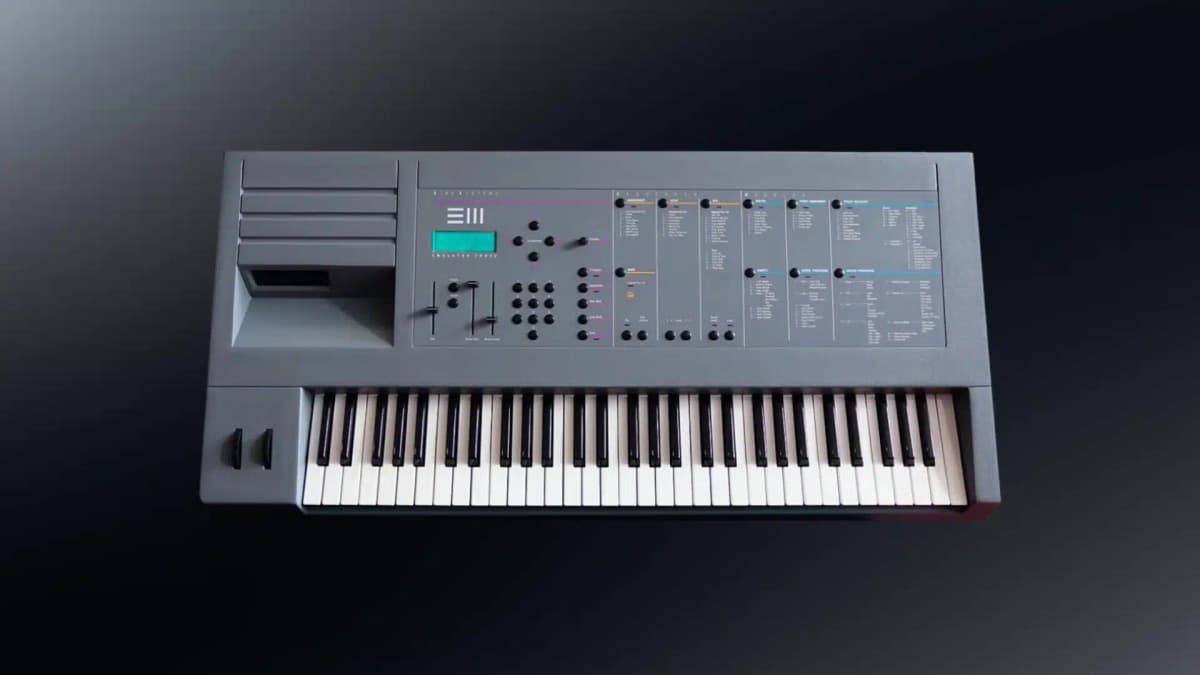
The E-mu Emulator III is a 16-bit stereo sampling keyboard that E-mu Systems unveiled at the 1987 Summer NAMM show and delivered from early 1988, as the third and most ambitious instrument in the Emulator line. It combined 44.1kHz linear sampling, 16 voices with an analog Curtis filter and amplifier on each, 4MB or 8MB of RAM, an internal 40MB hard disk, SCSI, SMPTE synchronization and a 16-track sequencer, in keyboard and later rack form. Priced at roughly $12,700 to $15,200, it was aimed squarely at the Fairlight and Synclavier. It sold only about 1,200 units, but its sound and its factory library had an influence far beyond those numbers.
Table of Contents
E-mu Emulator III sound and character
The E-mu Emulator III sounds clean, deep and full, with a weight in the low end that many owners attribute to its analog voice circuitry. The conversion was a major step beyond its predecessors: 16-bit linear sampling at 44.1kHz replaced the Emulator II’s companded 8-bit storage at around 28kHz. Paul Wiffen, reviewing it for Sound On Sound in 1988, reported that he could not hear a difference between demanding compact discs and the samples he took from them at 44.1kHz. Chris Meyer, in Music Technology, found the output almost exactly the same as the input and detected no sidebands when transposing.
Clean conversion is only half the story. Each of the 16 voices still runs through its own analog filter and amplifier, built around Curtis chips (owners and dealers usually identify them as CEM3387 parts), with cutoff, resonance, keyboard tracking and an invertible envelope. The result is a hybrid: CD-quality samples that can still be swept, resonated and shaped like a polysynth. Owners describe the character as warm and analog-flavored, with a strong bass response, and Vintage Synth Explorer sums up the filter simply as fat.
That combination made it particularly good at orchestral and acoustic libraries, choirs, pianos and large cinematic textures, the material that suited post-production suites and film work. It is less suited to deliberately gritty sampling; there is little of the 12-bit crunch of an Emax or SP-1200. Its limits are practical rather than sonic: one owner noted that the converters are not entirely transparent, and 16 voices and eight megabytes fill quickly with stereo multisamples. In the vintage spectrum it sits at the polished, high-fidelity end, closer to modern sampling than any earlier E-mu, yet colored enough by its analog stage to sound distinct.
Features and architecture
- Manufacturer: E-mu Systems, Inc., Scotts Valley, California
- Year introduced: 1987, shown at the Summer NAMM show; generally available from early 1988
- Production years: 1987 to 1991; the rack version arrived in 1988; the all-digital EIIIX and EIIIXP followed in 1992
- Synthesis type: digital sampling with analog filters and amplifiers
- Category: professional sampling keyboard and workstation
- Polyphony: 16 voices, each a discrete channel with its own output
- Multitimbrality: per-preset MIDI channel assignment and a multi-channel SuperMode for sequencing
- Original price: $12,695 for the 4MB keyboard and $15,195 for the 8MB model, according to most references (Sound On Sound’s 2002 history rounds this to $15,000); in the UK, £7,850 plus VAT for 4MB and £9,450 for 8MB in 1988
- Current market price: serviced, upgraded units are listed at about $5,500 on Reverb and £5,000 at UK specialist dealers
- Sampling: 16-bit linear, mono or stereo, at 44.1kHz or about 33kHz; sample rate conversion for other material; 2x oversampled output
- Sample memory: 4MB standard, expandable to 8MB; about 47 seconds mono or 23.6 seconds stereo at 44.1kHz with 4MB
- Oscillators: sample playback; two sample layers per preset, with up to eight presets stackable
- Filter: analog resonant low-pass filter per voice using Curtis chips, with cutoff, Q, keyboard tracking and an invertible envelope
- LFOs: one per voice with four waveshapes, delay, and separate depths for pitch, volume, filter and pan, plus a per-keystroke variation control
- Envelopes: three per voice (amplifier, filter, and an assignable envelope routable to pan, pitch and LFO), each with attack, hold, decay, sustain and release
- Modulation system: 14 velocity curves, velocity routable to ten destinations, wheels, pressure, pedal and MIDI controllers routable to ten destinations; positional, velocity and pressure crossfades and switches
- Sequencer / arpeggiator: 16-track sequencer at 96ppqn with step entry, auto-correct, cut, copy and paste, SMPTE and MIDI Time Code sync; comprehensive arpeggiator
- Effects: delay and chorus or autopanning effects
- Storage: internal 40MB hard disk, 3.5-inch floppy drive, SCSI port for external drives and CD-ROM
- Keyboard: 61 non-weighted keys with velocity and aftertouch; two assignable wheels
- Inputs / outputs: 16 individual outputs plus stereo mix, stereo sample inputs, SMPTE in and out, two trigger inputs, metronome output, two footswitch inputs and a pedal input
- MIDI / USB: MIDI In, Out and Thru; computer port for editing software (reported as RS422 or RS232); no USB
- Display: 4 x 20-character backlit LCD, numeric keypad and data slider
- Dimensions / weight: published dimensions and weight are not consistently documented; the rack version occupies 4U
- Power: internal supply, fan-cooled
Strengths
- Its audio quality was genuinely professional. 16-bit stereo sampling at 44.1kHz put it on a par with the best studio systems of its time, and contemporary reviewers struggled to tell source from sample.
- Analog filters on every voice gave clean samples real character. The Curtis-based filter and three envelopes per voice let it sculpt sounds in a way purely digital samplers of the day could not match.
- The internal hard disk changed the workflow. Loading 4MB took about 18 seconds instead of several minutes of floppy swapping, and Paul Wiffen declared himself a convert.
- It was a complete production center. SMPTE, MIDI Time Code, a 16-track sequencer, 16 separate outputs and SCSI made it a credible hub for film, television and studio work.
- Its editing was thorough for the period, with autocorrelation and equal-power crossfade looping, stereo editing with a clipboard, sample rate conversion and undo.
- It was far cheaper than the systems it targeted. Music Technology called it the best buy in town for a single-instrument studio and rated it ahead of the Fairlight in most categories.
Limitations
- The price kept it exclusive. At $12,695 to $15,195, it was out of reach for most musicians just as Akai, Ensoniq and Casio were selling samplers for under $2,000.
- Early units were unreliable. Faulty memory sockets and hard disk problems in the first production run forced an in-field recall that damaged dealer and customer confidence.
- Sixteen voices and eight megabytes are modest for stereo multisamples, and owners still cite polyphony and memory as the main constraints.
- Music Technology found the interface cumbersome, with modules that exit after each subfunction and behavior that varies between sections of the operating system.
- There is no operating system in ROM, so the E-mu Emulator III boots from disk, and Sound On Sound criticized the lengthy device checks at startup.
- The fan and internal hard disk are audible, a real issue in quiet studios and for some film and voice-over work.
- Its original 40MB drives, displays and power supplies are now age-related failure points, and spare parts are scarce.
Historical context
By the mid-1980s E-mu sat between two worlds. Its Emulator II was the industry standard for professional sampling, yet it cost more than $7,000, and 12-bit samplers from Japanese rivals were rapidly undercutting it. E-mu answered at both ends: the Emax took Emulator II-style sampling into the mid-priced market in 1986, while the E-mu Emulator III, which Rob Keeble’s history of the company in Sound On Sound says took around six years of development, aimed upward at the Fairlight and New England Digital Synclavier.
The E-mu Emulator III appeared at the 1987 Summer NAMM show and became generally available in early 1988. Reviews in Sound On Sound and Music Technology were strongly positive about the sound and the internal hard disk, and E-mu added a rack version in 1988. The launch, however, nearly broke the company. Faulty memory sockets and hard disk problems in the first production run led to an in-field recall, and the resulting cashflow crisis brought E-mu close to extinction in 1988. Co-founder Scott Wedge provided personal financial support while new executive Steve Tritto renegotiated with the banks.
The E-mu Emulator III stayed in production until 1991, while E-mu’s survival came from the much cheaper Proteus 1 sound module launched in 1989. In total the E-mu Emulator III sold only about 1,200 units. The company had spent around two years debating an all-digital successor, which finally appeared in 1992 as the EIIIX and the rackmount EIIIXP. These later models dropped the analog voice circuitry in favor of digital filtering, and the ESi line of samplers traces its design back to them.