

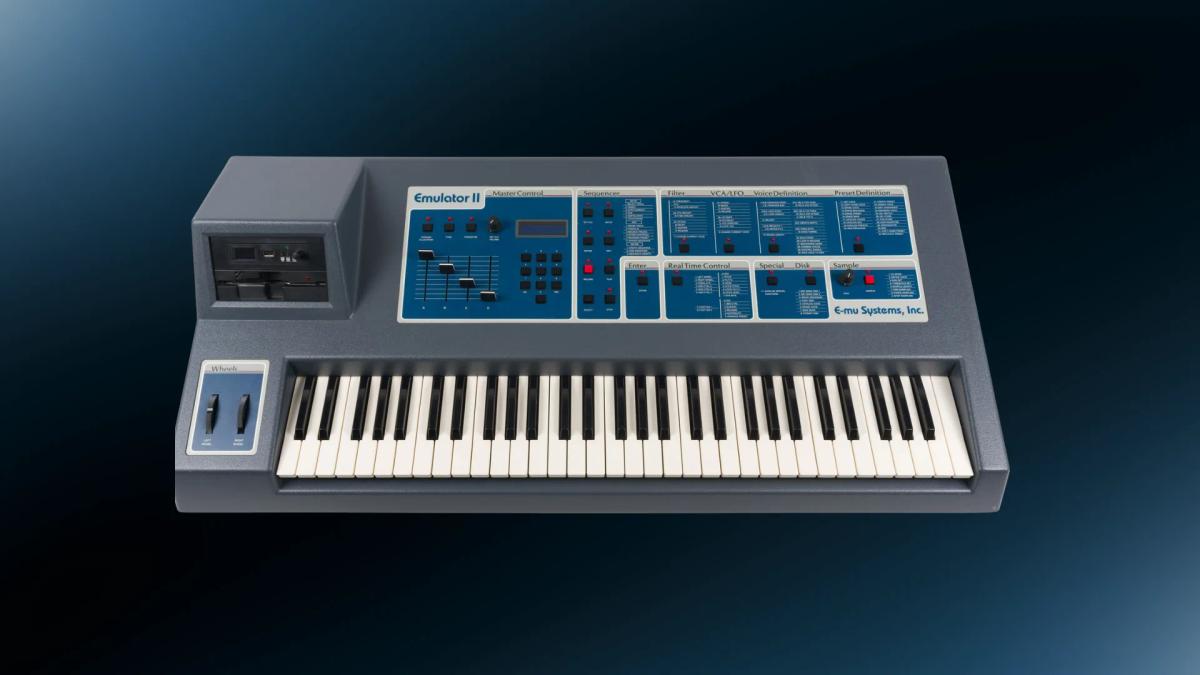
The E-mu Emulator II is an eight-voice, 61-key sampling keyboard launched at Winter NAMM in 1984 and shipped from June of that year at $7,995. It combined 8-bit companded sampling at roughly 27.7 kHz with a fully analog voice path for each of its eight channels, including a resonant 24 dB/octave low-pass filter, VCA, envelopes, and LFO. That hybrid gave it a sound both gritty and warm, and its price, roughly a quarter of a basic Fairlight’s, put professional sampling within reach of studios and bands that could not justify a Fairlight or Synclavier. It became, in Sound On Sound’s words, “the sampler of the mid-’80s.”
Table of Contents
Sound and character
The E-mu Emulator II sounds dense, slightly grainy, and unmistakably analog in its tail. The grain comes from the sampling side: an 8-bit system with a bandwidth of around 12 kHz cannot reproduce the full air of a source, and its top end has a soft, slightly rolled-off quality. Sound On Sound credits the E-mu Emulator II’s character to “the warm analogue filters and the grit of the low sample resolution,” and that pairing explains most of what players still hear in it.
The warmth comes from what happens after the conversion. Every voice passes through an SSM2045 four-pole resonant low-pass filter and an analog VCA, each with its own envelope. That means a sample of strings, brass, or choir can be darkened, swelled, and shaped much as a synth patch would be, rather than simply replayed. Mark Ayres, quoted by Arturia, said the E-mu Emulator II “always seemed” the sampler closest to analogue tape, which is a fair description of its texture.
Its strongest territory is the sound of the decade itself: thick string and choir pads, orchestral stabs, gated drums, breathy flutes, and percussive one-shots with a physical, slightly compressed punch. Paul Wiffen wrote in Electronics & Music Maker in 1984 that it was “audibly superior to any other eight-bit sampling system this reviewer has heard.” It never sounded clean or hi-fi. What it offers instead is weight and a coherent, almost tape-like color that has become shorthand for 1980s pop production.
Features and architecture
- Manufacturer: E-mu Systems
- Year introduced: 1984 (shown at Winter NAMM, shipping from June)
- Production years: commonly listed as 1984 to 1988
- Synthesis type: digital sampling with analog voice processing
- Category: sampling keyboard / sampler workstation
- Polyphony: 8 voices, each with its own analog processing channel
- Original price: $7,995 for the standard model and $9,995 for the expanded-memory Emulator II+; £7,250 (single drive) or £7,500 (dual drive) excluding VAT in the UK
- Sampling: 8-bit companded sampling; the rate is most often given as 27.7 kHz (some sources say 27 kHz), with about 12 kHz of bandwidth and, per Sound On Sound, an apparent 14-bit resolution
- Sample memory: 512 KB as standard, giving about 17 seconds of sampling time shared among all samples; 1 MB on the Emulator II+
- Filter: one analog SSM2045 four-pole (24 dB/octave) resonant low-pass filter per voice, with envelope, LFO amount, and keyboard tracking
- LFOs: one per voice, with rate and delay controls
- Envelopes: ADSR envelopes for the filter and the VCA on each voice
- Modulation system: velocity to amplitude, attack times, cutoff, and resonance; velocity switching and crossfading between samples; positional crossfades; assignable wheels, pedal, and footswitch
- Sampling tools: threshold-triggered recording, LCD level meter, auto and crossfade looping, truncation, reversing, and splicing
- Sequencer / arpeggiator: 8-track sequencer added through operating software; no arpeggiator
- Effects: none onboard
- Memory: 5.25-inch floppy disks (one or two drives), no battery-backed presets; 20 MB internal hard drive on the Emulator II+HD
- Keyboard: 61 keys with velocity sensitivity and aftertouch; two wheels, one spring-centred and one free
- Inputs / outputs: sample input for microphone or line sources, eight individual channel outputs plus a mix output, pedal and footswitch inputs
- MIDI / USB: MIDI in and out; SMPTE sync; RS-232 on early units, later RS-422 for editing with Digidesign’s Sound Designer; no USB
- Display: backlit 32-character LCD, with a numeric keypad and four data sliders
- Power: internal mains supply with selectable 110V or 220V operation
Strengths
- The hybrid voice path gives it a sound of its own: eight analog filter and VCA channels behind 8-bit companded samples.
- Each voice is a full synth channel. Filter envelopes, per-voice LFOs, and resonance mean samples can be shaped and animated, not just triggered.
- Velocity was unusually deep for its time. Routing it to filter, amplitude, and attack, or using it to switch and crossfade samples, made performances far more expressive than on the original Emulator.
- Eight separate outputs let engineers treat each channel as its own track in the mix, something engineers exploited on hit records of the period.
- Its sampling workflow was quick and well designed. Threshold triggering and crossfade looping made capturing a sound fast enough for the middle of a session.
Limitations
- Eight voices is a tight ceiling for layered pads, sustained chords, or multitimbral sequencing.
- The sampling time is short by any later standard: about 17 seconds on the standard model, shared across every sample in a bank.
- Everything loads from floppy disk. Loads took around 25 seconds, and with no battery-backed memory, live use required planning.
- The keyboard drew sharp criticism at launch. Paul Wiffen called it “nasty, over-sprung and incapable of adding anything to your playing technique.”
- MIDI support arrived through software updates and was considered sluggish, according to Sound On Sound’s history of E-mu.
- Today, maintenance is the main obstacle. Floppy drives fail, restoration is neither easy nor cheap, and a technician familiar with Emulators is strongly advised.
Historical context
The E-mu Emulator II grew out of E-mu’s first sampler. The original Emulator of 1981 offered only two seconds of sampling time and limited sound quality, and it was only after a cheaper revised version that it sold more than 400 units. Dave Rossum, who led the new project, believed 8-bit sampling could sound much better, and assembled a team with stronger DSP skills to prove it.
The timing was precarious. The project ran late, a stopgap product licensed from Clavia failed, and by spring 1984 E-mu was nearly broke and had to borrow from its UK distributor to survive. Its only real hit so far had been the Drumulator drum machine.
The opportunity was clear. Sampling was a proven professional tool, but the most basic Fairlight CMI Series II cost around $30,000. Sound On Sound’s Jem Godfrey later called the E-mu Emulator II the “‘budget’ cousin of the Fairlight,” priced like a decent family car rather than a house. Around 3,000 units sold over roughly three years, rescuing E-mu’s finances.
E-mu kept extending the platform with more memory, a hard disk, early sample CD-ROMs, Mac editing, and software that added the sequencer, SMPTE support, and multitimbral MIDI. In 1986 the Emax was designed to recreate the E-mu Emulator II at less than half the price, and the 16-bit stereo Emulator III arrived in 1987. Sound On Sound notes it remained the aspiration of many musicians until the Akai S1000 appeared in 1988.