

Home›Articles›Analog vs digital synths for studio use: what actually …
Articles

Analog vs digital synths for studio use: what actually changes in your workflow

Analog vs digital synths in the studio: signal path, tuning drift, filters, polyphony, recall, aliasing and hybrids, plus which type fits your workflow.

Bernardo de Azevedo
Bernardo de Azevedo
· Updated
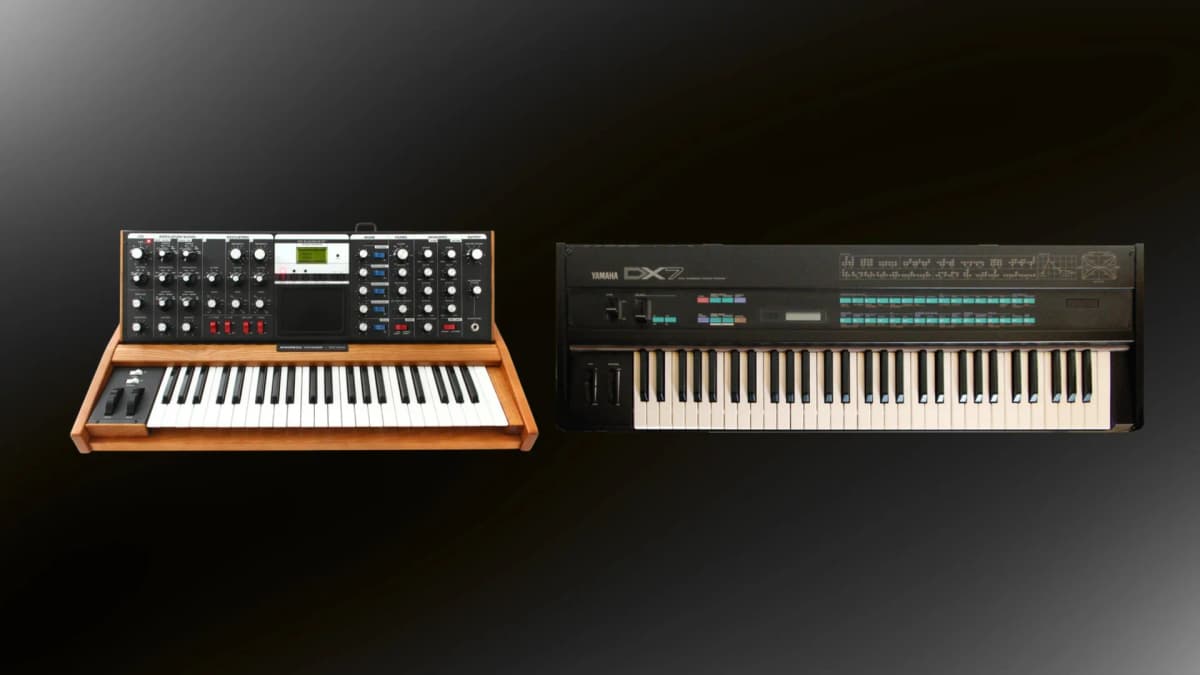
Digital synths vs analog: a Moog analog synthesizer and Yamaha DX7

In the analog vs digital synths debate, the biggest differences for studio use are practical rather than sonic: analog instruments drift, need warm-up and calibration, and cost more per voice, while digital instruments give you more polyphony, deeper modulation, built-in effects and perfect recall. In a finished mix the tonal gap is usually smaller than marketing suggests, so the better question is which instrument fits the way you record, edit and recall sessions. Many current synths are hybrids anyway, which makes the choice less binary than it used to be.

Table of Contents

What “analog” and “digital” really mean

In an analog synth, the audio signal is a continuous voltage that passes through physical circuits: oscillators, a filter and an amplifier. Changing a knob changes a voltage, and the sound responds through components such as transistors, capacitors and op-amps. In a digital synth, the sound is a stream of numbers calculated by a processor at a fixed sample rate, then converted to audio at the output.

The line blurs quickly. Many “analog” synths use digital control (a microprocessor scans the knobs, stores patches and generates envelopes), and many digital synths pass their signal through analog filters or amplifiers. When people argue about analog vs digital, they usually mean where the sound is generated and shaped, not whether there is a chip inside.

The real differences, one by one

Oscillators, drift and tuning

Voltage-controlled oscillators (VCOs) are sensitive to temperature. As an analog synth warms up, pitch moves, and small differences between voices create the slight detuning many players describe as movement or life. Digitally controlled oscillators (DCOs), found on the Juno series and the Prophet Rev2, keep analog waveforms but use a digital clock to hold the pitch steady. Fully digital oscillators are stable from the moment you switch on, and they can add drift deliberately as a parameter.

The studio cost of VCO drift is real. A tuning guide for the Prophet-6 and OB-6 measured internal temperatures climbing for about two hours after power-on, with tuning shifting during the first hour, and recommends running the calibration routine again once the unit is fully warm before recording. If you track a part, come back the next day and punch in a fix, you may need to retune first.

Filters in analog and digital synths

The filter is where analog designs have built most of their reputation. Ladder filters, state-variable filters and the various chip-based designs each distort and resonate in their own way when driven hard. Digital filters have improved a lot, and good ones now self-oscillate and saturate convincingly, but cheap or older digital filters can sound thin at high resonance. Digital synths answer with variety: the ASM Hydrasynth, for example, offers 16 filter models on its first filter alone, something no single analog circuit can do.

Polyphony and cost

Every analog voice needs its own set of physical circuits, so each extra voice adds parts, calibration work and cost. That is why analog polysynths are often four to eight voices and expensive, while digital synths at similar prices commonly offer eight voices or more and multiple layers. For pads, layered splits and long release tails in the studio, polyphony matters more than many buyers expect.

Presets and recall in analog and digital synths

Most modern analog polysynths store patches, but monosynths and semi-modulars often do not. A patch that lives only in knob positions and cables has to be photographed or written down, and it will never come back exactly the same. Digital synths recall everything, including effects and modulation routings, and many have editors that save patches with your DAW project. For mix revisions weeks later, total recall is the most important difference on this list.

Modulation depth in analog and digital synths

A classic analog mono might give you one LFO and two envelopes with fixed destinations. Digital instruments routinely offer large modulation matrices: the Hydrasynth lists 32 routing slots, five LFOs and six-stage envelopes. Analog instruments with digital control sit in between. The Prophet Rev2 has an eight-slot modulation matrix on top of its analog signal path. If your sound design depends on complex, evolving motion, digital usually gets you there faster.

Effects in analog and digital synths

Built-in effects are almost always digital, even on analog synths. The Rev2 includes digital delays, chorus and reverb per layer, and the Behringer DeepMind 12 pairs analog voices with a substantial digital effects section. In the studio this matters less than on stage, because you will often bypass onboard effects in favor of plugins or outboard gear, but they are handy for writing.

Aliasing in analog and digital synths

Digital systems can only represent frequencies below half the sample rate. A naive digital sawtooth or square wave contains harmonics above that limit, and they fold back down as inharmonic tones, known as aliasing. It is most audible on high notes, hard sync and fast pitch sweeps. Modern synths reduce it with band-limited oscillators, carefully designed wavetables and oversampling, and most of the remaining aliasing sits low enough in level to be hard to hear. Analog oscillators do not alias at all, though their own distortion can still add harsh content.

Noise in analog and digital synths

Analog circuits have a noise floor, and vintage or budget units can hiss audibly in quiet passages, especially with the filter open and the output gain low. Digital synths are quieter in principle, but their analog output stages and DACs add noise too. With modern gear, noise is rarely a deciding factor, but a hissy analog mono on a sparse ballad is worth checking before you commit to a take.

Maintenance and calibration

Analog synths age. Trimmers drift, sliders and pots get scratchy, and voices can fall out of calibration. Modern instruments include auto-tune routines, but older ones may need a technician. Digital synths have their own failure points, such as screens, encoders and firmware support, but they do not drift out of tune.

Hardware vs software and CPU

Any hardware synth, analog or digital, uses none of your computer’s CPU. That is a quiet advantage in large sessions. Software emulations cost nothing per voice once installed, but a dense project with several high-quality analog models can strain a laptop. Many studios end up with hardware for character and immediacy, and software for recall and layering.

Analog vs digital synths: comparison table

Factor Analog Digital Hybrid
Tuning stability Drifts with temperature (less with DCOs) Stable; drift can be added as a parameter Usually stable digital oscillators
Filter character Strong, circuit-specific saturation Many models; quality varies Analog filter on digital sources
Polyphony per dollar Low High Medium
Patch recall Often none on monos and semi-modulars Complete, including effects Usually complete
Modulation depth Simple, hands-on Large matrices, many LFOs and envelopes Often deep
Aliasing None from oscillators Possible, usually well controlled Possible at the oscillator stage
Noise floor Higher on some units Generally lower Depends on design
Maintenance Calibration, warm-up, aging parts Firmware and controls Calibration only for analog parts
Typical studio role Basses, leads, character parts Pads, layers, complex sound design Versatile all-rounder

Hybrids: the middle ground

A hybrid synth uses digital and analog stages in the same voice. The most common recipe is digital oscillators feeding an analog filter and amplifier. The Arturia MiniFreak is a good example: two digital oscillator engines with more than 20 algorithms, including virtual analog, FM, wavetable and Karplus-Strong, feeding a per-voice analog filter and VCA across six voices. You can read more in our MiniFreak profile.

The Korg minilogue xd flips part of that idea: two analog VCOs per voice plus a digital “multi engine” that acts like a third oscillator, with noise, phase modulation and user-loadable oscillators. See our minilogue xd article for details. The Novation Summit takes yet another route, with digitally generated oscillators running into analog filters, which we cover in our Summit review.

It helps to be precise with examples. The ASM Hydrasynth is entirely digital, with no analog filter stage. The Prophet Rev2 is the opposite: analog DCOs and a Curtis low-pass filter under digital control, with digital effects at the end. If you are deciding between a hybrid and an all-digital instrument, our Hydrasynth Explorer vs MiniFreak comparison puts the two approaches side by side, and Prophet-6 vs Prophet Rev2 shows how VCOs and DCOs differ in practice.

Virtual analog, modeling and clones

Virtual analog (VA) synths use digital processing to imitate analog subtractive synthesis. Early VA aimed at the general sound; modern modeling tries to reproduce how specific circuits behave.

Roland has two approaches. Analog Circuit Behavior (ACB) models individual circuits of vintage Roland instruments and is used in the AIRA and Boutique lines and in the System-8. Because it is processor-intensive, ACB units tend to have limited polyphony; the four-voice Boutique modules are a typical example. Analog Behavior Modeling (ABM), used in the Jupiter-X series, captures the main characteristics of instruments such as the Jupiter-8, Juno-106, JX-8P and SH-101, and Roland says it allows much higher polyphony and more layers than ACB. Our System-8 profile and Jupiter-X vs Jupiter-Xm cover both in context.

Korg covers the spectrum in one catalog: true analog in the minilogue and prologue, hybrid in the minilogue xd, and fully digital engines in the wavestate, opsix and modwave. Behringer, meanwhile, has built a large range of lower-cost recreations of classic designs. Some are analog, like the Model D and the eight-voice Pro-800 (based on the Prophet-600 and listed at $399 when it shipped), while others, such as the JT-4000 micro, are digital. If you are weighing a clone against the original, see Model D vs Minimoog Model D.

Do blind tests show a difference?

Informal and academic blind tests tend to tell the same story. A 2021 undergraduate study at IADT in Ireland compared an analog subtractive synth with a digital counterpart programmed in Max/MSP. Most participants said they preferred analog when asked, yet in the blind A/B test they could not reliably identify which sample was analog. An earlier student project, published on Synthtopia, pitted an original Minimoog against two software emulations in full mixes and drew criticism that differences in programming and mixing could swamp differences in the instruments.

The nuance matters. Blind tests usually compare static, carefully matched patches, which favors emulations. Differences tend to show up at the extremes: heavily driven filters, high resonance, fast modulation, audio-rate FM and how a synth reacts when you move a control while playing. The response of the panel also shapes what you play, and that is hard to measure in a listening test. A fair summary is that a good digital or modeled synth can match the sound of analog in most mix contexts, while the experience of playing the instrument can still differ.

How each type fits studio workflows

Recording

Analog hardware rewards printing to audio early. Record the part, keep the raw track and move on, rather than leaving the synth as a live MIDI instrument for weeks. Let it warm up and calibrate before important takes. Digital hardware and software can stay as MIDI until mixdown without risk.

Recall and revisions

If clients ask for changes long after a session, digital instruments and soft synths save time. For analog synths without memory, photograph the panel and note the cable routing in the session file. For analog synths with memory, remember that tuning and filter calibration can still make a recalled patch sound slightly different.

Layering

Digital polyphony makes layering easy, and multitimbral digital synths can cover several parts at once. A common studio approach is to layer: an analog mono for the bass or lead body, with a digital pad or texture underneath for width and movement.

Sound design

Digital synths are the stronger choice for complex modulation, wavetables, FM and evolving textures. Analog synths excel at fast, hands-on shaping of classic subtractive sounds, where turning a knob mid-take is part of the performance.

Which should you choose?

  • Producer on a laptop, small budget: start with software and one affordable hardware synth for tactile work. A hybrid or digital instrument with patch memory is the safer first purchase.
  • Bass and lead parts in electronic music: an analog monosynth is hard to beat for immediacy and filter character. Print the parts to audio.
  • Pads, film and ambient work: prioritize polyphony, long envelopes and modulation. Digital or hybrid synths deliver more voices for the money.
  • Session players and producers with many revisions: choose instruments with full recall. Digital and hybrid synths, or analog polysynths with memory.
  • Sound designers: digital first, with an analog filter, either in a hybrid or as outboard, for grit.
  • Players chasing a specific vintage sound: compare the original, a hardware recreation and a software model. Many people find a modeled or cloned version close enough at a fraction of the cost.

There is no wrong answer here. A well-chosen analog mono plus a capable digital or hybrid poly covers most studio needs, and the instrument you understand deeply will usually serve you better than the one with the better spec sheet.

Related articles

Sources

Image credits: Yamaha DX7 photo by Leo-setä, Wikimedia Commons, CC BY 2.0. Photos were cropped, cut out and placed on a gradient background for the featured image.

Bernardo de Azevedo
Written by
Bernardo de AzevedoFounder & Editor

His connection with music began at age 6, in the 1980s, when his father introduced him to Jean-Michel Jarre's Rendez-Vous on vinyl. He works professionally in the legal field, while synthesizers became his space for abstraction and creative exploration. Founder of The Synth Source.