

Homeโ€บReviewsโ€บM-VAVE FM-1 vs Yamaha DX7 and Dexed: why the same patchโ€ฆ
Reviews

M-VAVE FM-1 vs Yamaha DX7 and Dexed: why the same patches don’t always sound the same

The FM-1 loads DX7 patches, but they don’t always sound identical to a real DX7 or Dexed. Here is why: DACs, filters, polyphony, effects, controllers and more.

Bernardo de Azevedo
Bernardo de Azevedo
ยท Updated
Dexed, M-VAVE FM-1 and Yamaha DX7 compared side by side

In the M-VAVE FM-1 vs Yamaha DX7 comparison, the FM-1 uses the same six-operator, 32-algorithm architecture as the Yamaha DX7 and loads its SysEx patches, and its engine is derived from the same open-source code as the Dexed plugin. So the same patch should sound very similar on all three, and most of the time it does. The differences come from everything around the FM maths: the DX7’s 12-bit converter and analog output filter, the FM-1’s budget output stage and built-in effects, polyphony, velocity and controller routing, and which engine mode you choose in Dexed.

Table of Contents

M-VAVE FM-1 vs Yamaha DX7 vs Dexed at a glance

FeatureYamaha DX7 (1983)Dexed (plugin)M-VAVE FM-1 (2026)
EngineYamaha custom FM chipsmsfa engine, several engine modesDexed/msfa-derived, on a JieLi microcontroller
Operators and algorithms6 / 326 / 326 / 32
Polyphony16 voicesUp to your CPU12 voices at launch; 20 shared across 8 parts with v16
Output12-bit DAC with extra analog gain scaling, low-pass filteredSelectable modern or vintage-style behaviourBudget DAC, 3.5 mm output, USB audio
EffectsNoneNone (host effects)Filter, chorus, phaser, distortion, delay, reverb
Patch formatNative SysEx, 32-voice banksLoads and saves DX7 SysExImports DX7 SysEx; v16 exports banks as DX7 SysEx

Where the shared DNA comes from

Dexed is built on music-synthesizer-for-android (msfa), an engine written by Raph Levien and closely modelled on DX7 behaviour. Community reverse-engineering of the FM-1’s firmware found an engine derived from that same code, and the browser-based FM-1 emulator describes M-VAVE’s stock firmware as a port of msfa. That is why a well-known cartridge such as an electric piano or a bass loads on the FM-1 and is immediately recognisable. For the hardware side, see Inside the M-VAVE FM-1.

Why some patches sound different

1. The DX7’s converter and output filter

The original DX7 output its signal through a 12-bit DAC followed by an analog attenuator that scaled the level, a design that adds noise and a subtle, characterful distortion. Dexed’s developer has described emulating that analog behaviour as tricky and outside the plugin’s scope. The DX7 also had a low-pass filter around 14 kHz to tame converter noise. Many players hear that combination as warmth or “sweetness”, especially on bells and electric pianos. Neither Dexed’s modern engine nor the FM-1 reproduces it exactly.

2. Dexed’s engine choice

Dexed offers more than one engine: a modern 24-bit version of msfa, a “Mark I” mode that imitates the original’s reduced resolution, and an OPL-style mode. A patch played in Modern mode will sound cleaner and brighter than on a DX7, and comparisons on forums have found differences in modulation behaviour at the extremes of the keyboard. If you compare the FM-1 with Dexed, note which engine you are using.

3. The FM-1’s output stage

The FM-1 is built to a roughly $70 price. Synth Anatomy’s review found it cleaner than M-VAVE’s earlier keyboard engine but less glassy and refined than a real DX7, and suggested the converter and hardware as likely reasons. Some owners disagree and say it sounds the same. Treat this as a matter of degree: fine for most uses, audible in direct A/B tests.

4. Effects that the DX7 never had

The DX7 had no effects, but the FM-1 does, and patch or FX settings can colour an imported voice. Before comparing, switch off the FM-1’s effects or, on firmware v16, select an empty FX group. Firmware v16 stores effects in a separate library of 128 FX groups rather than inside each sound, so changing a voice no longer changes the effects automatically.

5. Velocity, controllers and breath

Many DX7 patches were programmed around velocity, the mod wheel, aftertouch and the BC-1 breath controller. If the controller data never arrives, the patch can sound flat or static. Early FM-1 firmware did not even respond to note velocity over MIDI; M-VAVE added note-on velocity in V15. If a patch depends on breath or aftertouch, it may never behave exactly as intended on the FM-1.

6. Polyphony and voice stealing

Long-release pads and sustained chords can run out of voices more quickly on a 12-voice FM-1 than on a 16-voice DX7, cutting tails short. With v16 the FM-1 has 20 voices in total, shared across all parts.

7. Level and tuning differences

Different output levels make side-by-side comparisons misleading, because louder usually sounds better. Match levels before deciding which sounds best. Also check transpose and tuning settings after import.

How to get closer to the DX7 sound on the FM-1

  1. Update to the latest official firmware so velocity and the improved bank import work.
  2. Import the bank over USB, not over the TRS MIDI port, which has a small SysEx buffer.
  3. Turn off the FM-1’s internal effects for that sound.
  4. Play it from a velocity-sensitive MIDI keyboard and check that the receive channel matches.
  5. Record through a decent audio interface or via USB audio, then try a gentle low-pass filter around 12 to 14 kHz and a little tape or console saturation if you want vintage colour.
  6. Compare against Dexed in Mark I mode rather than Modern mode.

The step-by-step import process is in our guide on loading DX7 banks on the FM-1.

Which one should you use?

Use a real DX7 if you want the original character and full-size keyboard, and accept vintage maintenance. Use Dexed if you work in a DAW: it is free, precise, endlessly recallable and has excellent editing. Use the FM-1 if you want those sounds away from the computer, on batteries, with a sequencer and effects, for the price of a plugin. Many people end up using Dexed and the FM-1 together, building banks on the computer and sending them to the hardware.

Sources

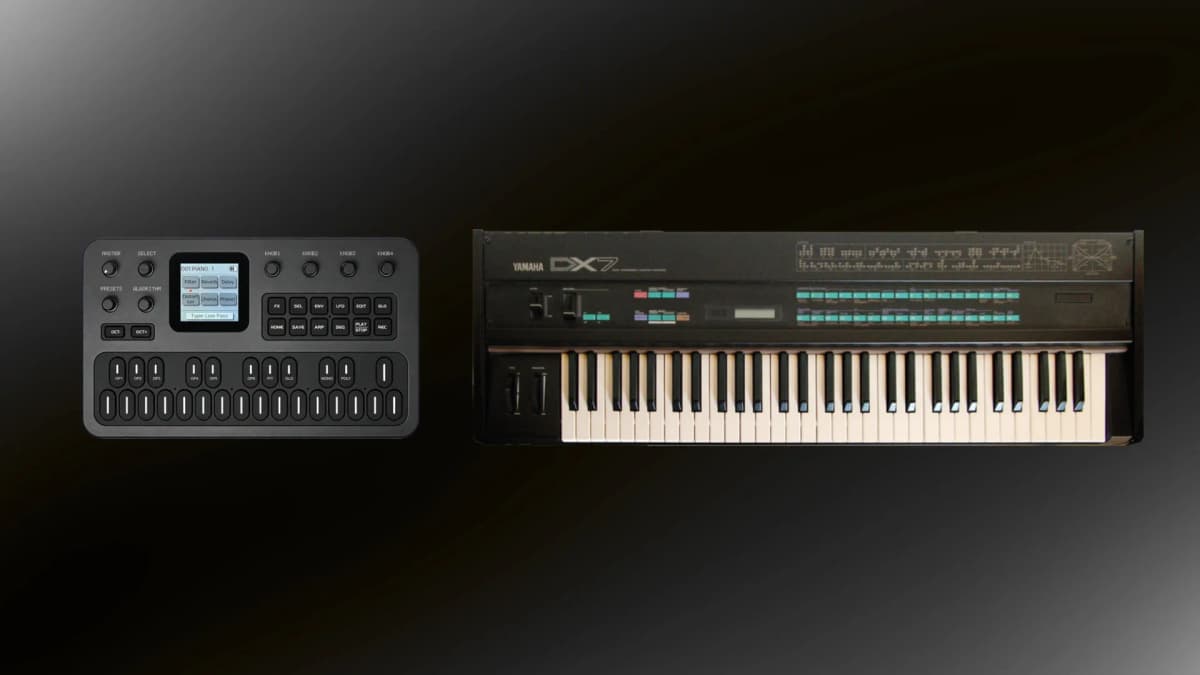
Image credits: Yamaha DX7 photo by Leo-setรค, Wikimedia Commons, CC BY 2.0. Photos were cropped, cut out and placed on a gradient background for the featured image.

Bernardo de Azevedo
Written by
Bernardo de AzevedoFounder & Editor

His connection with music began at age 6, in the 1980s, when his father introduced him to Jean-Michel Jarre's Rendez-Vous on vinyl. He works professionally in the legal field, while synthesizers became his space for abstraction and creative exploration. Founder of The Synth Source.