

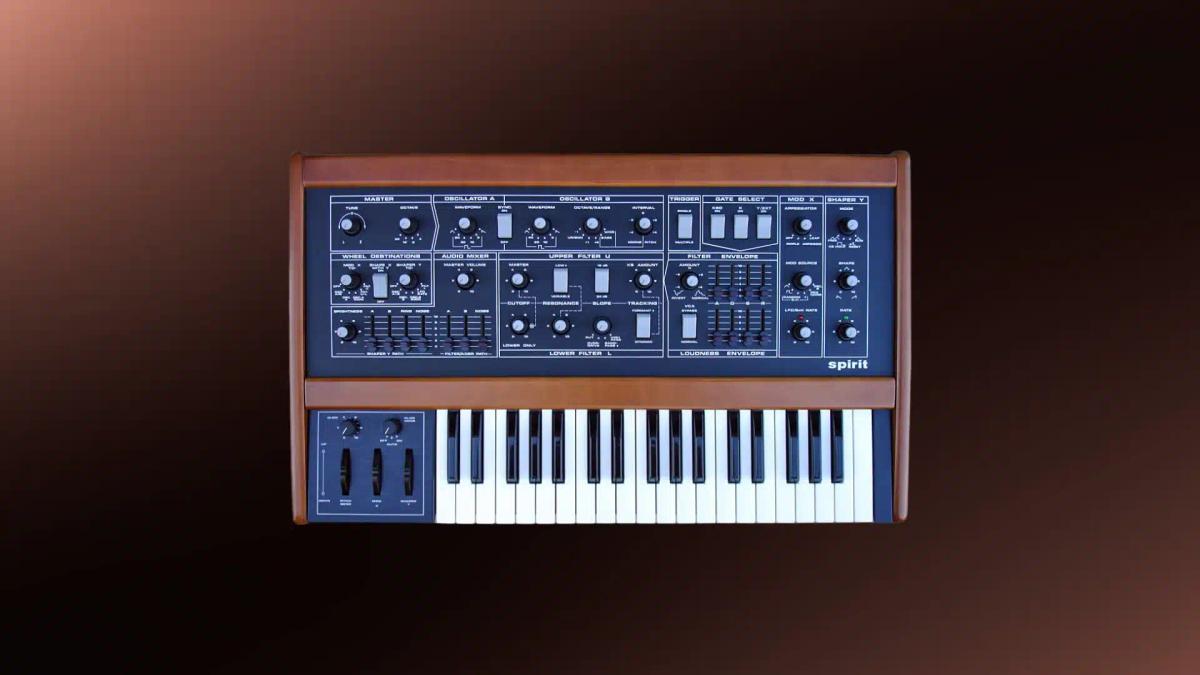
The Crumar Spirit is a 37-key analog monophonic synthesizer announced in 1983 by the Italian company Crumar and designed with an American team: Bob Moog, Minimoog co-designer Jim Scott, and former Moog writer and clinician Tom Rhea. Inside are two CEM3340 oscillators, two filters arranged in series with very different jobs, a second parallel signal path with its own low-pass filter and VCA, a ring modulator, an arpeggiator and two complex modulation sections controlled from dedicated wheels. It arrived as the monosynth market collapsed, sold in very small numbers, and was largely forgotten until collectors, a 2001 Sound On Sound retrospective and a 2023 reissue brought it back.
Table of Contents
Crumar Spirit sound and character
The Crumar Spirit’s character comes from its filter section. The upper filter is a low-pass with switchable 12 or 24dB/octave slopes, keyboard tracking, its own ADSR with normal or inverted depth, and fixed or variable resonance. The lower filter follows it and offers four modes: off, band-pass, high-pass and an Overdrive setting that adds saturation with a parametric-style boost. Its cutoff is set relative to the upper filter, or fixed in place with a Formant switch for vocal, resonant-body tones. Sound On Sound’s Gordon Reid noted that the two filters’ slightly offset cutoffs and phase shifts thicken the sound in ways a single filter cannot.
That combination makes the Crumar Spirit more nasal, vocal and aggressive than a Minimoog, even though the name of its designer invites the comparison. Gearnews has described its filters as a Moog ladder section paired with an Oberheim SEM-style section, but readers there disputed this, and Reid’s chip list (two CEM3350 dual filters) points to a Curtis-based design rather than copies of either. The more accurate summary is that it can do round Moog-like basses but is at its best with peaky, formant-heavy leads and distorted band-pass tones.
The second signal path widens the palette. Labeled Shaper Y, it mixes the oscillators, ring modulator and noise through a gentle 6dB/octave low-pass filter and a VCA driven by the Shaper Y modulator, with its own output. Run alongside the main Filter/ADSR path, it gives layered, evolving sounds from a monosynth, and the two outputs can be processed separately.
Modulation is the other half of its identity. Mod X offers triangle and square waves, sample and hold, red noise, oscillator B and an arpeggiator; Shaper Y is a variable-shape LFO and simple envelope with four trigger modes; and the two sections can modulate each other. Reid called the Crumar Spirit one of the most complex, challenging and powerful monosynths ever produced, and the Crumar Spirit rewards study more than instant gratification.
Features and architecture
- Manufacturer: Crumar, Castelfidardo area, Italy
- Year introduced: announced in 1983; Cherry Audio dates the release to late 1983, and the project was under way by October 1981 under the codename “Little Synth”
- Production years: from 1983 into the mid-1980s; the end date is not documented, and estimates of the total run range from 100 or fewer (Perfect Circuit, Cherry Audio) to 100 to 300 (Sound On Sound)
- Synthesis type: analog subtractive with dual series filters and a second parallel signal path
- Category: monophonic keyboard synthesizer
- Polyphony: monophonic; last-note priority that remembers the first held note; a duophonic mode is not documented in the sources consulted
- Original price: not documented in the sources consulted; Sound On Sound put its used value at around £350 in 2001
- Current market price: original units are rare; Synth Anatomy put vintage examples at roughly 8,000 to 10,000 euros in 2023, and one ended Reverb listing for a mint unit dropped to about $7,000
- Oscillators: 2 CEM3340 VCOs; oscillator A with triangle, square, three pulse widths and sawtooth over 32′ to 4′; oscillator B with its own waveform set, four octaves, plus or minus 8 semitone detune, sync, and Bass (30 to 300 Hz) and Wide (2 Hz to 10 kHz) ranges independent of the keyboard; noise generator
- Filter: upper low-pass, 12 or 24dB/octave, with tracking and fixed or variable resonance; lower filter with Out, Overdrive, Band-pass and High-pass modes and a Dynamic/Formant switch; Shaper Y path has a 6dB/octave low-pass; built on two CEM3350 dual VCFs
- LFOs: Mod X LFO plus the Shaper Y variable-shape LFO (Free, KB Hold, Reset and Run modes)
- Envelopes: two ADSRs (filter, with normal or inverted depth, and amplifier); Shaper Y doubles as a simple envelope
- Modulation system: Mod X sources include triangle, square, sample and hold, red noise, oscillator B and Shaper Y; Mod X and Shaper Y can modulate each other; depth set by dedicated wheels
- Sequencer / arpeggiator: arpeggiator with Ripple, Arpeggio and Leap modes
- Effects: ring modulator; no time-based effects
- Memory: none
- Keyboard: 37 keys, no velocity or aftertouch; portamento with On and Auto modes; three wheels (pitch, Mod X, Shaper Y)
- Controls: Vintage Synth Explorer counts 24 knobs, 10 switches and 15 sliders
- Inputs / outputs: separate outputs for the Filter/ADSR and Shaper Y paths, audio input (replacing the noise source), filter pedal input, oscillator B CV input, CV and gate inputs and outputs
- MIDI / USB: none on the original; the rear panel has a covered hole for a MIDI socket that was never fitted
- Display: none
- Dimensions / weight: wooden case, early units in dark wood and later units in a lighter blonde finish; published dimensions and weight are not consistently documented
- Power: mains powered; detailed specifications are not consistently documented
Strengths
- The dual filter section is genuinely unusual. A low-pass followed by a band-pass, high-pass, overdrive or fixed formant stage produces vocal and aggressive tones that standard single-filter monosynths cannot reach.
- It has two parallel signal paths with separate outputs. The Shaper Y path lets one monosynth play two related sounds at once, or feed two different processors.
- Modulation is deep for an analog monosynth of its time. Sample and hold, red noise, cross-modulating LFOs, a three-mode arpeggiator and wheel-controlled depths give it a range closer to a small modular than to a typical preset-free monosynth.
- Oscillator B can leave the keyboard entirely. Its Bass and Wide ranges turn it into a drone or an audio-rate modulator, which works well with sync and the ring modulator.
- The keyboard logic is thoughtful. Last-note priority with first-note memory and an Auto portamento mode support trills and legato lines the way a performer expects.
- The circuits use Curtis CEM chips found in many respected instruments, which helps both the sound and long-term serviceability.
Limitations
- It is hard to learn. Sound On Sound described it as more demanding than a Minimoog, and the interplay of Mod X, Shaper Y and the two filters takes time to understand.
- There is no patch memory, so complex sounds have to be rebuilt by hand.
- The original has no MIDI, despite the hole on the rear panel reserved for it, and no factory interface was produced.
- The keyboard is only 37 keys and offers no velocity or aftertouch.
- Originals are extremely rare. With estimates of 100 to 300 units at most, buying one means paying collector prices and accepting limited choice.
- Some owners report units with gate but no CV input, so the connection set of any given example should be checked rather than assumed.
- Its designer credits invite a Minimoog comparison that the sound does not really support, which can disappoint buyers expecting a Moog clone.
Historical context
Crumar was one of the larger electronic instrument makers in Castelfidardo, the Marche town whose accordion industry grew into organs and synthesizers. Founded by Mario Crucianelli, it had up to 300 workers at its peak, according to Cherry Audio’s history, and built organs, string machines, electric pianos and, from 1978, synthesizers such as the DS-2. From 1977 the founder’s son Sante Crucianelli drove the company’s design strategy, which also produced the GDS and Synergy digital instruments in partnership with Music Technology in New York.
How the Crumar Spirit project began is not documented. Cherry Audio’s research gives two theories: a meeting between Sante Crucianelli and Bob Moog at NAMM in 1980 or 1981, or Moog bringing a partly developed design to Crumar. What is clear is the team. Moog oversaw the circuitry and acted as the link between the American designers and Crumar’s production staff in Italy, visiting several times; Jim Scott is credited on the project cover page; Tom Rhea contributed the keyboard scanning, panel layout, functional architecture and documentation; and Crumar’s Luciano Jura was the company’s contact with Moog. Industrialization likely ran from 1982 into 1983.