

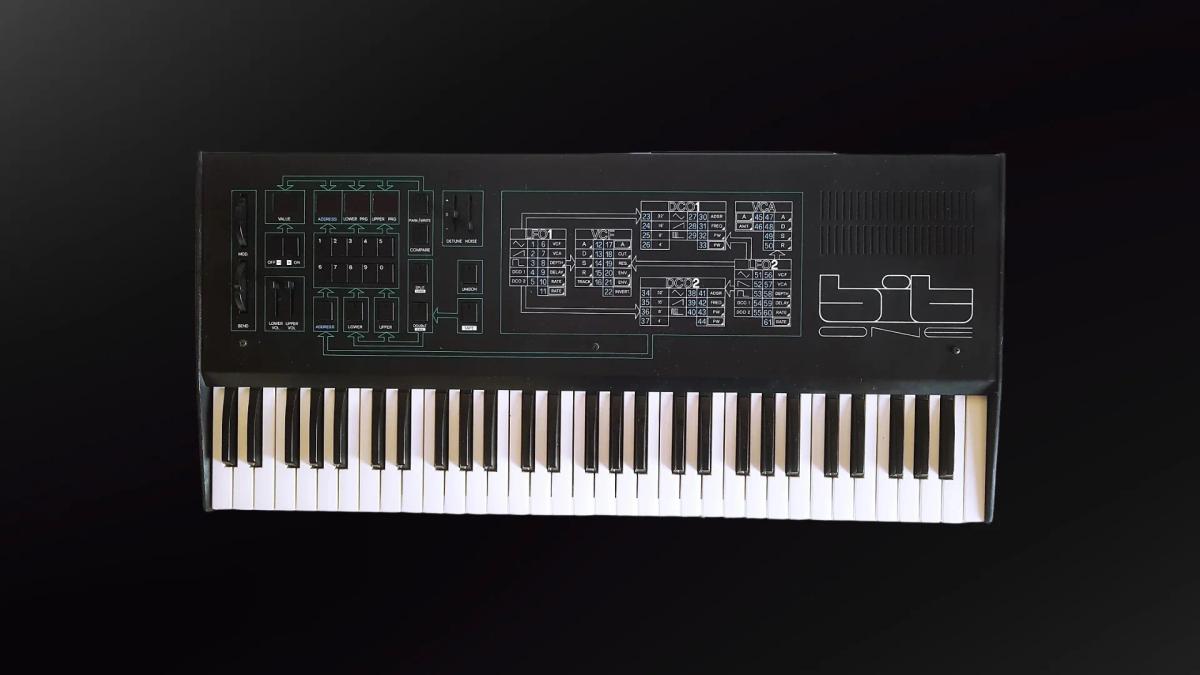
The Crumar Bit One is a six-voice analog polyphonic synthesizer that the Italian company Crumar launched in late 1984. Each voice has two digitally controlled oscillators, a Curtis or SSM low-pass filter depending on the revision, and two ADSR envelopes, played from a 61-note velocity-sensitive keyboard. It added bi-timbral splits, layers, unison, 63 memories and MIDI at a price well under the established American and Japanese polysynths, and Sound On Sound’s Gordon Reid later judged that its sound could match Prophets and Oberheims. It also arrived as FM synthesis took over, carried a weak first MIDI implementation, and lasted about a year before the improved Bit 99 replaced it.
Table of Contents
Crumar Bit One sound and character
The Crumar Bit One sounds warmer and broader than its digital control system suggests. The DCOs give stable tuning and a punchy attack, and the filters add the round, slightly vocal quality of early-1980s Curtis and SSM designs. Reid described the family as warm and versatile, capable of strong leads, pads, punchy brass and classic polysynth sounds, and GreatSynthesizers’ Theo Bloderer, who has owned a Crumar Bit One, six Bit 99s and two Bit 01s, calls the range “warm” and “broad” through to “strong” and “assertive”.
Velocity is central to its character. It can control pulse width, filter and amplifier envelope depth, attack times and LFO depth, so a single patch responds with real dynamic range under the fingers. Bloderer considers the leads the most convincing sounds and praises the nuanced velocity response; Reid notes that the Bit could also produce surprisingly good FM-like tones, DX-style electric pianos and harps, unusual for an analog synth of its period.
The oscillators have a quirk that cuts both ways. Because the two DCOs are locked so tightly, there is no natural beating between them, and players have to add movement with the detune slider or modulation. At the same time, Reid heard summing differences between DCO1 and DCO2 that give an organic, CS-80-like quality, if an unpredictable one. Bloderer finds that high resonance can make the filter sound somewhat tinny in the mid and upper range, and that its sweeps lack the elegance of a Jupiter-8 or Prophet-5.
Two filter generations exist. Early Bit Ones used the SSM2044, and later ones the CEM3328; Bloderer estimates that only about 250 SSM units were made. Reid suggested the CEM change made later units less desirable, though sources do not agree on how audible the difference is.
Features and architecture
- Manufacturer: Crumar, Italy
- Year introduced: late 1984 (Sound On Sound, GreatSynthesizers); some listings give 1985
- Production years: about one year, 1984 to 1985, before the Bit 99 replaced it
- Synthesis type: analog subtractive with digitally controlled oscillators
- Category: six-voice analog polysynth
- Polyphony: 6 voices; 3 voices in Double (layer) mode
- Multitimbrality: bi-timbral, with Upper and Lower zones around a user-set split point
- Voice modes: poly, split, double (layer), and unison, including a duophonic unison that assigns voices 1 to 3 to one key and 4 to 6 to another
- Original price: £799 in the United Kingdom, according to Sound On Sound
- Current market price: Equipboard recorded Reverb listings around $1,750 in October 2026; GreatSynthesizers gives roughly 600 to 1,500 dollars or euros for the related Bit 99 and Bit 01
- Oscillators: 2 DCOs per voice (12 in total) with triangle, sawtooth and pulse waves that can be combined; each DCO is switched on or off rather than mixed; detune and noise set by panel sliders rather than stored in patches
- Filter: one low-pass filter per voice, SSM2044 in early units and CEM3328 in later units
- LFOs: 2 global LFOs with triangle, sawtooth and square waves; no LFO-to-pulse-width routing
- Envelopes: 2 ADSRs per voice (filter and amplifier); the amplifier envelope can also sweep oscillator pitch
- Modulation system: velocity to pulse width, envelope depths, attack times and LFO depth; envelope to pulse width; modulation and pitch wheels
- Sequencer / arpeggiator: none on the original; a 2023 aftermarket upgrade from HKA Design adds an arpeggiator
- Effects: none
- Memory: 63 programs; split and layer combinations cannot be stored; cassette interface for backup
- Keyboard: 61 keys (five octaves), velocity sensitive
- Inputs / outputs: separate Upper and Lower audio outputs, cassette interface, MIDI In, Out and Thru
- MIDI / USB: early MIDI; transmits note and velocity on channel 1 only and receives program changes in Omni mode; no patch dumps; connecting MIDI In disconnects the local keyboard
- Display: small numeric readout for the parameter access system (the Bit 99 uses an LED display); parameters are selected by number and stepped with buttons rather than given dedicated knobs
- Dimensions / weight: black finish only; published dimensions and weight are not consistently documented
- Power: internal supply for European mains; owners report that US use requires a step-up transformer or an internal transformer change
Strengths
- The sound outclasses its reputation. Reid found its leads, pads and brass able to stand next to Prophets and Oberheims, and Bloderer calls the Bit family excellent analog synthesizers.
- Velocity response is unusually deep for a mid-1980s analog poly. Keyboard dynamics can shape pulse width, envelope depth, attack time and LFO depth, which makes it expressive in a way the Juno-106 and Six-Trak were not.
- It offers two envelopes per voice and two LFOs. Reid noted that competitors at the price usually provided one of each.
- Splits, layers and unison expand six voices into a performance instrument. The separate Upper and Lower outputs let the two parts be mixed and processed independently.
- DCO tuning is stable once the Crumar Bit One has warmed up, which made it practical on stage at a time when many VCO polysynths needed regular retuning.
- Aftermarket support is active. The HKA Design MIDI upgrade and Tauntek firmware address the original’s MIDI weaknesses, and a hardware controller from Stereoping offers knob-based editing.
Limitations
- The original MIDI implementation is poor. It transmits only notes and velocity on channel 1, receives in Omni mode, cannot dump patches, and disconnects its own keyboard when a MIDI In cable is plugged in.
- Programming is slow. Parameters are reached by number and stepped with buttons, and Bloderer calls the access system uninspiring for live tweaking.
- Some essential settings are not stored with patches. Detune and noise sit on panel sliders, oscillator levels cannot be balanced, and split or layer setups cannot be saved.
- Modulation is limited. There is no LFO-to-pulse-width routing, no oscillator sync, no ring modulation and no sample and hold, and Reid noted audible stepping in the LFOs.
- The build is fragile in places. Owners report cracked faders, imprecise large switches, broken rear jacks and keys that suffer in transport.
- European power supplies need conversion for US use, and aging supply components can cause crackle or tuning faults that require service.
- It was quickly overshadowed. The Bit 99 fixed many of its shortcomings within a year, which leaves the Crumar Bit One as the less refined first version.
Historical context
By the early 1980s Crumar, founded in Castelfidardo by Mario Crucianelli, had a long run of organs, string machines and electric pianos behind it, an expensive digital partnership with Music Technology of New York (the GDS and Synergy), and the Spirit monosynth designed with Bob Moog’s team. A polysynth was the obvious next step. Sound On Sound credits the Crumar Bit One design to Mario Maggi, the engineer behind the Elka Synthex, but some readers dispute that; GreatSynthesizers names Crumar’s Luciano Jura as chief designer, with Maggi having a hand in it.
The Crumar Bit One launched in late 1984 at £799 in the UK, competing with the Roland JX-3P and Juno-106, the Korg Poly-800 and the Sequential Six-Trak. On paper it was better specified than several of them: two DCOs, two envelopes and two LFOs per patch, velocity sensitivity, splits and layers. A version badged M.T.I. Crumar Bit One also existed, and Wikipedia reports the Bit line was sold there as Unique, a name GreatSynthesizers attaches mainly to the later Bit 99 and Bit 01. Reid argues that distribution undermined it in Britain, where it was sold exclusively through a single London shop, and that Crumar’s reputation for cheap electric pianos kept serious players away.