Elektron Digitone II as a compact synth
A desktop synth and sequencer with 16 tracks and four engines (FM Tone, FM Drum, Wavetone and Swarmer), multimode, lowpass and comb filters, and Elektron’s 128-step sequencer. It measures about 8.5 by 6.9 inches, weighs 3.3 pounds, and sends audio and MIDI over USB. Sound On Sound reviewed it at $999; US retailers now list it at $1,099.
Strengths: complete tracks without a computer, audio and MIDI over USB, powerful sequencing. Limitations: the Elektron workflow has a learning curve, and there is no keyboard or poly aftertouch. Who it suits: producers who want a groovebox built around synthesis rather than sampling.
Portable and pocket synths
Teenage Engineering OP-1 field as a compact synth
A synth, sampler, effects unit and four-track-style tape recorder in a 1.2-pound aluminum body with 24 keys, a built-in speaker, Bluetooth MIDI and a long-life battery (Teenage Engineering claims up to 24 hours). US retailers list it at $1,999. The OP-XY, a sequencer-focused sibling, sells for $2,299.
Strengths: a whole studio that fits in a bag. Limitations: high price, non-velocity keys, and a workflow you have to commit to. Who it suits: people who sketch on the couch or on the road. See our OP-1 field article.
Behringer Pro VS Mini as a compact synth
A four-voice hybrid vector synth inspired by the Sequential Prophet VS, with 128 waveforms, four oscillators per voice mixed by joystick, an analog low-pass filter, chorus, a 16-step sequencer and 27 touch-sensitive keys. It runs from USB-C, including a power bank, and costs about $119.
Strengths: real polyphony and vector synthesis at a very low price. Limitations: tiny keys and controls, headphone-level output, and a basic display. Who it suits: curious players on a budget.
M-VAVE FM-1 as a compact synth
A pocket six-operator FM synth with 32 algorithms, 12-voice polyphony (20 voices across eight parts since firmware v16), 27 silicone keys, a color screen, effects, an arpeggiator and a step sequencer that grew from 16 to 64 steps with firmware v16. It has a 2000 mAh battery rated for up to 12 hours, a built-in speaker, USB-C audio, Bluetooth MIDI and DX7 SysEx import. Street prices ran from about $70 to $100 depending on the store at the time of reviews.
Strengths: DX7-style sounds, battery, speaker and USB audio for the price of a pedal. Limitations: basic-sounding effects, a mono output at launch, and knobs that feel cheap. Who it suits: anyone curious about FM, or tinkerers who want to try alternative firmware. Start with our M-VAVE FM-1 profile.
How to choose a compact synth for a small room
Measure your desk first
Width is usually the problem, not depth. Most 37-key instruments here are around 54 to 55 cm wide, the Moog Messenger is close to 59 cm, and the minilogue xd module is almost 50 cm despite having no keys. If your desk already holds a controller keyboard, a module like the JU-06A or Digitone II adds sound without adding width. A small stand or shelf for desktop units also frees up space.
Power and USB
Every wall adapter takes a socket and often blocks the one next to it. USB bus power (Bass Station II, JU-06A, Pro VS Mini, FM-1) can run from a powered hub or your computer, which keeps the floor clear. Battery options (microKORG 2, Hydrasynth Explorer, JU-06A) are handy if you play away from the desk. If you plug several USB-powered synths into one computer, a powered hub avoids dropouts.
Built-in speakers
Speakers help for practice and couch sessions, not for mixing. The JU-06A, OP-1 field and FM-1 have them; most larger synths here do not, so plan on headphones or monitors.
USB audio
Synths that send audio over USB, such as the Digitone II and FM-1, can record straight into your DAW without extra cables or audio interface inputs. That matters in a small room where every cable and interface channel counts. For others, budget for interface inputs: stereo synths need two.
Mini keys versus a controller
Mini keys save space but limit two-handed playing. If you play piano-style, consider a module plus a full-size controller you already own, or a synth with full-size keys like the Bass Station II or Messenger. If you mostly program sequences, mini keys are fine.
Noise and neighbors
Analog synths can have a small noise floor (Sound On Sound noted a faint one on the Messenger), so check gain staging if you record quiet passages. For neighbors, headphone outputs and built-in speakers let you work late without waking anyone. Mechanical noise matters too: semi-weighted keys are louder to play at night than touch plates or silicone pads.
FAQ
What is the best compact synth for a beginner?
The Arturia MicroFreak is the most common recommendation at about $349, because it covers many synthesis styles and has a sequencer. If you mainly want bass, the Bass Station II is easier to understand with its one-function-per-knob panel.
Are mini keys a problem for recording?
For sequenced parts and simple lines, no. For chords and expressive playing, full-size keys are easier, so many people pair a desktop module with a controller.
Which compact synths run without a wall adapter?
Among those reviewed here, the Bass Station II, JU-06A, Pro VS Mini and FM-1 run over USB, and the microKORG 2, Hydrasynth Explorer, JU-06A, OP-1 field and FM-1 can run on batteries.
Is a desktop module better than a keyboard synth in a small studio?
If you already have a controller, yes, because modules add sounds without taking more desk width. If you don’t, a 37-key synth is one box instead of two.
Related articles
Sources
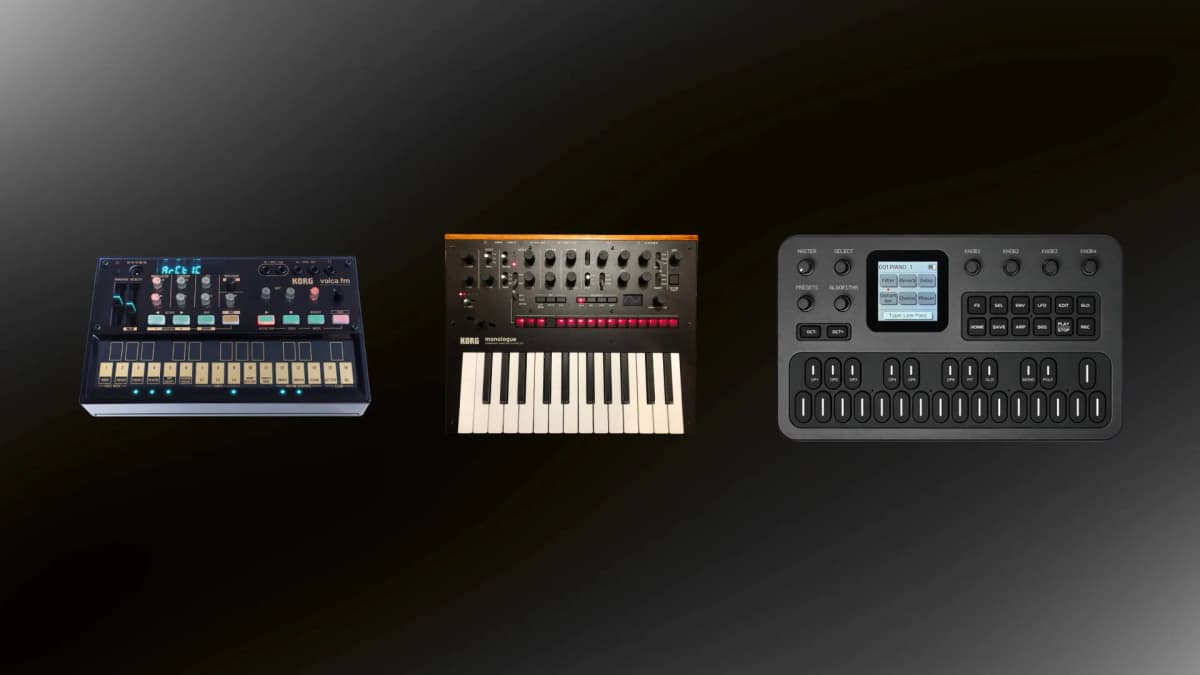
Image credits: Korg Volca FM2 photo by Multicherry, Wikimedia Commons, CC BY-SA 4.0; Korg monologue photo by medicalfools / David Chancey, Wikimedia Commons, CC BY-SA 4.0. Photos were cropped, cut out and placed on a gradient background for the featured image.