

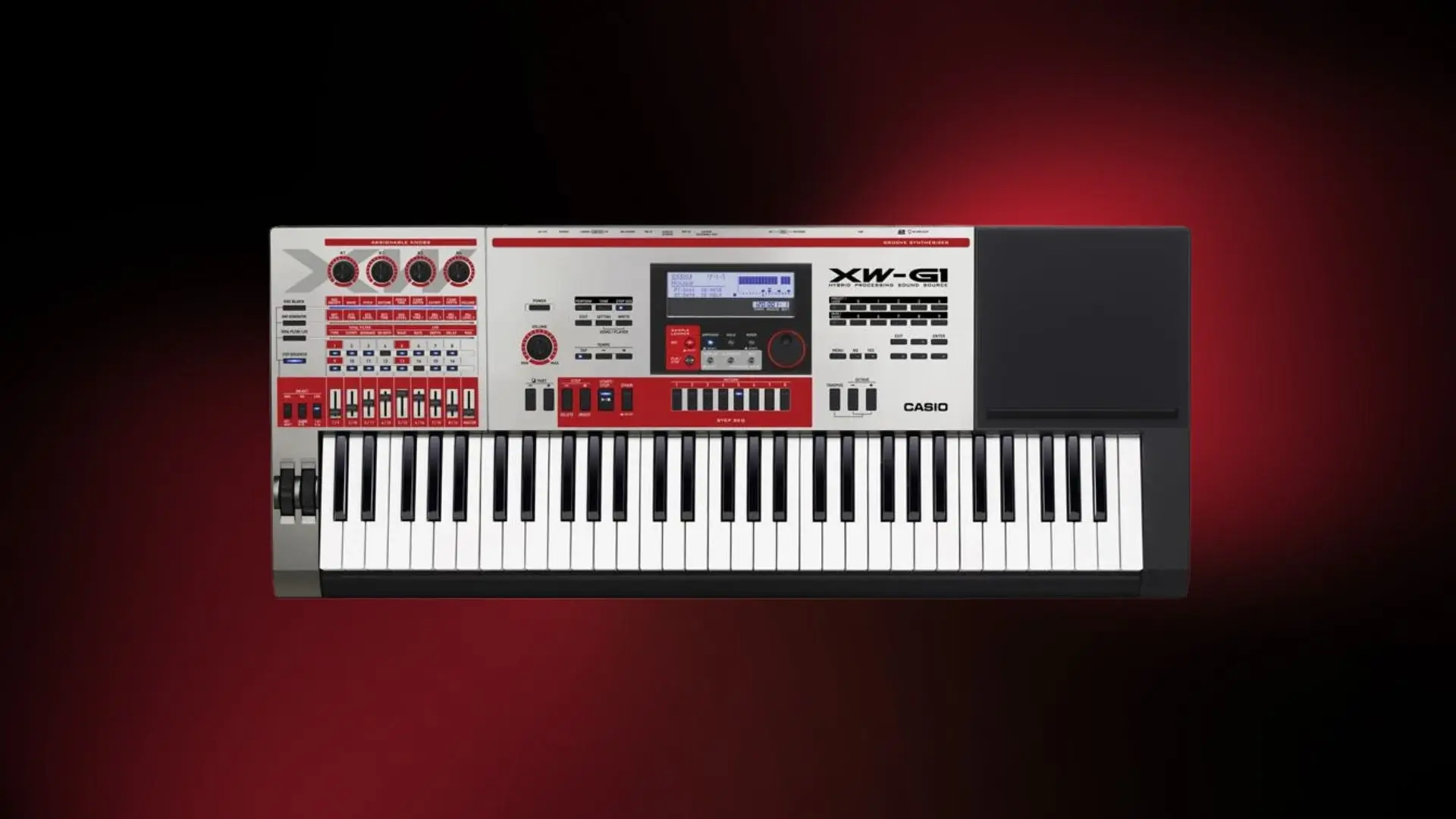
The Casio XW-G1 is a 61-key digital groove synthesizer introduced in 2012 as part of Casio’s XW series, alongside the XW-P1. Built around Casio’s Hybrid Processing Sound Source, it combined a monophonic solo synth engine, PCM tones, sampling, phrase sequencing, arpeggiation, and a 13-track step sequencer in a lightweight keyboard designed for live electronic performance. Its importance lies less in any single specification than in what it represented: Casio briefly re-entering the professional synth conversation with a machine aimed not at traditional stage keyboardists, but at DJs, beatmakers, and hands-on electronic performers.
Table of Contents
Casio XW-G1 sound and character
The Casio XW-G1 sounds unmistakably digital, but not in the sterile sense often attached to that word. Its character comes from the collision between Casio’s PCM vocabulary, virtual-analog-style oscillator structures, sample playback, drum-oriented sequencing, and an interface that encourages movement rather than static patch selection. It is not a lush analog polysynth, nor is it a vintage Casio phase-distortion instrument in the CZ sense. It is closer to a compact performance workstation built around loops, grooves, triggers, and monophonic synth gestures.
The solo synth engine is the most immediately “synthesizer-like” part of the instrument. It allows a single monophonic tone to be built from virtual analog oscillators, PCM oscillators, noise, and an external input source. That architecture gives the Casio XW-G1 a slightly hybrid personality: leads and basses can feel sharper, brighter, and more engineered than those of an analog synth, while the PCM material and samples pull the instrument toward groovebox territory. It can produce aggressive basses, synthetic hooks, rhythmic stabs, and processed textures more naturally than it produces warm, slowly blooming polyphonic pads.
Its deeper identity, however, is rhythmic. The 16-step sequencer, phrase sequencer, arpeggiator, sample looper, and user-wave functions turn the instrument into a performance environment. The sound is less about one perfect patch and more about what happens when short phrases, sampled fragments, drum parts, filter movement, and live transposition are combined in real time. That makes the Casio XW-G1 culturally interesting: it reflects a moment when keyboard manufacturers were trying to absorb the language of grooveboxes, DJ tools, samplers, and live electronic performance into a traditional 61-key format.
Features and architecture
- Manufacturer: Casio.
- Year: 2012.
- Production years: Casio’s current archival page identifies the Casio XW-G1 as a past model; a precise end-of-production year is not reliably published by Casio.
- Synthesis type: Digital synthesis using Casio’s Hybrid Processing Sound Source, with monophonic solo synth, PCM tones, user waves, sample looping, and sample playback.
- Category: Groove synthesizer, digital synthesizer, performance keyboard, and sample-oriented sequencing instrument.
- Polyphony: 64 notes maximum, with some tones using between 1 and 32 notes.
- Original price and current market price: The reported launch MSRP was $799. Current used-market signals are inconsistent because availability is thin; recent public listings and marketplace aggregators show examples roughly from the low-$300 range to above $500 depending on condition and seller.
- Oscillators: Solo Synth tones use Synth OSC1 and OSC2 blocks, PCM OSC1 and OSC2 blocks, an external input sound block, and a noise block.
- Filter: Filters are present inside the synth oscillator, PCM oscillator, external input, noise, and total blocks; the instrument does not use an analog filter path.
- LFOs: The official specification lists an LFO block and eight virtual controllers; retailer documentation also describes dual LFO functionality in the Solo Synth architecture.
- Envelopes: The solo synth architecture includes filter and amp shaping at oscillator-block level, with additional pitch-envelope and master-shaping functions described in retailer documentation.
- Modulation system: Real-time control is centered on four assignable knobs, nine sliders, pitch bend, modulation wheel, multi-function keys, oscillator-level editing, and assignable performance parameters.
- Sequencer / arpeggiator: 13-track step sequencer with eight monophonic tracks, one polyphonic track, and four control tracks; 16 maximum steps; eight patterns per sequence; 100 preset and 100 user sequences; chain function; 100 preset and 100 user phrases; 100 preset and 100 user arpeggios.
- Effects: System reverb, system chorus, 100 preset DSP effects, 100 user DSP effects, 53 DSP types, and a 4-band master EQ.
- Memory: 420 preset tones and 220 user tones; 100 preset and 100 user performance memories; 100 preset and 100 user sequences; 100 preset and 100 user phrases; 10 user samples plus one temporary sample.
- Keyboard: 61 standard-size keys with two touch-response settings and off.
- Inputs / outputs: MIDI In, MIDI Out/Thru, USB Type B, sustain/assignable jack, stereo headphone output, left/mono and right line outputs, mono instrument input, mono microphone input, stereo mini audio input, SD/SDHC card slot, and DC input.
- MIDI / USB: Standard MIDI ports and USB Type B for computer connection; 16-part multitimbral MIDI reception and GM Level 1 compatibility.
- Display: Backlit LCD.
- Dimensions / weight: 948 x 384 x 124 mm; 5.4 kg without batteries.
- Power: AD-E95100L AC adapter or six D-size alkaline or zinc-carbon batteries; Casio specified approximately 35 hours of battery life with alkaline batteries and headphones.
Strengths
- The Casio XW-G1’s strongest asset is its integration of synthesis, sampling, sequencing, and phrase triggering in a single 61-key instrument. It is not merely a preset keyboard with a few electronic sounds; it is designed around performance construction.
- The 13-track step sequencer gives the instrument a groovebox-like center. The combination of note tracks, control tracks, multiple patterns, and chain functionality makes it more rhythmically serious than many affordable keyboards of its period.
- The sample looper gives the Casio XW-G1 a practical identity distinct from the XW-P1. Being able to capture external sounds and use them in loops or as user-wave material makes the instrument feel more open-ended than a closed ROMpler.
- The Solo Synth engine is unusually ambitious for the price class. Its mixture of virtual analog oscillators, PCM oscillators, noise, and external input creates a broader palette than a simple single-oscillator lead synth.
- The interface offers more physical control than many budget digital keyboards. Four assignable knobs, nine sliders, 16 step buttons, wheels, and multi-function keys allow the player to shape grooves and performances without relying entirely on menus.
- Battery operation and low weight make the instrument genuinely portable. That detail matters because the Casio XW-G1 was explicitly oriented toward clubs, mobile performance, and nontraditional keyboard use.
- It occupies a rare category: a full-size keyboard that thinks partly like a groovebox. For users who want keys, sequencing, sampling, and hands-on control in one affordable machine, the concept remains distinctive.
Limitations
- The main synth engine is monophonic when used as the Solo Synth. This makes it effective for leads, basses, and hooks, but it prevents the Casio XW-G1 from behaving like a polyphonic virtual-analog synthesizer.
- The Casio XW-G1 does not include the XW-P1’s Hex Layer and drawbar-organ features. That makes it less attractive as a general stage-performance keyboard and more specialized as a groove and sampling instrument.
- The sample memory is useful but limited. Ten user samples plus one temporary sample are enough for performance experimentation, but not enough to treat the instrument as a deep modern sampler.
- The sequencer is powerful for its class, but its structure is still pattern-based and constrained. It is not a modern linear DAW-style sequencer, and some parts are assigned to specific musical roles.
- The interface is partly hands-on and partly menu-driven. Reviews from the period noted that its deeper functions reward study but can feel less immediate than the front panel initially suggests.
- The PCM sounds are functional rather than luxurious. The Casio XW-G1 can cover pianos, electric pianos, guitars, strings, basses, drums, and other material, but its lasting appeal does not rest on premium acoustic realism.
- Its current market position is awkward. It is not common enough to be easily replaceable, but it is not yet a universally recognized collectible. Buyers must judge condition carefully, especially sliders, buttons, outputs, card functionality, and sampling features.
Historical context
The Casio XW-G1 appeared at a significant moment for Casio. The company had been historically important in affordable electronic instruments, from early Casiotone keyboards to the CZ phase-distortion synthesizers and the SK sampling keyboards. Yet by the 1990s and 2000s, Casio’s public identity in many music circles had shifted toward home keyboards, digital pianos, and educational instruments rather than professional synthesizers.
The XW series interrupted that perception. At NAMM 2012, Casio presented the XW-P1 and XW-G1 as new professional-oriented synthesizers, and Casio’s own event material framed the launch as the company’s first unveiling of new synthesizers in 24 years. That historical claim is central to understanding the Casio XW-G1. It was not simply a quirky keyboard; it was part of a deliberate attempt to reintroduce Casio as a synth manufacturer.
The XW-P1 was more conventionally aimed at live keyboardists, with Hex Layer and drawbar organ features. The Casio XW-G1 took the more unusual route. It focused on DJs, electronic performers, sequencing, sampling, and groove creation. That choice placed it in dialogue not only with workstation keyboards, but also with grooveboxes, loopers, samplers, and DJ-adjacent performance tools. In 2012, that hybrid territory mattered: laptop performance, controllerism, EDM, and hardware sequencing were all shaping how manufacturers imagined live electronic music.