

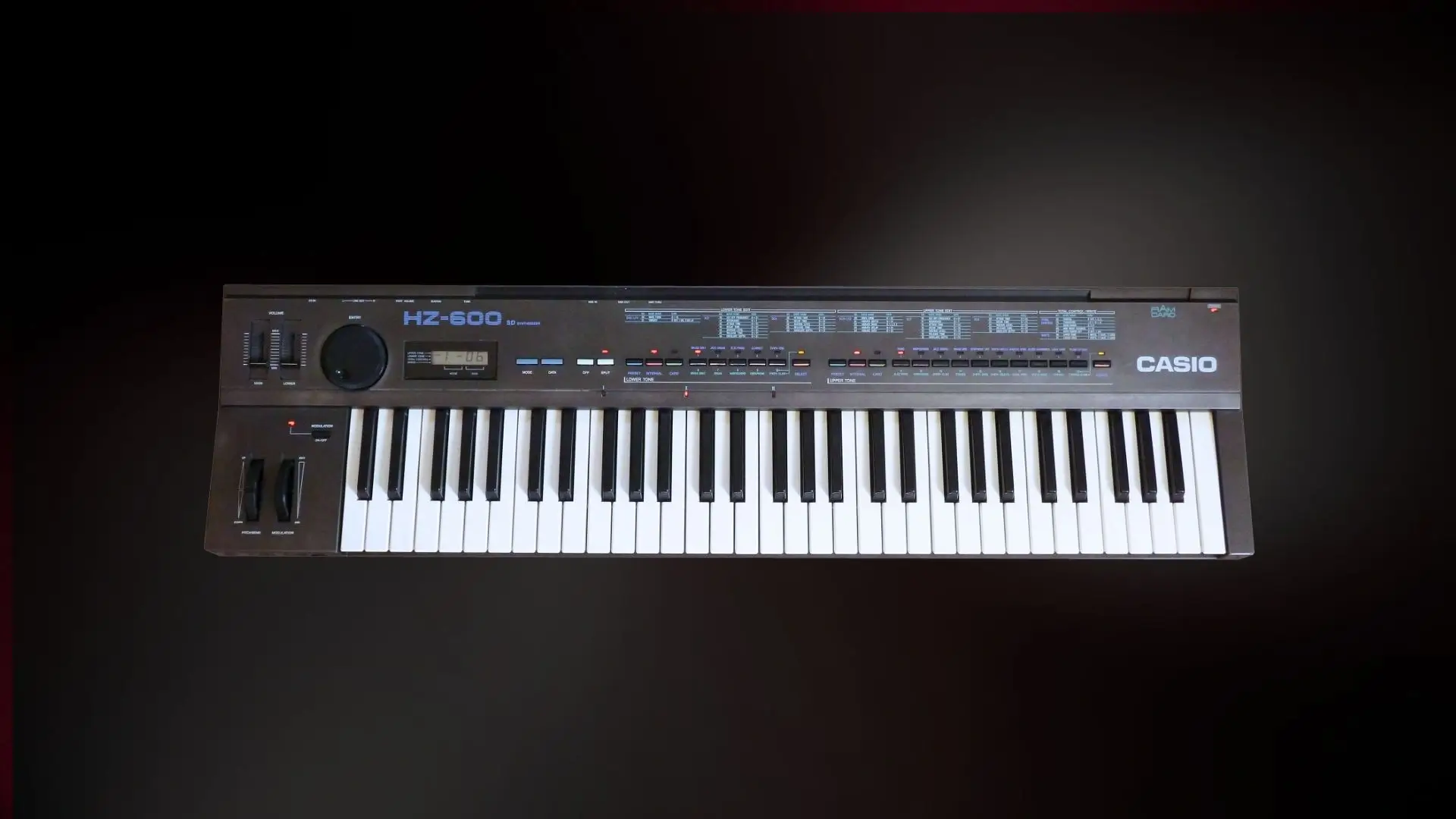
The Casio HZ-600 is an eight-note polyphonic, 61-key hybrid synthesizer introduced in 1987 as the more professional-looking member of Casio’s short-lived SD / HT-HZ family. It used Casio’s Spectrum Dynamic approach: digitally generated source waveforms shaped through filter, amplifier, envelopes, modulation, and stereo chorus. It was not a flagship in the sense of a CZ-1 or FZ-1, and it was not as technically ambitious as the later HT-6000, but it occupies a strange and revealing place in Casio history: a low-cost, full-size, programmable synth that tried to translate home-keyboard accessibility into a more serious-looking instrument.
Table of Contents
Casio HZ-600 sound and character
The Casio HZ-600 does not sound like a lush analog polysynth, even though its filter and chorus give it a more tactile edge than many purely preset-oriented home keyboards of the period. Its identity sits between brittle digital source material and rounded subtractive shaping. The result is a tone that can be thin, glassy, artificial, and occasionally surprisingly animated.
Its strongest sounds are not realistic imitations. The factory names suggest pianos, organs, brass ensembles, strings, bells, harmonicas, and other familiar categories, but the Casio HZ-600 becomes more interesting when those names are ignored. Bells, metallic tones, synthetic organs, brassy leads, simple pads, odd plucked textures, and spectral effects suit it better than naturalistic acoustic emulation.
The Casio HZ-600’s character comes from the tension between fixed digital waveforms, a constrained editing system, a low-pass VCF, and stereo chorus. It can sound narrow and lightweight without external processing, but it can also sit in a mix with a distinctive midrange brightness that does not resemble the more famous Yamaha FM or Roland analog-polysynth languages.
The sound is historically interesting because it reflects Casio’s transitional mindset. The company had already established the CZ series as a serious budget alternative through phase distortion synthesis, but the Casio HZ-600 took a different route: simpler waveform selection, subtractive-style filtering, and an interface intended to be approachable rather than deep. That makes it less powerful than some contemporaries, but also more peculiar. It is a synth of constraints, not abundance.
Features and architecture
- Manufacturer: Casio.
- Year: 1987.
- Production years: A precise production-year range is not confidently documented in the reliable public sources checked; 1987 is the verified introduction and review year.
- Synthesis type: Casio SD / Spectrum Dynamic hybrid synthesis, using digitally generated source waveforms shaped by VCF, DCA, envelopes, LFO, and chorus.
- Category: 61-key programmable hybrid polysynth / budget digital-analog-style keyboard synthesizer.
- Polyphony: 8-note polyphony in normal mode; in split mode, the upper and lower sections operate as two 4-note parts.
- Original price: £349 including VAT in the United Kingdom, as reported in contemporary 1987 reviews.
- Current market price: No reliable single price-guide average is available. Recent and ended examples show a broad, condition-dependent range, from low-price non-functioning units to working examples in the low-to-mid hundreds of dollars.
- Oscillators: One digitally generated sound source per tone. Upper tones provide 32 source waveform choices; lower tones provide 16 source waveform choices.
- Filter: Low-pass VCF with cutoff frequency, resonance, ADSR-style envelope controls, and envelope depth. The architecture is limited compared with true per-voice analog polysynths.
- LFOs: Upper tone editing includes LFO depth, waveform, delay, and speed. Lower tone editing has a simpler LFO setting with off, on, and delay options.
- Envelopes: VCF envelope and DCA envelope, each with attack, decay, sustain, release, and envelope depth parameters.
- Modulation system: Limited parameter editing through mode/data buttons and an entry dial; performance controls include modulation wheel, pitch bend wheel, transpose, tuning, and chorus control. There is no modern modulation matrix.
- Sequencer / arpeggiator: No onboard sequencer or arpeggiator is documented.
- Effects: Stereo chorus with off and three active character settings.
- Memory: Upper tones include 20 presets, 20 internal user tones, and up to 120 additional upper tones via optional RA-100 RAM card. Lower tones include 10 presets, 10 internal tones, and up to 60 additional lower tones via optional RA-100 RAM card.
- Keyboard: 61 full-size keys with three selectable split points. Velocity and aftertouch are not part of the Casio HZ-600’s expressive design.
- Inputs / outputs: Stereo line outputs, headphone output, sustain pedal jack, foot volume jack, AC adaptor input, and rear-panel tuning control.
- MIDI / USB: MIDI In, Out, and Thru. No USB.
- Display: Small tone/entry display used with the mode/data controls and entry dial.
- Dimensions / weight: 1000 mm wide, 274 mm deep, 93 mm high; 5.9 kg including batteries.
- Power: Optional Casio AD-5 AC adaptor, six D-size batteries, or optional CA-5 car adaptor. Power consumption is 3 W, with approximately 15 hours of battery life listed for SUM-1 batteries and an auto power-off function after about six minutes of inactivity.
Strengths
- The Casio HZ-600 has a recognizable sonic personality: bright, synthetic, slightly fragile, and more interesting for non-realistic textures than for faithful emulation.
- The combination of digital source waveforms, low-pass filtering, and stereo chorus gives it more tonal movement than a purely preset home keyboard, while keeping the workflow simple enough for quick editing.
- The full-size 61-key format makes it more playable than Casio’s mini-key instruments and more credible as a first real synthesizer.
- The split function is musically useful, letting the Casio HZ-600 behave as two independent four-note sections for simple layered or divided performances.
- The entry-dial programming system is limited but approachable. It lowers the intimidation factor compared with deeper menu-driven synths of the period.
- The RA-100 card system, when available, expands the memory substantially and shows that Casio was thinking beyond disposable preset-keyboard design.
- Its tone can be useful precisely because it is not fashionable in the same way as a Juno, DX7, D-50, or CZ. It brings a different shade of 1980s digital-hybrid color.
Limitations
- The Casio HZ-600 is not velocity-sensitive and does not offer aftertouch, which limits expressive playing and MIDI performance control.
- Eight-note polyphony is modest, and split mode reduces each side to four notes.
- The architecture is constrained: one main digital source per tone, limited waveform control, no sub-oscillator, no meaningful oscillator detune system, and no modern modulation routing.
- The filter behavior is not equivalent to a fully independent per-voice analog polysynth, so sustained chords and filter articulation can feel less organic than on more expensive instruments.
- The factory presets are historically useful but not always musically flattering. The Casio HZ-600 is better judged by editing and external processing than by preset realism.
- The display and parameter system are simple but coarse. It is easy to move quickly, but not always easy to make subtle adjustments.
- There is no onboard sequencer, arpeggiator, multi-effects section, reverb, delay, or performance automation.
- The optional RA-100 RAM card is now a practical ownership issue: useful if present, frustrating if missing.
- The low end is not its strongest area. It is more convincing for bright, synthetic, metallic, organ-like, and strange midrange textures than for deep bass authority.
Historical context
The Casio HZ-600 appeared in 1987, after Casio had gained credibility in the serious music market with the CZ series. The CZ instruments mattered because they offered programmable digital synthesis at prices that brought many musicians into the world of sound design. The HZ-600 followed that affordability logic, but it did not simply continue the CZ formula. Instead, it belonged to Casio’s SD family, which also included the HT-3000, HT-700, MT-600, and later the more powerful HT-6000.
That timing mattered. By 1987, the Casio HZ-600 market was no longer waiting for another basic analog-style polysynth. Yamaha FM had already reshaped expectations, sampling was becoming more visible, Roland’s D-50 was redefining polished digital synthesis, and Casio itself had the FZ sampler line emerging. Against that backdrop, the Casio HZ-600 felt both accessible and slightly out of step. It used digital waveforms and MIDI, but its musical logic remained close to subtractive synthesis and split-keyboard performance.
Its most peculiar historical role is that it was the professional-looking model of the HZ / HT line, yet not the most powerful engine in that family. The HT-6000, despite its more consumer-oriented identity, offered a more ambitious architecture. That contradiction says a lot about Casio in the late 1980s: the company was still trying to reconcile mass-market keyboard design with genuine synthesizer invention.